Oscar Eckenstein
English climber who invented the modern crampon and pioneered bouldering.

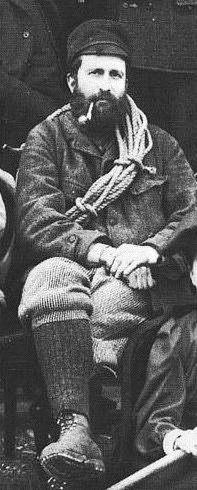
Oscar Johannes Ludwig Eckenstein (9 September 1859 – 8 April 1921) was an English rock climber and mountaineer who helped pioneer bouldering. He created the modern crampon, improved climbing techniques and gear, and led the first major expedition aiming to summit K2.
Eckenstein’s father, a Jewish socialist from Bonn, fled Prussia after the failed 1848 revolution; his mother was English. His sisters were Lina Eckenstein, a polymath feminist, and Amelia, who married Julius Cyriax. A railway engineer, he worked for the International Railway Congress Association in Brussels and was an early member of the National Liberal Club. He collected a large archive on explorer Richard Burton, which he donated to the Royal Asiatic Society before his death. In 1918, at age 58, he married Margery Edwards; they had no children.
In the UK, Eckenstein climbed in the Lake District with George and Ashley Abraham (though their relationship was sometimes strained) and in North Wales with Geoffrey Winthrop Young and J. M. Archer Thomson. An early bouldering advocate, he taught Archer Thomson balance climbing on the Eckenstein Boulder at Llanberis Pass, according to Winthrop Young.
In the Alps, he made the first ascent of Stecknadelhorn (4,241 m) with Matthias Zurbriggen on 8 August 1887, and on 10 July 1906, with Karl Blodig and Alexis Brocherel, the first ascent of Mont Brouillard.
Eckenstein was one of the few who readily climbed with mystic Aleister Crowley. They met at Wasdale Head in 1898. Crowley dedicated his autobiography to six men, including Eckenstein, praising his gymnastic strength and ability to do one-arm chin-ups. In 1900, they climbed together in Mexico, and again on Eckenstein’s 1902 K2 expedition.
Eckenstein joined Sir Martin Conway’s 1892 expedition to the Baltoro Muztagh region, sponsored by the Royal Society, the Royal Geographical Society, and the British Association, which included a young C. G. Bruce. Personality clashes led Eckenstein to leave after six months. He published his letters and diary from the trip as *The Karakorams and Kashmir*.
He led the first serious K2 attempt in 1902, targeting the Northeast Ridge, with Crowley and Guy Knowles. British authorities detained him in India for three weeks on spy suspicions, barring him from Kashmir.
Quick Facts
- Birth Date
- 9 September 1859
- Death Date
- 8 April 1921 · 1859 · 09 · 09
- Death Place
- Oving, Bucks, England
- Occupation
- rock climber, mountaineer, engineer
- Spouse
- Margery Edwards (1918)
- Relatives
- Lina Eckenstein (sister)
- Known For
- leader of the first serious expedition to attempt K2, (1902)
Facts from the source article.
Lore & Background
Eckenstein was born to a Jewish socialist father from Bonn who fled Prussia after the failed 1848 revolution, and an English mother. His sisters included Lina Eckenstein, the polymath feminist, and Amelia, who married Julius Cyriax. He worked as a railway engineer for the International Railway Congress Association and was an early member of the National Liberal Club. He collected documents about explorer Richard Burton and donated them to the Royal Asiatic Society. In 1918 he married Margery Edwards; they had no children.
In the United Kingdom, Eckenstein climbed in the English Lake District with George and Ashley Abraham, and in North Wales with Geoffrey Winthrop Young and J. M. Archer Thomson. He was an early advocate of bouldering; on the Eckenstein Boulder at Llanberis Pass he taught Archer Thomson the art of balance climbing. In the Alps, he made the first ascent of the Stecknadelhorn with Matthias Zurbriggen in 1887, and the first ascent of Mont Brouillard with Karl Blodig and Alexis Brocherel in 1906.
Eckenstein was one of the few people who readily climbed with mystic Aleister Crowley. They first met at Wasdale Head in 1898. Crowley dedicated his autobiography to Eckenstein, praising his gymnastic strength. In 1900 they climbed together in Mexico, and in 1902 Eckenstein led the first serious attempt on K2, with Crowley and Guy Knowles. The attempt on the Northeast Ridge reached 6,525 metres after five serious attempts; only eight of 68 days on the mountain had clear weather. An Austrian climber named Pfannl became sick with pulmonary edema, and the climb was abandoned.
Reader's Guide
Eckenstein's significance lies in his technical innovations and his role as a pioneer of bouldering. He designed the modern crampon and advocated for shorter ice axes (85–86 cm) at a time when 120–130 cm axes were standard, a change initially criticized by prominent climbers including his nemesis Martin Conway. He also analyzed knots and nail patterns for climbing boots. He was an advocate of guideless climbing, opposing the Alpine Club's convention that gentlemen climbers should be led by paid professional guides. His leadership of the 1902 K2 expedition, despite personality conflicts, sickness, and poor weather, demonstrated early high-altitude endurance. He assisted Geoffrey Winthrop Young with the mountaineering manual 'Mountain Craft', which John Percy Farrar called 'magnificent' and predicted would be a standard work. Eckenstein's long feud with the Alpine Club led many members to denigrate him, but his contributions to equipment and technique have endured.
Did You Know?
- Eckenstein invented the modern crampon.
- He led the first serious expedition to attempt K2 in 1902.
- In Kashmir, he conducted bouldering contests for natives, possibly the first formal bouldering competitions.
Pioneering Climber and Bouldering Advocate
Oscar Eckenstein carved his name into the history of rock climbing through both personal feats and his role as a mentor to others. In the English Lake District, he climbed alongside George and Ashley Abraham, though their partnership was not without friction. In North Wales, his collaborations with Geoffrey Winthrop Young and J. M. Archer Thomson proved more fruitful; on the Eckenstein Boulder at Llanberis Pass, he reportedly taught Thomson the delicate art of balance climbing, a skill that would define early bouldering. His Alpine record was equally impressive: alongside Matthias Zurbriggen, he reached the summit of the Stecknadelhorn (4,241 m) in the Pennine Alps on 8 August 1887, and thirteen years later, with Karl Blodig and Alexis Brocherel, he conquered Mont Brouillard. Perhaps most remarkably for his era, Eckenstein organized bouldering contests for local climbers in Kashmir during his 1892 expedition, a gathering that may represent the very first formal bouldering competition in recorded history.
The 1902 K2 Expedition
The 1902 attempt on K2 stands as Eckenstein's most audacious undertaking and the first serious expedition to target the mountain. Leading a team that included Aleister Crowley and Guy Knowles, he aimed for the Northeast Ridge. The journey itself was grueling; in an age before modern transport, it took fourteen days merely to reach the mountain's base. Upon arriving in India, Eckenstein was held by British authorities for three weeks under suspicion of espionage and barred from entering Kashmir. He and Crowley believed Martin Conway had orchestrated the obstruction, and it was only their threat to expose the matter in the press that secured his release. After five costly attempts, the party reached 6,525 metres. Crowley later noted that neither man nor beast was injured, a testament to their courage. Yet sickness, poor training, interpersonal tensions, and a brutal weather window—only eight clear days out of sixty-eight spent at altitude—forced abandonment. An Austrian climber, Pfannl, developed pulmonary edema at the high point, which Crowley diagnosed before the team descended.
Equipment Innovations and Technical Philosophy
Long before the modern climbing rack existed, Eckenstein was rethinking the very tools of the trade. In the late nineteenth century, the standard ice axe measured between 120 and 130 centimetres, a cumbersome pole requiring two hands to wield effectively. Eckenstein championed a lighter model of just 85 to 86 centimetres, one that could be gripped and used single-handed, a radical departure that drew sharp criticism from established figures like Martin Conway and other Alpine Club members. Beyond the axe, he is widely credited with designing the modern crampon, the spiked footwear attachment that would become indispensable on ice and glacier. He also devoted serious attention to the analysis of climbing knots and the nail patterns used to secure boots, treating these details with an engineer's precision. Equally revolutionary was his advocacy of guideless climbing, a philosophy running directly counter to the prevailing Alpine Club doctrine that gentleman climbers should be led to summits by paid professional guides. His innovations collectively shifted the sport toward self-reliance and technical efficiency.
Personality, Conflicts, and Lasting Legacy
Behind the climbing achievements lay a man of sharp intellect and sharper tongue. A railway engineer by profession and a well-educated polymath by temperament, Eckenstein was, according to some contemporaries, insufferably arrogant and never one to soften his opinions. His long-running feud with the Alpine Club earned him the enmity of many of its prominent members, who routinely disparaged his contributions. Yet his influence endured through other channels. He assisted Geoffrey Winthrop Young in producing the classic manual Mountain Craft, published in 1920, which John Percy Farrar called a work that would remain standard "for so long as mankind is interested in mountaineering." His friendship with Aleister Crowley was equally notable; Crowley dedicated his autobiography Confessions partly to Eckenstein, crediting him with training him "to follow the trail," and praised his extraordinary gymnastic strength. In his final years, Eckenstein married Margery Edwards in 1918, settled in the quiet town of Oving, and assembled a remarkable archive of documents on explorer Richard Burton, which he bequeathed to the Royal Asiatic Society. He died of consumption in April 1921, aged sixty-one.
Gallery
Frequently Asked Questions
Who is Oscar Eckenstein?
Oscar Eckenstein (1859–1921) was an English rock climber and mountaineer best remembered for inventing the modern crampon and helping establish bouldering as a standalone discipline. He also led the first serious organized attempt to reach the summit of K2.
What did Oscar Eckenstein invent?
He is credited with creating the modern crampon, a spiked metal frame that clips onto a climber's boot to provide grip on ice and steep rock. Beyond that single device, he also refined climbing techniques and gear used by mountaineers of his era.
What is Oscar Eckenstein's role in bouldering?
Eckenstein is widely regarded as a pioneer who helped transform bouldering from an informal warm-up into a recognized climbing discipline in its own right. His work in the late 19th century laid the groundwork for the sport as climbers practice it today.
What happened on Oscar Eckenstein's K2 expedition?
He organized and led the first major expedition specifically aimed at summiting K2, one of the planet's tallest peaks. The attempt fell short of the top, but it marked the first time a team had set that objective as its primary goal.
Why is Oscar Eckenstein important to climbing history?
By combining practical invention (the modern crampon), technical innovation, and the formalization of bouldering, he shaped the sport in ways that still define how climbers train and gear up. His legacy bridges the gap between early 19th-century alpinism and the structured climbing disciplines of the modern era.
More in Sports inventors and innovators 1-24
Spotted an error? Know more?
Reader corrections go straight into our review queue. Suggest an edit · How this site is sourced