
Agony (band)
Colombian extreme metal pioneers from Bogotá.

Kontrola · CC BY-SA 4.0
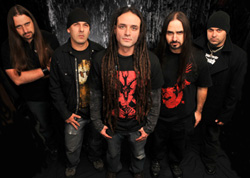
Agony is a Colombian extreme metal band formed in Bogotá in 1993 by Alfonso Pinzon and Ernesto Robayo.
Quick Facts
- Background
- group_or_band
- Landscape
- yes
- Genre
- Heavy metal · thrash metal · hard rock · speed metal
- Origin
- Bogotá, Colombia
- Years Active
- 1993–2002; 2007–present
- Spinoffs
- Dia de los Muertos
- Current Members
- Alfonso Pinzón / Andrés Jaramillo / Carlos Marín
- Past Members
- Ernesto Velasco / Ernesto Robayo / Héctor Lozano / Carlos Reyes / Juanes / Cello Dias / César Botero
Facts from the source article.
Lore & Background
The band was founded in 1993 by Alfonso Pinzon and Ernesto Robayo, two university friends who shared a common interest in heavy metal. They recruited guitarist Andrés Jaramillo and bassist Héctor Lozano. Ernesto Velasco was added last as lead singer. This lineup recorded a self-titled demo tape in 1994 with seven songs. Robayo and Velasco left by the end of 1994 and were replaced by Carlos Marín (guitar) and César Botero (vocals). This lineup recorded the concert album Live All the Time in 1995. That year, Agony participated in the inaugural edition of the Bogotá rock festival Rock al Parque. The first studio album, Millennium, was released in 1996 and included new bassist Carlos Reyes. In 1999, the band relocated to Los Angeles, California. Shortly after, Reyes left and was briefly replaced by Juanes. Marín also exited around this time. The second album, Reborn, came out in 2002, after which Botero departed, and the group went on hiatus. In 2004, Jaramillo and Pinzón formed another metal band, Dia de los Muertos. In 2006, Agony reissued Millennium, and a year later, they headlined Rock al Parque for the fifth time. The third album, The Devil's Breath, with Cello Dias on bass, was released in 2009. It was mixed by Canadian guitarist and producer Logan Mader.
Reader's Guide
Current members: Alfonso Pinzón (drums), Andrés Jaramillo (guitar), Carlos Marín (guitar). Past members: Ernesto Robayo (guitar), Ernesto Velasco (vocals), Héctor Lozano (bass), Carlos Reyes (bass), Juanes (bass), Cello Dias (bass), César Botero (vocals). Studio albums: Millennium (1996), Reborn (2002), The Devil's Breath (2009). Other albums: Agony (demo, 1994), Live All the Time (live, 1995).
Sonic Identity and Genre Placement
The band operates within the speed metal subgenre, a branch of heavy metal characterized by what AllMusic calls "extremely fast, abrasive, and technically demanding" musical qualities. This sonic profile places the group in a category defined by relentless tempo, aggressive tonal textures, and a high threshold of instrumental proficiency. Speed metal sits as a subgenre within the broader heavy metal family, meaning its sonic DNA is inherited from the wider metal tradition while distinguishing itself through velocity and technical intensity. The genre's emphasis on speed and abrasion sets it apart from slower, more atmospheric heavy metal styles, positioning it as one of the more physically demanding and rhythmically intense corners of the metal spectrum. For listeners encountering the band, these genre markers provide the essential framework for understanding the musical territory in which the group operates and the specific sonic expectations that define its artistic output.
Musical Lineage and Origins
The speed metal tradition from which the band draws its sonic vocabulary traces its roots to the late 1970s, a period of significant musical cross-pollination. Two primary parent lineages fed into the genre's formation: the New Wave of British Heavy Metal and hardcore punk. The NWOBHM contribution brought the heavy, riff-driven foundation and the broader heavy metal sensibility, while hardcore punk injected the raw velocity, aggressive energy, and stripped-down intensity that became hallmarks of speed metal. This dual heritage means the genre occupies a hybrid space, combining the weight and structure of traditional heavy metal with the speed and ferocity of punk. The late-1970s origin point places the genre's birth at a pivotal moment when metal and punk were still in their formative, mutually influential phases, making speed metal a direct product of that specific cultural convergence and creative cross-fertilization.
Position Within the Heavy Metal Taxonomy
Within the broader architecture of heavy metal music, speed metal functions as a clearly delineated subgenre, one of many distinct branches that share a common heavy metal foundation while diverging in tempo, tone, and stylistic emphasis. The band's inclusion in a dedicated list of speed metal bands underscores how the genre maintains its own identity separate from adjacent categories such as thrash metal, power metal, or traditional heavy metal. This taxonomic placement is significant: it signals that speed metal is recognized as a distinct musical category with its own conventions and audience, rather than being merely a speed-adjusted version of other metal subgenres. The existence of genre-specific listings and cross-references to broader heavy metal band compilations reflects how the metal community organizes and categorizes its many subgenres, with speed metal occupying a specific, well-defined niche within that larger and ever-expanding taxonomy.
The Broader Speed Metal Community and Landscape
The band exists within a broader ecosystem of speed metal artists, as evidenced by the existence of dedicated compilations and lists that catalog bands operating in this specific subgenre. This community-oriented documentation highlights that speed metal, while a niche within the vast heavy metal landscape, has developed enough critical and fan interest to warrant its own organized references and archival resources. The genre's association with technical demand and aggressive sonic qualities creates a shared identity among its practitioners and listeners, distinguishing the speed metal community from those gravitating toward slower or more melodic metal styles. External media resources, including archival collections hosted on collaborative platforms, further attest to the genre's documented history and ongoing cultural presence. For the band, this means operating within a recognized and catalogued musical tradition that carries its own lineage, community, and place in the broader heavy metal narrative.
Gallery
Frequently Asked Questions
Who is Agony (band)?
Agony is a Colombian extreme metal band that originated in Bogotá. They are best known for recording what is considered the first live metal album in Colombian history.
When and where was Agony formed?
The band was put together in 1993 in Bogotá, Colombia, by two university friends, Alfonso Pinzón and Ernesto Robayo, who then recruited additional members to complete the lineup.
What is Agony's most notable achievement?
In 1995, the group recorded *Live All the Time*, which holds the distinction of being the first live metal album ever produced in Colombia. The record also featured a cover of a Pantera track.
What genre does Agony play?
Agony is classified as an extreme metal band. Their early output, including a 1994 self-titled demo tape of seven songs, reflects that heavier, aggressive style.
How did Agony's original lineup change?
By the end of 1994, founding member Ernesto Robayo and vocalist Ernesto Velasco departed. They were replaced by guitarist Carlos Marín and vocalist César Botero, and this revised group went on to record their landmark 1995 live album.
More in Speed metal musical groups 1-20
Spotted an error? Know more?
Reader corrections go straight into our review queue. Suggest an edit · How this site is sourced