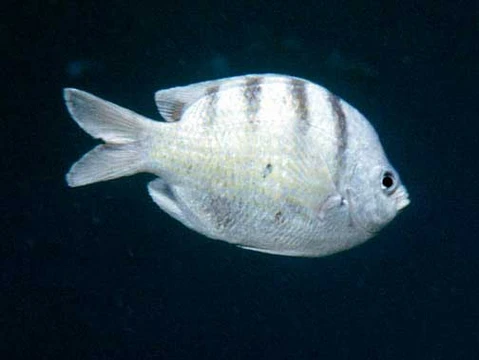
Green damselfish (Abudefduf abdominalis)
Source-cited species reference: taxonomy from WoRMS, biology from FishBase, occurrence map from GBIF, conservation from IUCN Red List, description from Wikipedia.

The green damselfish (Abudefduf abdominalis), also known as the Hawaiian sergeant major, is a non-migratory fish of the family Pomacentridae. This fish also goes by the name maomao It occurs in the Pacific Ocean in the vicinity of the Hawaiian Islands, Midway Island and Johnston Atoll. It can grow to a maximum total length of 30 cm.
- Scientific name
- Abudefduf abdominalis
- Authority
- (Quoy & Gaimard, 1825)
- Family
- Pomacentridae
- Order
- Ovalentaria incertae sedis
- Maximum length
- 30 cm
- Depth range
- 1–50 m
- Habitat zone
- reef-associated
- Iucn red list
- Least Concern
- Gbif occurrence records
- 1,918
Classification (WoRMS)
Full classification as recorded by WoRMS: Kingdom: Animalia · Phylum: Chordata · Class: Teleostei · Order: Ovalentaria incertae sedis · Family: Pomacentridae · Genus: Abudefduf.
Accepted name: Abudefduf abdominalis · Authority: (Quoy & Gaimard, 1825) · Taxonomic status: accepted · AphiaID: 254879.
Synonyms and superseded combinations recorded for this taxon: Glyphisodon abdominalis Quoy & Gaimard, 1825.
Source: World Register of Marine Species (WoRMS) — https://www.marinespecies.org/aphia.php?p=taxdetails&id=254879 (CC BY 4.0). Accessed 2026-09-23.
Biology and life history (FishBase)
Measured values published by FishBase for Abudefduf abdominalis. Only fields the database actually holds for this species are shown; these are database values, not aquarium guidance.
Maximum length: 30 cm · Depth range: 1–50 m · Habitat zone: reef-associated · Body shape: short and / or deep · Vulnerability index: 20 of 100 · Fishery importance: minor commercial · Aquarium trade: commercial.
FishBase notes: Found in quiet waters with rocky bottoms in inshore and offshore reefs; juveniles sometimes found in surge pools (Ref. 205). Benthopelagic (Ref. 58302). Adults form school. Feed on a variety of algae and zooplankton. Oviparous, distinct pairing during breeding (Ref. 205). Eggs are demersal and adhere to the substrate (Ref. 205). Males guard and aerate the eggs (Ref. 205). Used as food by the Hawaiians (Ref. 7364).
Source: FishBase species summary (SpecCode 6652) — https://www.fishbase.se/summary/Abudefduf-abdominalis.html (CC BY-NC 3.0 — non-commercial use only). Accessed 2026-09-23.
Distribution and occurrence records (GBIF)
1,918 georeferenced occurrence records for Abudefduf abdominalis are published through GBIF from 5 countries or marine areas. The map above plots 26 distinct locations from a sample of 1,918 records, omitting 14 inland records that carry an institution's coordinates rather than a collection site; it shows where the species has been observed and reported, not a modelled range.
Most records by country or area: United States of America (1,821); United States Minor Outlying Islands (92); American Samoa (2); China (2); Indonesia (1).
The full country table, WoRMS marine regions and the sampling notes are on this species' Distribution page.
Source: GBIF Occurrence Search (taxonKey 2398692) — https://www.gbif.org/occurrence/search?taxon_key=2398692&has_coordinate=true (records CC0 / CC BY); WoRMS distribution records (MarineRegions) — https://www.marinespecies.org/aphia.php?p=taxdetails&id=254879 (CC BY 4.0); Natural Earth 110m basemap — https://www.naturalearthdata.com/ (public domain). Accessed 2026-09-23.
Conservation status (IUCN Red List)
The IUCN Red List assesses Abudefduf abdominalis (Quoy & Gaimard, 1825) as Least Concern (code LC). No trend, population estimate or threat analysis is given here, because none is available from this source without the Red List API; follow the source link for the full assessment, including its date.
Source: IUCN Red List of Threatened Species (taxon 188304) — https://www.iucnredlist.org/species/188304/0; GBIF IUCN Red List category endpoint (taxonKey 2398692) — https://api.gbif.org/v1/species/2398692/iucnRedListCategory. Accessed 2026-09-23.
Description and natural history (Wikipedia)
Adults of the species are typically found in quiet waters with rocky bottoms in inshore and offshore reefs at a depth of 1 to 50 m, although juveniles may sometimes be found in surge pools. It is a benthopelagic species, with adults being known to form schools. The species feeds on a variety of algae and zooplankton. It is known to be used as a food source for humans in Hawaii. It occasionally appears in the aquarium trade.
Abudefduf abdominalis is oviparous, with distinct pairing occurring during breeding. Abudefduf abdominalis is known for being a species of fish that are polygamous during their breeding time. Eggs are demersal and adhere to the substrate, with males guarding and aerating the eggs. Breeding cycles depend on the availability of food. It is known to hybridise with Abudefduf vaigiensis which has been introduced to Hawaiian coastal waters. Abudefduf abdominalis are capable of spawning year round, though are most active during mid December all through July. To enchant the female of the species, males will take what are called "nuptial colors" like dark blue and have light yellow bars and will perform various dances to attract a mate. Such dances include swimming in zig-zag patterns, swimming in loops, or floating head down.
These fishes can range from 7 inches to 9 inches on average. The juveniles start out with a yellow tinge, which turns greenish white as they mature. The rear fin has a black marking. During breeding the males turn blue and their black bars begin to fade into a gray instead.
These fish are known to nibble on zooplankton, Copepods usually and on occasion they'll also eat algae.
Some fish that prey on this species include but are not limited to the Milletseed Butterflyfish, Racoon Butterflyfish, and the Black Triggerfish. Some predators like the Milletseed Butterflyfish will travel close behind divers to find a Hawaiian Sergeant nest and feast on the eggs.
Source: Wikipedia: Green damselfish — https://en.wikipedia.org/wiki/Green_damselfish (CC BY-SA 4.0). Accessed 2026-09-23.
Related in Green damselfish
Links follow this subject's own source article.
Elsewhere in Green damselfish
Spotted an error? Know more?
Reader corrections go straight into our review queue. Suggest an edit · How this site is sourced