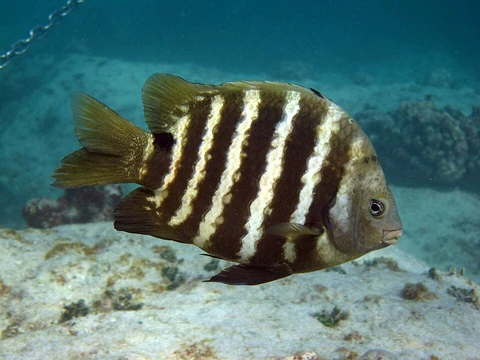
Panamic sergeant major (Abudefduf troschelii)
Source-cited species reference: taxonomy from WoRMS, biology from FishBase, occurrence map from GBIF, conservation from IUCN Red List, description from Wikipedia.

Abudefduf troschelii, the Pacific sergeant major or Panama sergeant major, is a species of damselfish belonging to the family Pomacentridae that can be identified by the pronounced black stripes on the lateral sides of the fish. Its specific name honors the zoologist Franz Hermann Troschel (1810-1882). It is native to the neritic pelagic zone of the shallow water coral reefs in the Eastern Pacific Ocean and they are an omnivorous species feeding on plankton and algae attached to their coral habitat. Abudefduf troschelii is a sister-species of A. saxatilis but have diverged from each other since the uplift of the isthmus of Panama, separated by the rise of the Panama land bridge 3.1 to 3.5 million years ago. Males, like in many other marine species, take care of and defend newborn A. troschelii after they have been hatched by eggs from the female.
- Scientific name
- Abudefduf troschelii
- Authority
- (Gill, 1862)
- Family
- Pomacentridae
- Order
- Ovalentaria incertae sedis
- Maximum length
- 20 cm
- Depth range
- 1–12 m
- Habitat zone
- reef-associated
- Iucn red list
- Least Concern
- Gbif occurrence records
- 4,815
Classification (WoRMS)
Full classification as recorded by WoRMS: Kingdom: Animalia · Phylum: Chordata · Class: Teleostei · Order: Ovalentaria incertae sedis · Family: Pomacentridae · Genus: Abudefduf.
Accepted name: Abudefduf troschelii · Authority: (Gill, 1862) · Taxonomic status: accepted · AphiaID: 273702.
Synonyms and superseded combinations recorded for this taxon: Glyphidodon troschelii Gill, 1862.
Source: World Register of Marine Species (WoRMS) — https://www.marinespecies.org/aphia.php?p=taxdetails&id=273702 (CC BY 4.0). Accessed 2026-09-23.
Biology and life history (FishBase)
Measured values published by FishBase for Abudefduf troschelii. Only fields the database actually holds for this species are shown; these are database values, not aquarium guidance.
Maximum length: 20 cm · Common length: 10 cm · Depth range: 1–12 m · Habitat zone: reef-associated · Body shape: short and / or deep · Vulnerability index: 10 of 100 · Aquarium trade: never/rarely.
FishBase notes: Adults inhabit rocky and coral reefs (Ref. 9334). Usually in large aggregations. These diurnal feeders feed on plankton at the surface or mid-water; also graze on benthic invertebrates and algae on the reef. Breed during early summer in the Gulf and continues throughout the summer until fall. This fish is a warm-water, stenothermal species. Juveniles of second year class have been observed cleaning schools of striped mullet, halfbeaks and needlefish (Ref. 5592). Oviparous, distinct pairing during breeding (Ref. 205). Eggs are demersal and adhere to the substrate (Ref. 205). Males guard and aerate the eggs (Ref. 205).
Source: FishBase species summary (SpecCode 8245) — https://www.fishbase.se/summary/Abudefduf-troschelii.html (CC BY-NC 3.0 — non-commercial use only). Accessed 2026-09-23.
Distribution and occurrence records (GBIF)
4,815 georeferenced occurrence records for Abudefduf troschelii are published through GBIF from 18 countries or marine areas. The map above plots 95 distinct locations from a sample of 3,000 records, omitting 46 inland records that carry an institution's coordinates rather than a collection site; it shows where the species has been observed and reported, not a modelled range.
Most records by country or area: Mexico (2,269); Ecuador (1,435); Costa Rica (596); Panama (326); Colombia (122).
The full country table, WoRMS marine regions and the sampling notes are on this species' Distribution page.
Source: GBIF Occurrence Search (taxonKey 2398672) — https://www.gbif.org/occurrence/search?taxon_key=2398672&has_coordinate=true (records CC0 / CC BY); WoRMS distribution records (MarineRegions) — https://www.marinespecies.org/aphia.php?p=taxdetails&id=273702 (CC BY 4.0); Natural Earth 110m basemap — https://www.naturalearthdata.com/ (public domain). Accessed 2026-09-23.
Conservation status (IUCN Red List)
The IUCN Red List assesses Abudefduf troschelii (Gill, 1862) as Least Concern (code LC). No trend, population estimate or threat analysis is given here, because none is available from this source without the Red List API; follow the source link for the full assessment, including its date.
Source: IUCN Red List of Threatened Species (taxon 183397) — https://www.iucnredlist.org/species/183397/0; GBIF IUCN Red List category endpoint (taxonKey 2398672) — https://api.gbif.org/v1/species/2398672/iucnRedListCategory. Accessed 2026-09-23.
Description and natural history (Wikipedia)
Abudefduf troschelii have five dark bands on the lateral surfaces of the body with dorsal yellow spaces in between. These dark bands spread towards the ventral side of the fish creating black stripes. This eye catching coloration of the fish is one of the reasons that they are popular aquarium fishes. Their pectoral fins are lengthened, slender, and paddle-shaped allowing them to swim fast and change direction quickly around coral reefs. This is a common morphology among coral reef living fish. These pectoral fins are structured with a long, straightened hydrodynamic leading edge, and a rounded hydrodynamic trailing edge allowing them to easily maneuver around pieces of rock and coral. Compared to other damselfish, A. troschelii have relatively large eyes, and a long angular shaped head. The mouth of this species is located in a higher position on the frontal side of the fish compared to other damselfish, allowing A. troschelii to successfully feed on suspension floating plankton in the oceanic pelagic zone.
Abudefduf troschelii are found widely throughout the Eastern Pacific and are endemic to this area. They are commonly found in Colombia, Costa Rica, Ecuador, El Salvador, Guatemala, Honduras, Mexico, Nicaragua, Panama, Peru, and the United States to name a few. In these places, this species is abundant in coralline and sandy bottoms, but they can also be found at rocky bottoms and tide pools where they are usually found in large aggregations. Furthermore, this species can be found in the pelagic area of the neritic feeding on plankton. This neritic area where A. troschelii are commonly found, is made up of massive corals, deep rocky walls, and shallow exposed reef.
These Eastern Pacific damselfish are feeders whose diet consists mainly of plankton in the pelagic zone and mid-water, but they also graze on benthic invertebrates and algae on their coral reef habitat. These feeding tendencies make them an omnivorous species. The physical structure of the A. troschelii mouth is one that it small but conveniently located so that it can easily feed on small plankton suspended in the water column and small bits of algae attached to pieces of benthic structure.
Abudefduf troschelii spawn within nine days on either side of the new moon, and hatching occurs after four days where newborns are hatched during the hour after sunset. Extended periods of spawning can occur during seasonal increases in plankton productivity. This seasonal increase is due to upwelling and leads to an increase in egg production of the species. During a wet season, this reproductive process lasts three to four days. In a dry season, on the other hand, this process can be drawn out to 8 days. Due to this, reproductive patterns are found within A. troschelii populations particularly during wet seasons. Reproductive patters of this species is beneficial because a hatching taking place at dusk results in favorable tides allowing newborns to be transported away from reef-based predators found at the time of a new moon. Furthermore, reproductive patterns reduces the risk of predation of unhatched embryos found at nests. During this spawning period, the male A. troschelii mates, chosen by the females, will clear and defend spawning sites of pieces of dead coral and rock. This area is where the females will eventually lay their adhesive eggs soon to be defended by the male. Male A. troschelii mate with one to five females for 1 to 3 days resulting in 250,000 eggs, and these males defend the young for 4 to 5 days following the spawning. When the newborn fish are hatched, the young have well-developed eyes and are able to control and utilize directive swimming. Like other damselfishes, larvae spend several weeks in open-water plankton and then settle on reefs as juveniles.
There are no real major threats to the overall population size of A. troschelii, but they are in fact a small percent of the yellow snapper (Lutjanus argentiventris) diet. Another predator of this species is the Thalassoma lucasanum, the neotropical pacific wrasse, which forms groups of 30 to 300 individuals that will typically overwhelm the parental defense of A. troschelii embryos, ultimately gaining access to an easy unprotected, solitary food source.
Source: Wikipedia: Abudefduf troschelii — https://en.wikipedia.org/wiki/Abudefduf_troschelii (CC BY-SA 4.0). Accessed 2026-09-23.
Frequently Asked Questions
What is the Panamic sergeant major (Abudefduf troschelii)?
It is a small damselfish in the family Pomacentridae, easily recognized by the bold black stripes running along its flanks. First described by Gill in 1862, it is a close relative of A. saxatilis but has since diverged into its own distinct species.
Where can you find the Panamic sergeant major in the wild?
This species lives in the neritic pelagic zone of shallow coral reefs across the Eastern Pacific Ocean, typically at depths between 1 and 12 metres. Its range is most strongly associated with the reef systems around Panama and the broader Eastern Pacific.
What does the Panamic sergeant major eat?
It is an omnivore, feeding on both free-floating plankton and algae attached to the coral structures it inhabits. This mixed diet lets it exploit the varied food sources available throughout its reef environment.
How big does the Panamic sergeant major grow and what does it look like?
Adults reach a maximum total length of roughly 20 centimetres. Its most striking visual trait is the set of pronounced black lateral stripes that set it apart from other damselfish in the genus.
Why is it called the 'Panamic' sergeant major and who is the name after?
The common name reflects the species' strong association with the Pacific waters off Panama, where it is well known to local divers. The scientific specific epithet 'troschelii' honours the 19th-century zoologist Franz Hermann Troschel (1810–1882).
Related in Panamic sergeant major
Links follow this subject's own source article.
Elsewhere in Panamic sergeant major
Spotted an error? Know more?
Reader corrections go straight into our review queue. Suggest an edit · How this site is sourced