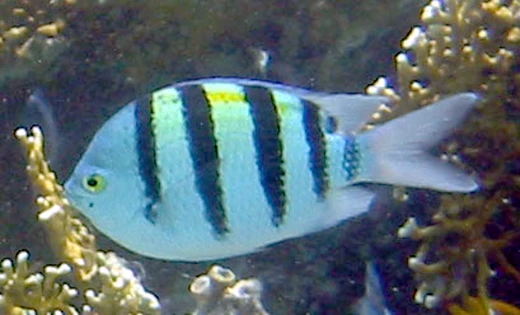
Indo-Pacific sergeant (Abudefduf vaigiensis)
Source-cited species reference: taxonomy from WoRMS, biology from FishBase, occurrence map from GBIF, conservation from IUCN Red List, description from Wikipedia.

The Indo-Pacific sergeant (Abudefduf vaigiensis) is a species of damselfish in the family Pomacentridae. It may also be known as the Sergeant major although this name is usually reserved for the closely related species Abudefduf saxatilis. The closely related Abudefduf caudobimaculatus was formerly considered to be synonymous with this species and, according to some authorities, is synonymous.
- Scientific name
- Abudefduf vaigiensis
- Authority
- (Quoy & Gaimard, 1825)
- Family
- Pomacentridae
- Order
- Ovalentaria incertae sedis
- Maximum length
- 20 cm
- Depth range
- 0–15 m
- Habitat zone
- reef-associated
- Iucn red list
- Least Concern
- Gbif occurrence records
- 11,165
Classification (WoRMS)
Full classification as recorded by WoRMS: Kingdom: Animalia · Phylum: Chordata · Class: Teleostei · Order: Ovalentaria incertae sedis · Family: Pomacentridae · Genus: Abudefduf.
Accepted name: Abudefduf vaigiensis · Authority: (Quoy & Gaimard, 1825) · Taxonomic status: accepted · AphiaID: 212879.
Synonyms and superseded combinations recorded for this taxon: Abudefduf caudobimaculatus Okada & Ikeda, 1939; Abudefduf quinquelineatus von Bonde, 1934; Abudefduf quinquilineatus von Bonde, 1934; Abudefduf vaigensis (Quoy & Gaimard, 1825); Abudefduf vargensis (Quoy & Gaimard, 1825); Abudefdus vaigiensis (Quoy & Gaimard, 1825); Chaetodon tyrwhitti Bennett, 1830; Glyphisodon quadrifasciatus Bleeker, 1847; Glyphisodon rahti Cuvier, 1830; Glyphisodon vaigiensis Quoy & Gaimard, 1825.
Source: World Register of Marine Species (WoRMS) — https://www.marinespecies.org/aphia.php?p=taxdetails&id=212879 (CC BY 4.0). Accessed 2026-09-23.
Biology and life history (FishBase)
Measured values published by FishBase for Abudefduf vaigiensis. Only fields the database actually holds for this species are shown; these are database values, not aquarium guidance.
Maximum length: 20 cm · Depth range: 0–15 m · Habitat zone: reef-associated · Body shape: short and / or deep · Vulnerability index: 15.8 of 100 · Fishery importance: subsistence fisheries · Aquarium trade: commercial.
FishBase notes: Adults inhabit upper edge of outer reef slopes and inshore rocky reefs. Juveniles associated with drifting seaweed (Ref. 12114, 12115). Benthopelagic (Ref. 58302). Feed on zooplankton, benthic algae, and small invertebrates (Ref. 1602). Often in aggregations (Ref. 9710) feeding at midwater or tending nests among rocks and coral ledges (Ref. 90102). In large numbers at spawning sites that are timed with large tides that carry their pelagic offspring far offshore (Ref. 48636). Oviparous, distinct pairing during breeding (Ref. 205). Eggs are demersal and adhere to the substrate (Ref. 205). Males guard and aerate the eggs (Ref. 205). Minimum depth reported taken from Ref. 128797.
Source: FishBase species summary (SpecCode 6630) — https://www.fishbase.se/summary/Abudefduf-vaigiensis.html (CC BY-NC 3.0 — non-commercial use only). Accessed 2026-09-23.
Distribution and occurrence records (GBIF)
11,165 georeferenced occurrence records for Abudefduf vaigiensis are published through GBIF from 79 countries or marine areas. The map above plots 338 distinct locations from a sample of 3,000 records, omitting 91 inland records that carry an institution's coordinates rather than a collection site; it shows where the species has been observed and reported, not a modelled range.
Most records by country or area: Australia (2,119); Chinese Taipei (1,647); United States of America (1,238); Egypt (1,042); Japan (781).
The full country table, WoRMS marine regions and the sampling notes are on this species' Distribution page.
Source: GBIF Occurrence Search (taxonKey 2398634) — https://www.gbif.org/occurrence/search?taxon_key=2398634&has_coordinate=true (records CC0 / CC BY); WoRMS distribution records (MarineRegions) — https://www.marinespecies.org/aphia.php?p=taxdetails&id=212879 (CC BY 4.0); Natural Earth 110m basemap — https://www.naturalearthdata.com/ (public domain). Accessed 2026-09-23.
Conservation status (IUCN Red List)
The IUCN Red List assesses Abudefduf vaigiensis (Quoy & Gaimard, 1825) as Least Concern (code LC). No trend, population estimate or threat analysis is given here, because none is available from this source without the Red List API; follow the source link for the full assessment, including its date.
Source: IUCN Red List of Threatened Species (taxon 188609) — https://www.iucnredlist.org/species/188609/0; GBIF IUCN Red List category endpoint (taxonKey 2398634) — https://api.gbif.org/v1/species/2398634/iucnRedListCategory. Accessed 2026-09-23.
Description and natural history (Wikipedia)
The Indo-Pacific sergeant is found in the Indo-Pacific including the Red Sea. Indian Ocean populations are found in the Red Sea, the Gulf of Aden, Arabia, the Persian Gulf, the Arabian Sea, the Maldives, eastern Africa, Tanzania, Madagascar, Seychelles, Sri Lanka, the Andaman Sea, Indonesia, Malaysia, and Australia. Populations in the Pacific Ocean are found in the Gulf of Thailand, Malaysia, Indonesia, the Philippines, Taiwan, Japan, the Yellow Sea, the Great Barrier Reef around Australia, New Zealand, and Pacific islands all the way to Hawaii. Likely introduced via Suez Canal in the Mediterranean Sea, where its distribution remains unclear due to possible confusion with Abudefduf saxatilis and Abudefduf troschelii.
Abudefduf vaigiensis are white bluish with a yellow top. They have a black spot around their dorsal fin. It has yellow eyes. The dorsal fin on this fish has 13 dorsal spines and 11 to 14 dorsal soft rays. The anal fin on the Indo-Pacific sergeant has 2 anal spines and 11 to 13 anal soft rays. Its maximum recorded size is 20 cm. Juveniles mature at 12 cm. Males turn more blue during spawning. Many people confuse this fish for Abudefduf saxatilis, a closely related species found in the Atlantic Ocean.
They feed on zooplankton, benthic algae, and small invertebrates.
Adults live in coral reefs, tide pools, and rocky reefs. Larva of this species live in the open sea. It is found in tropical and subtropical waters. Depth ranges of 1 to 15 m are where people encounter this fish.
These fish form large aggregations. In the aggregations, individuals either feed in the midwater or tend their nests.
This fish is found in the aquarium trade.
There have been reports of ciguatera poisoning from this fish.
The larva hatch and drift out in to the pelagic zone. They drift in the waves and grow up until they go to a reef.
Males turn more bluish during spawning. They build nests on rocks or coral ledges. Then, females lay their eggs in the nests and the male fertilizes them. Males guard and aerate the eggs until they hatch.
Source: Wikipedia: Indo-Pacific sergeant — https://en.wikipedia.org/wiki/Indo-Pacific_sergeant (CC BY-SA 4.0). Accessed 2026-09-23.
Related in Indo-Pacific sergeant
Links follow this subject's own source article.
Elsewhere in Indo-Pacific sergeant
Spotted an error? Know more?
Reader corrections go straight into our review queue. Suggest an edit · How this site is sourced