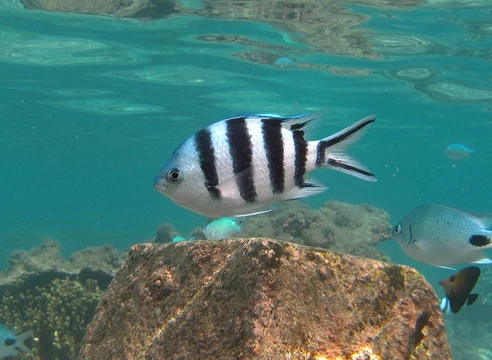
Scissortail sergeant (Abudefduf sexfasciatus)
Source-cited species reference: taxonomy from WoRMS, biology from FishBase, occurrence map from GBIF, conservation from IUCN Red List, description from Wikipedia.

The scissortail sergeant or striptailed damselfish (Abudefduf sexfasciatus) is a large damselfish in the family Pomacentridae. It earns its name from the black-striped tail and sides, which are reminiscent of the insignia of a military Sergeant, being similar to those of the sergeant major damselfish. It grows to a length of about 16 cm. Scissortail sergeants live on coral reefs at depths of up to 15 m in tropical reaches, often living in a group surrounding a single head of coral. They are found on reefs in the Indo-Pacific region, including the Red Sea.
- Scientific name
- Abudefduf sexfasciatus
- Authority
- (Lacepède, 1801)
- Family
- Pomacentridae
- Order
- Ovalentaria incertae sedis
- Maximum length
- 19 cm
- Depth range
- 1–20 m
- Habitat zone
- reef-associated
- Iucn red list
- Least Concern
- Gbif occurrence records
- 8,984
Classification (WoRMS)
Full classification as recorded by WoRMS: Kingdom: Animalia · Phylum: Chordata · Class: Teleostei · Order: Ovalentaria incertae sedis · Family: Pomacentridae · Genus: Abudefduf.
Accepted name: Abudefduf sexfasciatus · Authority: (Lacepède, 1801) · Taxonomic status: accepted · AphiaID: 159289.
Synonyms and superseded combinations recorded for this taxon: Abudefduf coelestinus (Cuvier, 1830); Glyphidodon caelestinus Cuvier, 1830; Glyphisodon coelestinus Cuvier, 1830; Labrus sexfasciatus Lacepède, 1801.
Source: World Register of Marine Species (WoRMS) — https://www.marinespecies.org/aphia.php?p=taxdetails&id=159289 (CC BY 4.0). Accessed 2026-09-23.
Biology and life history (FishBase)
Measured values published by FishBase for Abudefduf sexfasciatus. Only fields the database actually holds for this species are shown; these are database values, not aquarium guidance.
Maximum length: 19 cm · Depth range: 1–20 m · Habitat zone: reef-associated · Body shape: short and / or deep · Vulnerability index: 10 of 100 · Fishery importance: minor commercial · Aquarium trade: public aquariums.
FishBase notes: Adults inhabit inshore and offshore coral or rocky reefs. Also in shallow coastal reef flats or crests, usually where lots of tall soft corals or hydroid colonies are present (Ref. 48636). Often found in groups feeding at midwater or tending nests among rocks and coral ledges (Ref. 90102). Feed on zooplankton and algae and aggregates high in the water column (Ref. 9710). Oviparous, distinct pairing during breeding (Ref. 205). Eggs are demersal and adhere to the substrate (Ref. 205). Males guard and aerate the eggs (Ref. 205).
Source: FishBase species summary (SpecCode 5688) — https://www.fishbase.se/summary/Abudefduf-sexfasciatus.html (CC BY-NC 3.0 — non-commercial use only). Accessed 2026-09-23.
Distribution and occurrence records (GBIF)
8,984 georeferenced occurrence records for Abudefduf sexfasciatus are published through GBIF from 57 countries or marine areas. The map above plots 299 distinct locations from a sample of 3,000 records, omitting 45 inland records that carry an institution's coordinates rather than a collection site; it shows where the species has been observed and reported, not a modelled range.
Most records by country or area: Australia (3,585); French Polynesia (678); New Caledonia (529); Egypt (477); Tonga (415).
The full country table, WoRMS marine regions and the sampling notes are on this species' Distribution page.
Source: GBIF Occurrence Search (taxonKey 2398669) — https://www.gbif.org/occurrence/search?taxon_key=2398669&has_coordinate=true (records CC0 / CC BY); WoRMS distribution records (MarineRegions) — https://www.marinespecies.org/aphia.php?p=taxdetails&id=159289 (CC BY 4.0); Natural Earth 110m basemap — https://www.naturalearthdata.com/ (public domain). Accessed 2026-09-23.
Conservation status (IUCN Red List)
The IUCN Red List assesses Abudefduf sexfasciatus (Lacepède, 1801) as Least Concern (code LC). No trend, population estimate or threat analysis is given here, because none is available from this source without the Red List API; follow the source link for the full assessment, including its date.
Source: IUCN Red List of Threatened Species (taxon 188557) — https://www.iucnredlist.org/species/188557/0; GBIF IUCN Red List category endpoint (taxonKey 2398669) — https://api.gbif.org/v1/species/2398669/iucnRedListCategory. Accessed 2026-09-23.
Description and natural history (Wikipedia)
The fish feed upon the larvae of invertebrates, zooplankton, smaller fishes, crustaceans, and various species of algae. They are preyed upon by some members of the Labridae and Serranidae families. They lay their eggs in patches on a firm substrate and guard them vigorously till they hatch.
Scissortail sergeants are found in the Indo-Pacific including the Red Sea. Areas scissortail sergeants can be found in around the Indian Ocean include the Red Sea, eastern Africa, Madagascar, Seychelles, the Persian Gulf, India, Sri Lanka, the Bay of Bengal, the Andaman Sea, Indonesia, and Australia. Pacific Ocean populations are found in the Great Barrier Reef around Australia, the Gulf of Thailand, Indonesia, the Philippines, Taiwan, Japan, and various Pacific islands all the way to Hawaii. A single record was reported recently (2017) in the eastern Mediterranean Sea near Athens, Greece, likely a result of aquarium release.
Adults live in coral reefs while younger individuals live in the open sea. They are found at depths of 1 to 20 m.
This fish is white. They have 5 vertical bands that are black. Two horizontal bands are present on the lobes of their tail. This fish can grow up to 22 cm at maximum length.
This species fish feeds on algae, zooplankton, and sometimes its own eggs.
This fish aggregates in large groups above coral.
This fish is popular in the aquarium trade. It is very aggressive and difficult to stay peaceful with other similar size fishes.
Like some other fish species, male scissortail sergeants are in charge of parental care. Males are polygamous and will collect eggs from up to 12 females while females spawn with a male and then abandon their eggs. Male parental care is more common than female- or bi-parental care in fish because territorial males are able to guard several clutches of eggs while simultaneously attracting new mates.
Male scissortail sergeants undergo brood cycling, in which they alternate between a mating phase and a parental phase. During the mating phase, males become gold in color and put on displays to attract egg-laying females. After two to three days in the mating phase, male scissortail sergeants will lose their gold color and transition into a four- to five-day parental phase. During the parental phase, males guard their eggs until they hatch. Filial cannibalism occurs during the parental phase.
In order to select the best quality males and maximize their offspring survival rate, females will pool their eggs with other females into a single male's territory and create a larger brood. Studies have shown that pooling to create larger broods serves to not only decrease predatory effects, but also increases paternal investment. By increasing brood size, predation rate per individual decreases as a result of dilution effects. Also, males with larger broods are less likely to cannibalize their broods. It has also been hypothesized that egg pooling is a simple imitation tactic by which females confirm the quality of the male. By copying the spawning behavior of other females, females can minimize the search costs of finding a good mate.
In order to increase the propagation of their offspring, female scissortail sergeant must also actively select for good fathers. Female fish utilize multiple strategies in order to select for male parental quality: important factors include mate size, courtship rates, and male cannibalism. Some females will monitor a male's parental quality by laying small clutches of "test eggs" in a male's territory. This unusual tactic is a direct way for females to confirm the parenting ability of males who do not yet have any eggs in their brood. Females only lay one test clutch and return shortly after laying it. Capable males prove their parental quality by defending the brood and not cannibalizing the eggs. Test eggs are energetically expensive to create, so this strategy is typically only used by large females at the beginning of the mating phase.
Filial cannibalism, the act of eating one's own offspring, is a common phenomena in territorial male fish. It occurs during the parental phase of brood cycling. Embryo mortality rates are generally attributed more to filial cannibalism than to predation effects because embryo predators are largely unsuccessful. Recent studies suggest that filial cannibalism, in fact, is an evolutionarily adaptive behavior. Baseline cannibalism is a result of males eating nonviable or damaged eggs, but males may cannibalize their current broods even more based on the costs and benefits of their parental investment. Raising offspring requires a large energy investment. Increased filial cannibalism occurs when the cost-to-benefit ratio of raising offspring is too high.
Filial cannibalism balances the loss of foraging opportunities. When guarding their territories, investment costs are lowest for large males with easy food access. When fathers are small and are unable to forage while caring for their broods, their offspring can be used as an extra food source to offset the energy requirements needed for parental care. By eating part of his brood, a male can improve his care for the remaining young in his brood. Supplementary feeding, however, decreases the energetic costs of raising a brood and can modulate cannibalistic tendencies in male scissortail sergeants. Experiments that supply provisional food like scissortail sergeant eggs and/or crab meat to brooding males lead to a decrease in cannibalism.
Source: Wikipedia: Scissortail sergeant — https://en.wikipedia.org/wiki/Scissortail_sergeant (CC BY-SA 4.0). Accessed 2026-09-23.
Related in Scissortail sergeant
Links follow this subject's own source article.
Elsewhere in Scissortail sergeant
Spotted an error? Know more?
Reader corrections go straight into our review queue. Suggest an edit · How this site is sourced