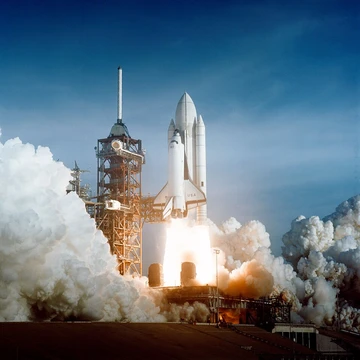
The Space Shuttle program
First reusable crewed space vehicle, flown 1981–2011.

The Space Shuttle program was NASA's fourth human spaceflight effort, running from 1981 to 2011 and providing routine trips to and from low Earth orbit for both people and supplies. Its official name came from a 1969 plan for a reusable Space Transportation System, though only the shuttle itself and its supporting rockets were actually built; a proposed nuclear-powered lunar shuttle from that plan was scrapped in 1972. Over its lifetime, the program completed 135 missions and carried 355 astronauts from 16 different countries, many of whom flew multiple times.
The Space Shuttle itself consisted of an orbiter launched with two reusable solid rocket boosters and a disposable external fuel tank. It could carry up to eight astronauts and as much as 50,000 pounds (23,000 kg) of cargo into low Earth orbit. After finishing its mission, the orbiter would reenter the atmosphere and land like a glider at either the Kennedy Space Center in Florida or Edwards Air Force Base in California. It remains the only winged crewed spacecraft to have reached orbit and landed, and it was the first reusable crewed vehicle to make multiple trips into space. Its tasks included delivering large payloads to various orbits—especially the International Space Station (ISS)—rotating station crews, and servicing the Hubble Space Telescope. The orbiter could also retrieve satellites and other items from orbit and bring them back to Earth, though this was done rarely. Each orbiter was designed for a lifespan of 100 launches or 10 years of operation. Originally, the program was marketed as capable of over 150 launches over 15 years, with a peak rate of one launch per month, but long delays in building the International Space Station meant that demand never reached that level.
The concept of a reusable shuttle had been studied since the late 1960s. The program officially began in 1972, becoming NASA's main human spaceflight focus after the Apollo, Skylab, and Apollo-Soyuz missions ended in 1975. It was first presented to the public in 1972 as a "Space Truck" that would help build a U.S. space station in the 1980s and then be replaced by a new vehicle in the early 1990s. Those stalled station plans eventually evolved into the International Space Station, which was formally approved by President Ronald Reagan in 1983. However, the ISS suffered from long delays, design changes, and cost overruns, forcing the Shuttle's service life to be extended several times until it finally retired in 2011—lasting twice as long as originally intended. In 2004, President George W. Bush's Vision for Space Exploration directed that the Shuttle be used almost exclusively to finish assembling the ISS, which was far behind schedule.
The first experimental orbiter, Enterprise, was a high-altitude glider launched from a modified Boeing 747 for initial atmospheric landing tests. Its first test flight was on February 18, 1977, just five years after the program began. The first spaceworthy shuttle, Columbia, launched on April 12, 1981 (the 20th anniversary of Yuri Gagarin's flight) on mission STS-1. The program ended with its final mission, STS-135 flown by Atlantis, in July 2011, and formally concluded on August 31, 2011.
All Shuttle missions launched from Kennedy Space Center in Florida. Some civilian and military polar missions were planned for Vandenberg Air Force Base in California, but those were canceled after the Challenger disaster in 1986. Launch weather criteria included precipitation, temperature, cloud cover, lightning forecasts, wind, and humidity; the Shuttle was never launched when there was a risk of lightning strike.
The first fully functional orbiter was Columbia (OV-102), built in Palmdale, California, delivered to Kennedy Space Center on March 25, 1979, and first launched on April 12, 1981, with a crew of two. Challenger (OV-099) arrived at KSC in July 1982, Discovery (OV-103) in November 1983, Atlantis (OV-104) in April 1985, and Endeavour (OV-105) in May 1991. Challenger was originally built as a structural test article but was converted into a complete orbiter when that proved cheaper than converting Enterprise from its landing test configuration. On April 24, 1990, Discovery carried the Hubble Space Telescope into orbit on STS-31.
Of the 135 missions, two orbiters—Challenger and Columbia—were destroyed in catastrophic accidents, killing all 14 crew members combined. These accidents led to national investigations, detailed analysis of the causes, and long pauses while changes were made before flights resumed. After Challenger in January 1986, there was a 32-month delay; after Columbia in February 2003, a 29-month delay. The longest Shuttle mission was STS-80, lasting 17 days and 15 hours. The final flight was STS-135 on July 8, 2011.
Since the Shuttle's retirement, many of its former duties have been taken over by various government and private spacecraft. The European ATV (Automated Transfer Vehicle) supplied the ISS from 2008 to 2015. Classified military missions are now handled by other vehicles.
- Program start
- 1972
- First orbital flight
- April 12, 1981 (STS-1)
- Last flight
- July 2011 (STS-135)
- Total missions
- 135
- Astronauts carried
- 355 from 16 countries
- Orbiters built
- 5 (Columbia, Challenger, Discovery, Atlantis, Endeavour)
- Fatal accidents
- 2 (Challenger 1986, Columbia 2003)
Lore & Background
The Space Shuttle program, NASA’s fourth human spaceflight effort, operated from 1981 to 2011, providing routine transport of crew and cargo to low Earth orbit. The spacecraft itself consisted of a winged orbiter, two reusable solid rocket boosters, and a single-use external fuel tank. It could carry up to eight astronauts and substantial payloads. After completing its mission, the orbiter reentered the atmosphere and landed like a glider, typically at Kennedy Space Center or Edwards Air Force Base. It remains the only winged crewed vehicle to have reached orbit and the first reusable spacecraft to fly multiple orbital missions. The program flew 135 missions, carrying 355 astronauts from 16 nations. Its tasks included delivering large payloads to the International Space Station (ISS), rotating station crews, servicing the Hubble Space Telescope, and occasionally retrieving satellites for return to Earth. Originally conceived in 1972 as a “Space Truck” to build a U.S. space station, the program faced delays as the ISS evolved and was repeatedly extended, serving twice its intended design life. Five orbiters flew: Columbia, Challenger, Discovery, Atlantis, and Endeavour. Two were lost in accidents—Challenger in 1986 and Columbia in 2003—killing all 14 crew members, leading to lengthy pauses for safety improvements. The final mission, STS-135 by Atlantis, ended in July 2011, and the program formally concluded on August 31, 2011.
Reader's Guide
The Space Shuttle program's significance lies in its role as the first reusable crewed space vehicle, enabling routine access to low Earth orbit for crew and cargo over three decades. It carried large payloads to various orbits, including components of the International Space Station, and performed service missions on the Hubble Space Telescope. The program also recovered satellites and other payloads from orbit, though this was rare. The total cost of the actual 30-year service life through 2011, adjusted for inflation, was $196 billion. The program's legacy includes its contributions to space station construction, satellite deployment, and scientific research, as well as lessons learned from its two fatal accidents. Since its retirement in 2011, many of its duties have been taken over by government and private vessels, including the Russian Soyuz, SpaceX's Dragon 2, and the uncrewed X-37B.
Did You Know?
- The Space Shuttle program flew 135 missions and carried 355 astronauts from 16 countries.
- The Shuttle is the only winged crewed spacecraft to have achieved orbit and landing.
- Two orbiters (Columbia and Challenger) suffered catastrophic accidents, with the loss of 14 astronauts total.
- The longest Shuttle mission was STS-80 lasting 17 days, 15 hours.
Frequently Asked Questions
Who is The Space Shuttle program?
The Space Shuttle program was NASA's fourth crewed spaceflight initiative, operating from 1981 to 2011 as the world's first reusable crewed spacecraft system. It provided routine Earth-to-orbit transport of astronauts and cargo for three decades.
What are The Space Shuttle program's powers/role?
Its core capability was launching a winged orbiter with a large payload bay, enabling satellite deployment, Hubble Space Telescope servicing, and International Space Station assembly. Over 135 flights it carried 355 astronauts from 16 nations into orbit.
How does The Space Shuttle program's story end?
The program closed with STS-135 in July 2011, when Atlantis completed its final mission and touched down at Kennedy Space Center. That landing marked the end of a 30-year stretch of American crewed orbital operations.
Why is The Space Shuttle program important?
As the first reusable crewed vehicle, it proved a spacecraft could be flown repeatedly rather than discarded after one trip, reshaping how humanity accessed orbit. It also constructed the International Space Station and kept Hubble operational, setting the stage for modern exploration.
What orbiters made up The Space Shuttle program?
Five orbiters were built: Columbia, Challenger, Discovery, Atlantis, and Endeavour. Columbia and Challenger were lost in accidents in 1981 and 1986, while the remaining three carried the program through its final missions.
More in Space Missions 1-22
Spotted an error? Know more?
This is a living reference — every entry is fact-audited, and reader corrections feed straight into our audit queue. Suggest an edit · See this site's audit record