Voyager 2
Only spacecraft to visit Uranus and Neptune.

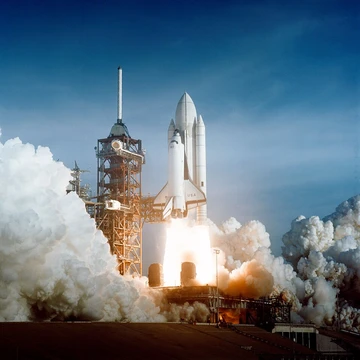
Voyager 2 left Earth on August 20, 1977, part of NASA's Voyager program. It was aimed at the gas giants Jupiter and Saturn, but its path also allowed later visits to the ice giants Uranus and Neptune—the only spacecraft ever to reach either of those worlds. It was the third of five probes to reach solar escape velocity, meaning it could leave the Solar System. Launched 16 days before its twin, Voyager 1, its main job was to study the outer planets; now, in an extended mission, it examines interstellar space beyond the Sun's heliosphere. The probe completed its primary goals: it flew past Jupiter in 1979, Saturn in 1981, Uranus in 1986, and Neptune in 1989. Today, it studies the interstellar medium. As of February 2026, it sits 143.05 AU (about 21.4 billion kilometers, or 13.3 billion miles) from Earth. It entered interstellar space on November 5, 2018, at 119.7 AU from the Sun (11.1 billion miles, or 17.9 billion kilometers), moving at 15.341 km/s (34,320 mph) relative to the Sun. Though it has left the heliosphere, it remains within the Solar System, joining Voyager 1 (which crossed into interstellar space in 2012). Voyager 2 has given the first direct readings of interstellar plasma density and temperature. Contact with Earth uses the NASA Deep Space Network. Because of its southern trajectory, only Australia's DSS 43 antenna—part of the Canberra complex—can communicate with it; the Goldstone and Madrid sites are out of range.
- field
- Space exploration
- nationality
- United States (NASA)
Verified Timeline
Quick Facts
- Mission Type
- Planetary exploration
- Operator
- NASA / JPL
- Website
- https: · science.nasa.gov/mission/voyager
- Cospar Id
- 1977-076A
- Satcat
- 10271
- Mission Duration
- Total: / 1em20 Aug 1977 · show=yd · sep=, (elapsed) / Planetary mission: / 1em20 Aug 1977 · 2 Oct 1989 · show=ymd · sep=, / Interstellar mission: / 1em2 Oct 1989 · show=yd · sep=, (elapsed)
- Manufacturer
- Jet Propulsion Laboratory
- Launch Mass
- 721.9 kg
- Power
- 470 watts (at launch)
- Launch Date
- August 20, 1977, 14:29:00 · timezone=yes UTC
- Launch Rocket
- Titan IIIE
- Launch Site
- Cape Canaveral LC-41
Facts from the source article.
Lore & Background
Voyager 2 was launched from Cape Canaveral, Florida, aboard a Titan IIIE/Centaur launch vehicle, 16 days before its twin Voyager 1. Its trajectory was designed to allow flybys of Jupiter and Saturn, with the option to continue to Uranus and Neptune. The backup receiver could only receive transmissions at a precise frequency, affected by Earth's rotation and onboard temperature. Despite this, the probe continued its mission. It communicates with Earth via the NASA Deep Space Network, specifically Australia's DSS 43 antenna. The spacecraft's power is supplied by three radioisotope thermoelectric generators, which have been managed through careful shutdown of instruments to extend operations.
Reader's Guide
Voyager 2's significance lies in its unprecedented exploration of the outer Solar System. It is the only spacecraft to have visited Uranus and Neptune, providing humanity's first close-up views of these ice giants. Its journey also demonstrated the feasibility of gravity-assist trajectories, enabling a single probe to visit multiple planets. After completing its primary mission, Voyager 2 continued into interstellar space, becoming the second human-made object to leave the heliosphere. Its measurements of interstellar plasma have advanced understanding of the boundary between the Solar System and the galaxy. The probe's longevity, despite technical challenges such as a failed primary receiver and diminishing power, showcases the durability of its design and the ingenuity of mission engineers. Voyager 2 remains in contact with Earth, transmitting data from beyond the Sun's influence, and its legacy includes inspiring future interstellar missions and expanding knowledge of the cosmos.
Did You Know?
- Voyager 2 is the only spacecraft to have visited Uranus and Neptune.
- It was launched 16 days before its twin Voyager 1, on August 20, 1977.
- As of February 2026, Voyager 2 is 143.05 AU (about 21.4 billion km) from Earth.
- It entered interstellar space on November 5, 2018, at a distance of 119.7 AU from the Sun.
- The probe's backup receiver can only receive transmissions at a precise frequency due to a failed capacitor.
The Grand Tour Vision and Dual-Probe Strategy
In the early decades of the space age, astronomers recognized that a rare planetary alignment in the late 1970s would permit a single spacecraft to sweep past Jupiter, Saturn, Uranus, and Neptune using the then-novel technique of gravity assists. NASA initially conceived a sweeping Grand Tour involving two groups of two probes each—one set targeting Jupiter, Saturn, and Pluto, the other Jupiter, Uranus, and Neptune. By 1972, budget pressures trimmed the plan to two Mariner-derived spacecraft focused on Jupiter and Saturn flybys, though the Grand Tour option was deliberately preserved. The program was eventually rebranded as Voyager. Voyager 1 was tasked with exploring Jupiter, Saturn, and Titan, while Voyager 2 followed a trajectory that kept the door open to Uranus and Neptune, with Titan as a backup target should Voyager 1's objectives fail. Once Voyager 1 completed its primary goals, Voyager 2 received its extension, becoming the only spacecraft ever to visit both ice giants.
Crossing into the Interstellar Medium
Traveling at roughly 15.341 km/s relative to the Sun, the probe entered a region no human-made object had previously sampled in such detail. This milestone marked the beginning of its extended mission: direct measurement of the density and temperature of interstellar plasma, data that had never before been captured firsthand. It remains the sole spacecraft to have flown past both Uranus and Neptune, and the third of five probes to achieve solar escape velocity. The interstellar phase transforms Voyager 2 from a planetary explorer into a one-of-a-kind sensor floating in the void between stars.
The Slow Power Decline and the Big Bang Swap
Voyager 2 draws its energy from three radioisotope thermoelectric generators, each packed with 24 pressed plutonium-oxide spheres. At launch, each RTG provided about 157 W of electrical power, totaling 470 watts (halving every 87.7 years). They were predicted to allow operations until at least 2020, and five instruments still ran into early 2023. In April 2023, JPL tapped a backup power reservoir meant for an onboard safety mechanism, hoping to keep all five instruments running through 2026. But in October 2024, NASA announced the plasma science instrument had been turned off on September 26, 2024, to preserve power for the remaining four. In March 2025, NASA announced plans to shut off the low-energy charged particle (LECP) instrument on March 24, 2025, to manage the diminishing power supply while keeping three instruments operational. On August 4, 2026, JPL engineers announced a successful 'simultaneous' swap of multiple power-consuming devices for lower-power alternatives aboard Voyager 2, freeing up power to keep all three remaining science instruments usable for at least one additional year. This procedure, internally nicknamed 'Big Bang,' required switching off a set of powered devices and substituting them with lower-power alternatives while ensuring the spacecraft remained warm enough to continue operating in near absolute zero temperatures. Without this activity, the mission would have had to turn off another instrument before the end of 2026.
Engineering for the Deep South
Built at NASA's Jet Propulsion Laboratory in California, Voyager 2 rides on a decagonal-prism bus equipped with 16 hydrazine thrusters, gyroscopes, a Sun sensor, and a Canopus star tracker that collectively keep its 3.7-meter parabolic high-gain antenna locked on Earth. The Attitude and Articulation Control Subsystem carries redundant units and eight backup thrusters to ensure pointing precision across decades of flight. Communications run on S-band and X-band radio frequencies, delivering up to 115.2 kilobits per second at Jupiter's distance, with the rate falling off by the inverse-square law as the probe recedes. When line-of-sight is lost, a digital tape recorder stashes roughly 64 megabytes of data for later downlink. Because Voyager 2's southern trajectory places it permanently out of range of the Deep Space Network's Goldstone and Madrid complexes, all communications fall to Australia's DSS 43 antenna at the Canberra complex—a single-point dependency that makes every contact window a small logistical event.
Frequently Asked Questions
Why is Voyager 2 considered unique among space probes?
It holds the distinction of being the only spacecraft ever to visit both Uranus and Neptune, the two ice giant planets at the outer edge of our Solar System. No other mission has matched that achievement.
Has Voyager 2 escaped the Sun's gravity?
Yes — Voyager 2 is one of only five spacecraft in history to reach Solar escape velocity. This means it has enough speed to permanently leave the Solar System's gravitational influence.
More in Space Missions 1-22
Spotted an error? Know more?
This is a living reference — every entry is fact-audited, and reader corrections feed straight into our audit queue. Suggest an edit · See this site's audit record