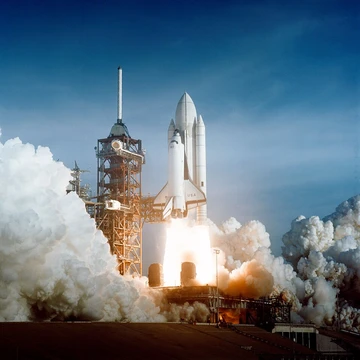
Apollo 11
First crewed mission to land humans on the Moon.

Apollo 11, which took place from July 16 to July 24, 1969, was the first spaceflight to put humans on the Moon. It was the fifth crewed mission in NASA’s Apollo program. The crew consisted of Commander Neil Armstrong, Command Module Pilot Michael Collins, and Lunar Module Pilot Edwin “Buzz” Aldrin. All three men were making their second and final trip into space.
The mission launched on a Saturn V rocket from Kennedy Space Center in Florida on July 16 at 13:32 UTC. The Apollo spacecraft had three main parts. The command module (CM) held the astronauts and was the only section that came back to Earth. The service module (SM) supplied the command module with propulsion, electricity, oxygen, and water. The Lunar Module (LM) had two stages: a descent stage with a large engine and fuel tanks for landing on the Moon, and a lighter ascent stage with a cabin for two astronauts and a small engine to lift them back into lunar orbit.
After traveling for three days, Armstrong and Aldrin descended to the surface in the LM, named *Eagle*. They landed in the Sea of Tranquility (Mare Tranquillitatis) on July 20 at 20:17 UTC. Collins stayed in lunar orbit aboard the command module *Columbia*. About six hours after landing, Armstrong became the first person to walk on the Moon. Aldrin joined him nineteen minutes later. The two spent roughly two and a half hours on the surface. They planted an American flag, spoke with President Richard Nixon at the White House, set up scientific instruments, and gathered 21.5 kg (47.5 lb) of lunar material. After more than 21 hours on the Moon, they rejoined Collins in orbit, and the crew returned safely to Earth on July 24, splashing down in the Pacific Ocean.
Apollo 11 marked the peak of the Space Race, a Cold War-era competition between the United States and the Soviet Union. It achieved a national goal set by President John F. Kennedy in May 1961, when he challenged the country to land a man on the Moon and bring him back safely before the decade ended. The program had to overcome a major setback: the deadly Apollo 1 launchpad fire in January 1967. It also relied on technology developed during the earlier Mercury and Gemini programs. The Soviet Union, despite early successes in spaceflight, could not match the Saturn V rocket. Its uncrewed lunar probe, Luna 15, crashed on the Moon on July 21 while Armstrong and Aldrin were still on the surface.
Armstrong’s moonwalk was broadcast live to an estimated 600 million viewers—about one-fifth of the world’s population—making it one of the most-watched television events ever. As he stepped onto the lunar surface, Armstrong said: “That’s one small step for [a] man, one giant leap for mankind.” The lunar samples brought back led to the discovery of three previously unknown minerals. Scientific instruments left on the Moon continued sending data for years. The crew received ticker-tape parades, a world goodwill tour, and the Presidential Medal of Freedom. The command module *Columbia* is now kept at the National Air and Space Museum in Washington, D.C. The descent stage of *Eagle* remains on the lunar surface.
**Background**
In the late 1950s and early 1960s, the United States was in the Cold War, a geopolitical rivalry with the Soviet Union. On October 4, 1957, the Soviet Union launched Sputnik 1, the first artificial satellite. This surprised the world and raised fears about Soviet technological and military strength. The success showed that the USSR could potentially deliver nuclear weapons across continents, challenging American claims of superiority in military, economic, and technological areas.
This event sparked the Sputnik crisis and started the Space Race, as both superpowers tried to prove their dominance in spaceflight. President Dwight D. Eisenhower responded by creating NASA and starting Project Mercury, which aimed to put a man in Earth orbit. The Soviets took the lead on April 12, 1961, when cosmonaut Yuri Gagarin became the first person in space and the first to orbit Earth. Nearly a month later, on May 5, 1961, Alan Shepard became the first American in space; his 15-minute flight was suborbital, not a full orbit.
Because the Soviet Union had rockets with greater lifting power, President John F. Kennedy, Eisenhower’s successor, chose a challenge that went beyond the abilities of existing rockets, so both countries would start from a more equal position. A crewed mission to the Moon would serve that purpose.
On May 25, 1961, Kennedy spoke to the U.S. Congress about “Urgent National Needs” and declared:
“I believe that this nation should commit itself to achieving the goal, before this decade [1960s] is out, of landing a man on the Moon and returning him safely to the Earth. No single space project in this period will be more impressive to mankind, or more important for the long-range exploration of space; and none will be so difficult or expensive to accomplish. We propose to accelerate the development of the appropriate lunar space craft. We propose to develop alternate liquid and solid fuel boosters, much larger than any now being developed, until certain which is superior. We propose additional funds for other engine development and for unmanned explorations—explorations which are particularly important for one purpose which this nation will never overlook: the survival of the man who first makes this daring flight. But in a very real sense, it will not be one man going to the Moon—if we make this judgment affirmatively, it will be an entire nation. For all of us must work to put him there.”
On September 12, 1962, Kennedy gave another speech in front of about 40,000 people at the Rice University football stadium.
- Mission
- Apollo 11
- Launch date
- July 16, 1969
- Landing date
- July 20, 1969
- Crew
- Neil Armstrong, Michael Collins, Edwin 'Buzz' Aldrin
- Field
- Spaceflight
- Nationality
- American
- Known for
- First human Moon landing
Lore & Background
Launched atop a Saturn V rocket from Kennedy Space Center in Florida on July 16 at 13:32 UTC, the Apollo spacecraft consisted of three parts: the command module (CM), which housed the three astronauts and was the only part to return to Earth; the service module (SM), which provided propulsion, electrical power, oxygen, and water; and the Lunar Module (LM), which had two stages—a descent stage for landing and an ascent stage to return astronauts to lunar orbit. After a three-day transit, Armstrong and Aldrin descended to the surface aboard the LM Eagle, landing in the Sea of Tranquility on July 20 at 20:17 UTC while Collins remained in lunar orbit aboard the CM Columbia. Armstrong became the first human to walk on the Moon approximately six hours after landing, followed by Aldrin nineteen minutes later. Together they spent around two and a half hours walking on the surface, planting an American flag, speaking with President Richard Nixon, deploying scientific instruments, and collecting 21.5 kg of lunar material. After more than 21 hours on the surface, they rejoined Collins in lunar orbit, and the crew returned safely to Earth on July 24, splashing down in the Pacific Ocean.
Reader's Guide
Apollo 11 was the culmination of the Space Race, a geopolitical competition between the United States and the Soviet Union rooted in Cold War rivalry. It fulfilled a national goal set by President John F. The Soviet Union, despite early leads in spaceflight, was unable to match the Saturn V rocket, and its uncrewed lunar probe Luna 15 crashed on the Moon on July 21, while Armstrong and Aldrin were still on the lunar surface. Lunar samples returned by the mission led to the identification of three previously unrecognized minerals, and scientific instruments deployed on the surface continued returning data for years afterwards. The crew were honoured with ticker-tape parades, a world goodwill tour, and the Presidential Medal of Freedom. The command module Columbia is preserved at the National Air and Space Museum in Washington, D.C., while the descent stage of Eagle remains on the lunar surface.
Did You Know?
- Armstrong and Aldrin spent around two and a half hours walking on the lunar surface.
- The Soviet uncrewed lunar probe Luna 15 crashed on the Moon on July 21, but Armstrong and Aldrin had already lifted off from the surface before the crash.
- Lunar samples returned by the mission led to the identification of three previously unrecognized minerals.
- The command module Columbia is preserved at the National Air and Space Museum's Steven F. Udvar-Hazy Center in Chantilly, Virginia.
The Fire That Reset Everything
NASA halted all crewed flights for nineteen months while engineers traced and corrected the root causes of numerous safety failures. The disaster effectively killed all plans to fly the original Block I Command/Service Module with astronauts aboard and forced a complete rethinking of the mission sequence. What had been a straightforward progression of Saturn IB test flights was scrapped and replaced with a new lettered framework running from A through G, later extended to J, where G represented the first crewed lunar landing. The surviving crews—Schirra's team and McDivitt's team—were reorganized into new roles, and the entire schedule was rebuilt from the ground up. In a sense, the three men who perished in that cabin ensured that no one else would fly until every known hazard was addressed.
The C-Prime Gambit and the Man Who Walked
The Command/Service Module, however, was already three months ahead of schedule. Apollo manager George Low saw an opportunity: instead of merely repeating an Earth-orbit test, why not send the CSM all the way to the Moon and attempt lunar orbit? This improvised C-Prime mission became Apollo 8, pulling Borman's crew forward while McDivitt's team stayed with the delayed Lunar Module for what became Apollo 9. The E mission, an elliptical medium-Earth-orbit test, was simply dropped. The crew swap had a consequence no one could have predicted: Pete Conrad, who as backup commander would have rotated into the Apollo 11 seat, lost that spot to Neil Armstrong, Borman's own backup. A scheduling fix to solve a hardware delay quietly determined which name would be etched into history as the first human to set foot on another world.
The Long Cancellation and What Was Left Behind
NASA had contracted for fifteen flight-worthy Saturn V rockets, and Apollo 11 consumed the sixth, leaving nine for subsequent landings planned at roughly four-month intervals through July 1972. Yet the program's final chapters were defined less by achievement than by subtraction. After Apollo 12, the last planned lunar mission, Apollo 20, was scrapped so that its hardware could be repurposed to launch Skylab as a dry workshop assembled on the ground inside an unused S-IVB Saturn IB second stage. The Apollo 13 incident and continued budget pressure then eliminated Apollo 18 and 19, and two additional Skylab missions also fell from the schedule. In the end, two complete Saturn V rockets were never flown; they sat in storage and were eventually placed on public display in the United States. The pattern across the 1960s and 1970s was consistent: technical setbacks, the Apollo 1 tragedy, the Apollo 13 crisis, shifting engineering priorities, and shrinking budgets each chipped away at the original vision until only a fraction of the planned flights ever reached space.
Building the Ladder: Uncrewed Tests and the Road to G
Before any astronaut could step onto the Moon, NASA had to validate every major system through a carefully sequenced set of uncrewed and crewed development flights. Two Saturn V test launches, designated A missions, flew as Apollo 4 and Apollo 6, while a third planned test was dropped as unnecessary. The first development Lunar Module, LM-1, flew uncrewed as the B mission (Apollo 5), and a second planned LM test using LM-2 was likewise canceled. LM-2 was subsequently modified to resemble a production landing vehicle and donated to the Smithsonian National Air and Space Museum, where it still stands as a simulation of the Apollo 11 first landing. Each letter in the A-through-G sequence represented a distinct capability that had to be proven before the next could be attempted, and the entire architecture existed to make the G mission, the first crewed landing, possible.
Frequently Asked Questions
What is Apollo 11?
Apollo 11 was the fifth crewed flight in NASA's Apollo program and the first mission to put human beings on the lunar surface. It launched on July 16, 1969, and touched down on the Moon four days later.
Who flew on Apollo 11?
The three-person crew consisted of Commander Neil Armstrong, Command Module Pilot Michael Collins, and Lunar Module Pilot Edwin 'Buzz' Aldrin. All three astronauts were on their second and final spaceflight.
When did Apollo 11 land on the Moon?
The Lunar Module touched down on the Moon on July 20, 1969, four days after the spacecraft lifted off from Earth. The crew returned safely to Earth on July 24, 1969.
What happened after the Moon landing?
After completing their lunar surface activities, Armstrong and Aldrin lifted off in the Lunar Module and reconnected with Collins in the Command Module. The crew then splashed down in the Pacific Ocean on July 24, 1969, concluding the mission.
More in Space Missions 1-22
Spotted an error? Know more?
This is a living reference — every entry is fact-audited, and reader corrections feed straight into our audit queue. Suggest an edit · See this site's audit record