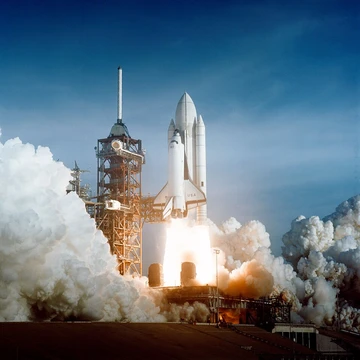
The Artemis program
NASA-led program to return humans to the Moon.

The Artemis program, led by NASA, aims to return humans to the Moon and establish a permanent base there, marking the first such visits since the Apollo era. It was formally created in 2017 by Space Policy Directive-1 under President Donald Trump. The program relies on Space Shuttle–derived components, including the Space Launch System’s core stage, its RS-25 engines, and solid rocket boosters, alongside hardware from the canceled Constellation program, such as the Orion spacecraft (paired with the European Service Module) and booster upgrades originally meant for Ares V. Private companies are developing new elements, like the Human Landing System (HLS), under contract, while international partners are governed by the Artemis Accords.
The program’s missions are designed to increase in complexity, roughly one year apart. Artemis I, an uncrewed test in 2022, sent Orion to lunar orbit. Artemis II, in 2026, carried four astronauts on a lunar flyby, becoming the only crewed flight beyond low Earth orbit not part of Apollo. Artemis III, planned for late 2027, will test an HLS lunar lander in Earth orbit. Artemis IV, targeted for 2028, is intended as the first crewed lunar landing since Apollo 17 in 1972. Starting with Artemis V, scheduled for no earlier than late 2028, NASA plans yearly lunar landings to build a permanent base, as a step toward deeper space missions. Each numbered mission launches an SLS rocket with Orion; missions after Artemis II also rely on support flights from other organizations. Planners have considered sending a collection of cultural works, called the Lunar Codex, to the Moon.
The core infrastructure includes SLS, Orion, and the HLS, with additional elements like Commercial Lunar Payload Services, Exploration Ground Systems, Artemis Base Camp, a Lunar Terrain Vehicle, and spacesuit development. Some choices, such as the near-rectilinear halo orbit and long-term sustainability plans, have drawn criticism. Orion’s first SLS launch, originally set for 2016, faced repeated delays before flying on November 16, 2022, as Artemis I, carrying mannequins and robotic payloads. The crewed Artemis II flew on April 1, 2026. Future missions are planned for late 2027 (Artemis III), early 2028 (Artemis IV), and late 2028 (Artemis V), with annual landings thereafter.
Artemis I was an uncrewed test that sent Orion into a polar distant retrograde lunar orbit for about six days, then returned it to a Pacific Ocean splashdown. The mission succeeded, though Orion’s heat shield eroded more than expected. Artemis II was the first crewed test, with four astronauts performing spacecraft tests in high Earth orbit before a free-return lunar flyby and splashdown, comparable to Apollo 7 and 8 but without orbiting the Moon. Artemis III will test docking with commercial landers—SpaceX’s Starship HLS and Blue Origin’s Blue Moon—in Earth orbit, along with the Axiom Extravehicular Mobility Unit spacesuit, similar to Apollo 9. Artemis IV depends on a prior support flight to place a lander in lunar orbit; astronauts will transfer to it, conduct at least two spacewalks on the surface, and return to Orion. Artemis V will be the second landing and the start of building the Moon base.
The program incorporates components from canceled NASA projects, including Constellation and the Asteroid Redirect Mission. Constellation, legislated by the 2005 NASA Authorization Act, included Ares I and Ares V rockets and Orion. In 2009, President Barack Obama’s Augustine Committee found it underfunded and a 2020 Moon landing impossible, leading to its suspension. On April 15, 2010, Obama announced the cancellation of non-Orion Constellation elements.
- field
- Space exploration
- nationality
- United States
- known_for
- Returning humans to the Moon and building a permanent lunar base
Lore & Background
The Artemis program is a NASA-led Moon exploration initiative that aims to return humans to the lunar surface for the first time since the Apollo program and establish a permanent base there. Formally created in 2017 under a presidential space policy directive, the program draws heavily on Space Shuttle–derived hardware, including the Space Launch System’s core stage, its RS-25 engines, and solid rocket boosters. It also incorporates systems from the canceled Constellation program, such as the Orion spacecraft paired with a European Service Module, and booster upgrades originally intended for the Ares V rocket. Private companies are developing the Human Landing System under contract. International collaboration is governed by the Artemis Accords. The program’s core infrastructure includes SLS, Orion, and the HLS, along with commercial lunar payload services, ground systems, a planned base camp, a lunar terrain vehicle, and new spacesuits. Missions are organized in increasing complexity, roughly a year apart, starting with the uncrewed Artemis I in 2022, which sent Orion into lunar orbit. Artemis II in 2026 carried four astronauts on a lunar flyby, the only crewed flight beyond low Earth orbit outside Apollo. Future missions plan crewed landings and yearly expeditions to build a lunar base as a stepping stone to deeper space.
Reader's Guide
The Artemis program, formally established in 2017, is a NASA-led effort to return humans to the Moon and build a permanent base there, incorporating hardware from the Space Shuttle and the canceled Constellation program. Its core infrastructure includes the Space Launch System rocket, the Orion spacecraft with its European Service Module, and commercially developed Human Landing Systems. The program began with the uncrewed Artemis I mission in 2022, which tested Orion in lunar orbit. Artemis II, a crewed lunar flyby, followed in 2026. Future missions plan for orbital tests of landers, a crewed lunar landing, and then annual landings to construct a lunar base as a stepping stone for deeper space missions. The program also includes the Lunar Codex archive of cultural works and has drawn criticism for its orbital choices and sustainability plans. Its legacy hinges on achieving sustained lunar exploration and enabling human missions to Mars.
Did You Know?
- Artemis I's Orion capsule experienced greater-than-expected heat shield erosion during reentry.
- Artemis missions have contemplated sending an archive of cultural works to the Moon under the name Lunar Codex.
More in Space Missions 1-22
Spotted an error? Know more?
This is a living reference — every entry is fact-audited, and reader corrections feed straight into our audit queue. Suggest an edit · See this site's audit record