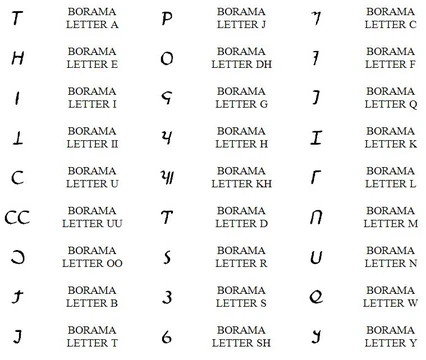
Gadabuursi Somali Script
An alphabetic script for Somali devised around 1933 by Sheikh Abdurahman Sheikh Nuur.

I. M. Lewis · Public domain
The Gadabuursi script, also called the Borama script, is an alphabet created for writing the Somali language. It was developed around 1933 by Sheikh Abdurahman Sheikh Nuur, a member of the Gadabuursi clan, and was mainly used in and around his hometown of Borama. Although it is less famous than Osmanya, the most widely known invented Somali script, Borama has generated a significant collection of literature, especially qasidas.
Quick Facts
- Languages
- Somali language
Facts from the source article.
Lore & Background
Sheikh Abdurahman Sheikh Nuur, a Qur'anic teacher and son of Borama's qadi (judge), devised the Gadabuursi script in 1933. He created the orthography for transcribing the Somali language, which belongs to the Afro-Asiatic Cushitic family. The script was a quite accurate phonetic writing system. It was principally used by Sheikh Nuur, his circle of associates in the city of Borama, and some merchants controlling trade in Zeila and Borama. Students of Sheikh Nuur were also trained in the use of this alphabet.
Reader's Guide
The Gadabuursi script, though less widely known than Osmanya, holds significance as one of several indigenous scripts created for the Somali language. Its development around 1933 by Sheikh Abdurahman Sheikh Nuur reflects local initiative in orthographic innovation. The script produced a notable body of literature, primarily qasidas, indicating its use for poetic and religious expression. Its use was concentrated among Sheikh Nuur's associates and merchants in Borama and Zeila, and it was taught to his students. The script's phonetic accuracy suggests a careful design for representing Somali sounds. Its legacy is preserved in the body of qasidas and in references within studies of Somali writing systems, such as those by Mauro Tosco. The script demonstrates the broader historical effort to create a standardized writing system for Somali before the adoption of the Latin alphabet.
Did You Know?
- The Gadabuursi script is also known as the Borama script.
- The script was principally used in and around Borama and by merchants in Zeila and Borama.
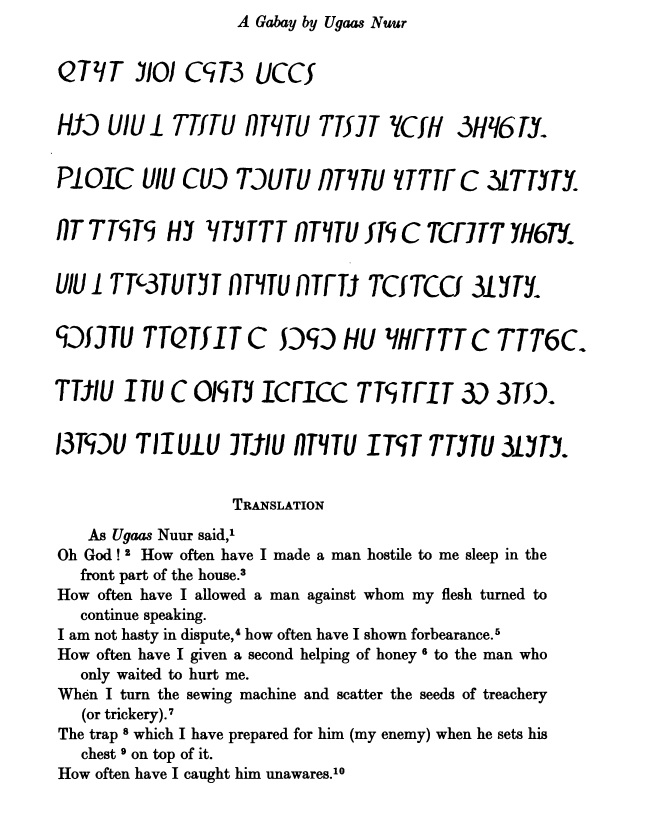
- It has produced a notable body of literature mainly consisting of qasidas.
Origins and the Man Behind the Script
The Gadabuursi script, more commonly referred to as the Borama script, traces its creation to the year 1933 and to a single individual: Sheikh Abdurahman Sheikh Nuur, a member of the Gadabuursi clan. His intellectual and social position in the town of Borama was considerable. He served as a Qur'anic teacher, a role that placed him at the center of religious and educational life in the community. His father held the position of qadi, the local judge, which meant Sheikh Nuur grew up in a household steeped in legal and scholarly authority. It was from this background that he undertook the project of devising a new orthographic system specifically designed to transcribe the Somali language, which belongs to the Afro-Asiatic Cushitic branch. The script was born not in a university or a colonial office but in the streets and mosques of a small town, reflecting the grassroots character of much of the Somali literary renaissance of the early twentieth century.
Structure and Linguistic Purpose
At its core, the Borama script is an alphabetic system, meaning it assigns distinct letter-forms to individual sounds rather than syllables or whole words. What distinguishes it from many other indigenous Somali writing attempts is its phonetic precision. The system was designed to be a quite accurate phonetic transcription of spoken Somali, capturing the sounds of the Afro-Asiatic Cushitic language with a degree of fidelity that allowed speakers to read and write their own tongue without the mediation of Arabic or Latin alphabets. This made it a practical tool for literacy among those who had no access to formal colonial education. The script was principally confined to the town of Borama and its immediate surroundings, where Sheikh Nuur and his immediate circle employed it in daily scholarly and commercial life. Its geographic concentration gave it a local identity that set it apart from more widely disseminated systems.
Literary Output and Community Practice
Although the Borama script never achieved the broad geographic spread of its more famous counterpart, it generated a genuine and notable body of written literature. The dominant literary form produced in this alphabet was the qasida, a traditional Arabic-influenced poetic genre that Somali poets had long adapted to their own language and themes. Sheikh Nuur himself was the primary practitioner, but the script extended beyond his personal use. His circle of associates in Borama adopted it for their own writing, and it found practical application among the merchants who controlled trade routes linking Zeila and Borama, two of the region's most important commercial centers. Furthermore, Sheikh Nuur took the deliberate step of training his students in the use of the alphabet, ensuring that a small but dedicated community of literate users could sustain the tradition. This combination of poetic production, commercial utility, and pedagogical transmission gave the script a functional life within its local community.
Place in the Broader Somali Writing Landscape
The Gadabuursi script occupies a distinctive but modest position within the wider family of indigenous Somali writing systems. It is not as widely known as Osmanya, which is generally regarded as the most popular script ever invented for the Somali language, nor does it share the same profile as Kaddare, another local orthographic innovation. Nevertheless, the Borama script has attracted sustained academic attention. Mauro Tosco of the University of Turin included it in his 2010 survey of Somali writings, placing it alongside Wadaad's writing, Osmanya, and Kaddare in a comprehensive overview. The Somali Language Committee has also produced reports referencing the script, and a 2001 article published in the journal World Development, connected to Amoud University, discussed Somali reconstruction efforts in which local writing traditions like the Gadabuursi script figure as important cultural assets. These references confirm that, despite its limited geographic reach, the script is recognized as a significant chapter in the story of Somali literacy.
Gallery
Frequently Asked Questions
Who created the Gadabuursi Somali Script?
Sheikh Abdurahman Sheikh Nuur, a member of the Gadabuursi clan, devised the script around 1933. It is also commonly referred to as the Borama script after his hometown.
What type of writing system is the Gadabuursi Somali Script?
It is an alphabetic script designed specifically for writing the Somali language, which belongs to the Afro-Asiatic Cushitic branch. It was developed as a local alternative to other Somali writing systems of the era.
How does the Borama script compare to Osmanya?
While Osmanya is the most widely recognized invented Somali script, the Borama script is less famous but still produced a meaningful body of written work. Its literary output, particularly in the form of qasidas, is considered a significant contribution to Somali written heritage.
Where was the Gadabuursi Somali Script primarily used?
The script saw its main use in and around Borama, the hometown of its creator, Sheikh Abdurahman Sheikh Nuur. It did not achieve the broader regional spread that some other Somali scripts did.
What kind of literature was written in the Gadabuursi Somali Script?
A notable collection of literature was produced in the script, with qasidas (poetic odes) being the most prominent genre. This body of work demonstrates that the script was used for serious literary and religious expression, not just casual notation.
More in Somali inventions 1-20
Spotted an error? Know more?
Reader corrections go straight into our review queue. Suggest an edit · How this site is sourced