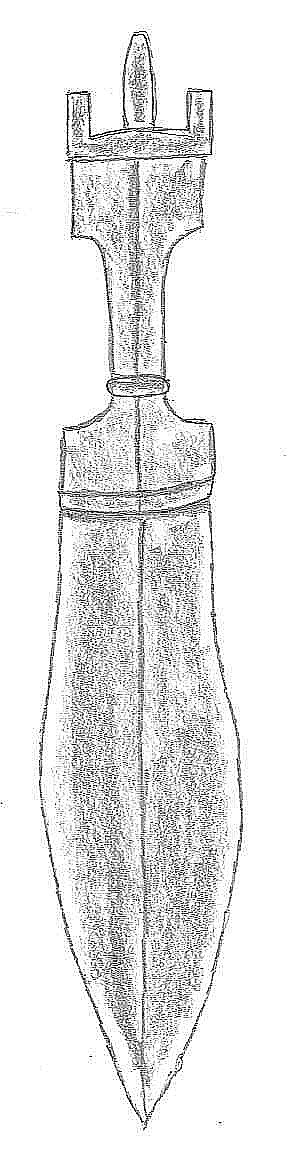
Billao
A horn-hilted Somali shortsword used by the Dervish State.

Pere prlpz · CC BY-SA 3.0
The billao (Somali: billaawe), sometimes called a bilaawe, is a Somali weapon with a horn hilt, classified as either a shortsword or a long dagger based on its blade length. It was notably used for close-quarters fighting in the Dervish State and in northern sultanates around the early 1900s. Considered an ancient weapon, its design appears in old rock carvings at the Bur Eibi archaeological site in southern Somalia. The blade is double-edged, leaf-shaped, and asymmetrical, made of iron or steel, measuring 10.5 inches (27 cm) long and 2.5 inches (6.4 cm) wide. The handle, typically buffalo horn (though other horn types are used), and the three-pronged pommel together have a circumference of 6.75 inches (17.1 cm). Some versions have a single-pronged pommel with the metal tang protruding from the hilt's center. The total length of the dagger is 17.25 inches (43.8 cm). The sheath is made of sheepskin, and the weapon is worn on a belt at the waist. A longer variant can be straight or curved like a sabre, sometimes called a sayf, but it keeps the same hilt shape.
Quick Facts
- Origin
- Horn of Africa
- Is Bladed
- Yes
- Used By
- Somali
- Wars
- Dervish resistance (1896–1920)
- Weight
- 9 oz
- Length
- 17 to
- Blade Type
- iron or steel; pointed, double-edged
- Hilt Type
- horn
- Sheath Type
- sheepskin
Facts from the source article.
Lore & Background
The billao is believed to be an ancient weapon, with early depictions possibly found in rock engravings at Bur Eibi in southern Somalia. These engravings are thought to show the unique design of the blade, particularly the hilt, for which no parallel is found elsewhere. Revoil suggested that these blades are depicted in the Deir-el-Bahri wall paintings on the belt of Punt chiefs.
The billao features a double-edged, leaf-shaped, asymmetrical blade and a three-pronged pommel, though one-pronged pommels with the metal tang protruding from the center of the hilt have also been reported. The grip and pommel together measure 6.75 inches (17.1 cm) in circumference. The blade is made of iron or steel, 10.5 inches (27 cm) long and 2.5 inches (6.4 cm) wide. The handle is typically made from buffalo horn, though other horn types are also used. The total length of the dagger is 17.25 inches (43.8 cm).
The sheath is made of sheepskin, and the sword is worn on a belt around the waist. A longer variant of the billao can be either a straight sword or have a curved blade similar to a sabre, and is sometimes referred to as sayf. Despite the difference in length, it retains the hilt shape.
Reader's Guide
The billao holds significance as a traditional Somali weapon, particularly associated with the Dervish State and northern sultanates at the turn of the 20th century. Its design is distinctive, with a horn hilt and a leaf-shaped, asymmetrical blade, and its antiquity is suggested by rock engravings at Bur Eibi. The weapon's unique hilt, for which no parallel is found, and its possible depiction in ancient Egyptian wall paintings at Deir-el-Bahri, link it to the broader history of the Horn of Africa. The billao's legacy lies in its role as a close-quarters weapon in a period of Somali resistance and its continuity with older regional traditions. Variants such as the longer sayf show adaptation while preserving the characteristic hilt. The weapon remains a symbol of Somali martial culture, documented in archaeological and historical records.
Did You Know?
- The billao is also known as a bilaawe.
- Ancient rock engravings at Bur Eibi in southern Somalia are believed to depict the billao's unique hilt design.
Ancient Roots and Archaeological Echoes
The billao's lineage stretches back far beyond any single historical record. Rock engravings discovered at Bur Eibi, an archaeological site in southern Somalia, are widely regarded as some of the earliest visual evidence of this distinctive weapon. What makes those ancient carvings particularly remarkable is that they appear to capture the billao's signature hilt design—a form for which scholars have identified no parallel anywhere else in the world of edged weapons. The connection reaches even further afield: the researcher Revoil proposed that the blades shown on the belt of Punt chiefs in the famous wall paintings at Deir-el-Bahri in Egypt may in fact be depictions of the billao. If that identification holds, the weapon's visual identity would have been recognizable across the Red Sea and into the Mediterranean world in antiquity. Together, these scattered pieces of evidence paint a picture of a blade whose design was not merely practical but deeply rooted in Somali cultural memory, preserved in stone and pigment long before any written account could capture it.
Anatomy and Craftsmanship
The billao's physical form is as distinctive as its history. Its blade is double-edged and takes on a leaf-like silhouette, with an asymmetrical profile that sets it apart from more conventional straight daggers. The cutting edge is forged from iron or steel and measures roughly 27 centimetres in length and 6.4 centimetres at its widest point. The hilt is the weapon's most recognizable feature: a grip wrapped in horn—most commonly buffalo horn, though other horn types have been used—crowning into a three-pronged pommel. In some reported examples the pommel is reduced to a single prong, with the metal tang of the blade protruding visibly from the centre of the hilt. The combined circumference of grip and pommel sits at about 17.1 centimetres, giving the weapon a substantial, secure hold. The full length of the assembled dagger, blade to pommel, reaches approximately 43.8 centimetres. For protection and display, the billao is housed in a sheath of sheepskin and carried on a belt at the waist, keeping it immediately accessible in the heat of close combat.
The Billao in Somali Military History
At the close of the nineteenth century and into the early twentieth, the billao found its most prominent military role in the hands of Somali fighters resisting colonial encroachment. It served as a close-quarters weapon of choice within the Dervish State, the theocratic resistance movement that mounted one of the most determined campaigns against foreign occupation in the Horn of Africa during that era. The same period saw the blade in active use among the warriors of the northern Somali sultanates, who fielded it alongside other traditional arms in their own conflicts. In these contexts the billao was not a ceremonial object or a status symbol alone; it was a practical fighting tool, drawn when engagements closed to grappling range and longer swords or spears became unwieldy. Its compact overall length of just over forty-three centimetres made it ideal for the tight, fast exchanges that characterised Dervish and sultanate skirmishes. The fact that a single blade design could serve both a large organised resistance force and smaller sultanate armies speaks to its versatility and to the deep familiarity Somali warriors had with its handling.
Variants and Place in the Somali Armory
The billao is not a single fixed object but a family of blades united by their hilt. The standard form is a shortsword or long dagger, but a longer variant exists in which the blade extends well beyond the typical 27-centimetre length. This extended version may be forged with a straight profile or given a gentle curve reminiscent of a sabre, and in Somali it is sometimes called a sayf. Despite the added reach, the defining three-pronged or single-pronged pommel and horn grip remain unchanged, preserving the weapon's unmistakable silhouette regardless of blade length. The billao also occupies a specific niche within the broader Somali and Afar tradition of edged weapons. It is frequently discussed alongside the qolxad, another traditional dagger of the region, and both appear in wider catalogues of historical swords. Together they illustrate a culture in which blade design was not merely functional but carried identity, lineage, and regional pride in every curve of the hilt and every prong of the pommel.
Gallery

Frequently Asked Questions
What is a Billao?
The Billao (also spelled Billaawe) is a traditional Somali blade weapon that sits somewhere between a shortsword and a long dagger. It is instantly recognizable by its horn-wrapped grip and a double-edged, leaf-shaped cutting edge.
What are the physical dimensions and materials of a Billao?
The blade runs about 10.5 inches long and 2.5 inches wide, forged from iron or steel with an asymmetrical, leaf-shaped profile. Total length reaches roughly 17.25 inches, and the hilt is typically carved from buffalo horn.
Who historically wielded the Billao in combat?
It saw prominent use in close-quarters fighting during the Dervish State era and across northern Somali sultanates in the early 1900s. Its compact size made it particularly suited to tight, melee engagements.
How old is the Billao design?
The weapon is regarded as ancient, with depictions of its form appearing in rock carvings at the Bur Eibi archaeological site in southern Somalia. This suggests the design predates written records by a considerable margin.
What makes the Billao distinct from other Somali blades?
Its asymmetrical, double-edged leaf-shaped blade paired with a buffalo-horn hilt sets it apart from more symmetrical sword types. It occupies a unique niche as a hybrid between a dagger and a shortsword rather than fitting neatly into either category.
More in Somali inventions 1-20
Spotted an error? Know more?
Reader corrections go straight into our review queue. Suggest an edit · How this site is sourced