Fracture blister
Blister on swollen skin directly overlying a fracture.
A fracture blister is a blister that forms on skin overlying a fractured bone. Fractures complicated by the development of overlying blisters present a clinical dilemma in orthopedics.
Quick Facts
- Specialty
- dermatology
Facts from the source article.
Description
Fracture blisters are fluid-filled sacs that form on severely swollen skin directly above a broken bone. They are an uncommon complication, seen in only 2.9% of fracture patients who need hospital care. These blisters usually appear in areas where the skin is thin and tightly bound to the bone, such as the elbows, knees, ankles, and wrists. They can make treatment more difficult by getting in the way of splints, casts, or surgical cuts needed to fix the bone. Blisters may develop as early as 6 to 8 hours after the injury, with most showing up within the first day or two.
In the area around the fracture, pressure inside the limb’s compartments increases, but blisters tend not to form where this pressure is highest. It is thought that the blister itself helps release some of that pressure. The skin in the blistered region has fewer tight junctions between cells, and the paracellular pathway becomes active, allowing fluid to leak into the blister. The main cause is believed to be shearing forces from the injury. When a bone breaks and changes shape, the skin attached to it stretches. The amount of stretch can be predicted using a formula based on the angle of the bone’s deformation and the original and final lengths of the skin. This shearing happens because the dermis and epidermis have different levels of elasticity.
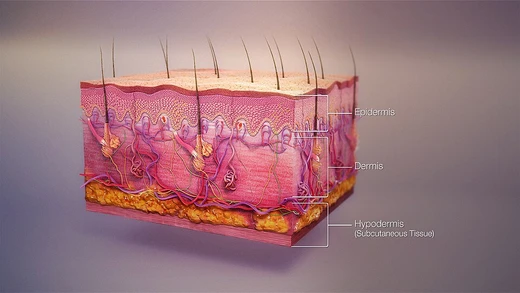
There are two types of fracture blisters: clear and hemorrhagic. The difference comes from how deep the shear occurs. Clear blisters form when layers within the epidermis separate, while hemorrhagic blisters form when the separation happens at the junction between the dermis and epidermis. A skin strain of 152% is enough to cause a hemorrhagic blister. Hemorrhagic blisters are more serious because they involve a complete loss of epidermal cells. Healing time depends on the type: clear blisters usually heal in about 12 days, while hemorrhagic ones take roughly 16 days. Factors that increase the risk of developing a blister include thin, tightly attached skin at the injury site, peripheral vascular disease, collagen vascular disease, high blood pressure, smoking, alcoholism, diabetes, lymphatic blockage, high-energy injuries, and grade I or II open tibia fractures.
More in Skin Conditions Resulting from Physical Factors
Spotted an error? Know more?
Reader corrections go straight into our review queue. Suggest an edit · How this site is sourced