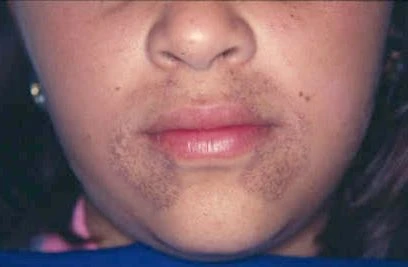
Erythropoietic protoporphyria
A painful photosensitivity disorder from defective heme synthesis.
Last updated
Erythropoietic protoporphyria (EPP) is a form of porphyria caused by a deficiency of the enzyme ferrochelatase, leading to elevated protoporphyrin levels in red blood cells, plasma, skin, and liver. The condition varies widely in severity and can be extremely painful. A clinically similar form, X-Linked dominant protoporphyria, was identified in 2008.
Quick Facts
- Risks
- pain and irritation
Facts from the source article.
Presentation
EPP typically first appears in childhood, with acute photosensitivity of sun-exposed skin as the most common presentation. Even a few minutes of sun exposure can trigger itching, redness, swelling, and pain; longer exposure may cause second-degree burns. Repeated episodes can lead to lichenification, changes in pigmentation, and scarring. The face, upper surfaces of the arms, hands, feet, and exposed legs are most often affected.
In less severe cases, symptoms may first emerge at puberty when hormone levels rise. More severe disease can manifest in infancy. Sun exposure through glass or even arc welding with a full protective mask can provoke symptoms. Prolonged sun exposure may cause edema of the hands, face, and feet, rarely with blistering or petechiae, and skin thickening can develop over time.
Patients with EPP have an increased risk of gallstones and may experience vitamin D deficiency. In 5–20% of patients, protoporphyrin accumulates to toxic levels in the liver, leading to a spectrum of hepatobiliary disease including cholelithiasis, mild parenchymal disease, progressive hepatocellular disease, and end-stage liver disease. There are no diagnostic markers to predict liver failure, and its mechanism is poorly understood. Some female patients report lessened photosensitivity during pregnancy and menstruation, though this is inconsistent and not understood.
Pathophysiology
Heme synthesis occurs mainly in erythroblasts and reticulocytes in the bone marrow (80%) and in hepatocytes (20%). Deficiency of ferrochelatase leads to increased protoporphyrin release, which binds to albumin in plasma and is taken up by the liver. Normally, most protoporphyrin is secreted into bile, with some converted to heme; the remainder is excreted in feces. Because protoporphyrin is insoluble, it cannot be excreted by the kidneys.
In EPP, reduced conversion to heme causes protoporphyrin to accumulate in hepatocytes. Elevated protoporphyrin in skin predisposes to acute photosensitivity: absorption of ultraviolet and visible light (peak at 400 nm, with lesser peaks between 500 and 625 nm) by protoporphyrin in dermal blood vessels generates free radicals, destabilizes erythrocytes, and causes skin injury. Increased hepatobiliary excretion of protoporphyrin damages the liver through cholestatic effects and oxidative stress, leading to hepatobiliary disease of varying severity.
Diagnosis
EPP is suspected based on acute skin photosensitivity and confirmed by detecting a plasma fluorescence peak at 634 nm. Elevated protoporphyrin levels in feces and excess free protoporphyrin in erythrocytes are also useful findings. Screening for a ferrochelatase mutation on one allele or an aminolevulinic acid synthase 2 gain-of-function mutation in selected family members may aid genetic counseling. Liver biopsy can confirm hepatic disease by showing protoporphyrin deposits as brown pigment in biliary canaliculi and portal macrophages; the cirrhotic liver may appear black.
Under polarized light, the deposits show a characteristic Maltese cross shape. Liver tissue examined under a Wood's lamp fluoresces red due to protoporphyrin. Liver biopsy is not helpful for estimating prognosis of liver disease.
Treatment
There is no cure for EPP, but symptoms can often be managed by limiting exposure to daytime sun and certain artificial lights. Fluorescent lighting is the worst offender; incandescent and LED bulbs in the soft white range (2700–3000 K) produce the least problematic light, and lower wattage bulbs reduce overall light output. Most sunscreens are ineffective because the photosensitivity involves visible light, though non-nano zinc oxide provides uniform protection from 290 to 400 nm and some protection up to 700 nm.
Sun protective clothing can help, though UPF ratings only cover UV protection; some manufacturers use zinc oxide in fabrics to block visible light. Window films that block UV and visible light up to 450 nm can relieve symptoms when applied to car and home windows. Blue-blocking screen protectors can help with symptoms from televisions, phones, tablets, and computer screens. Afamelanotide was approved in Europe in December 2014 and in the United States in October 2019 for treatment or prevention of phototoxicity in adults with EPP.
Several drugs are used off-label: ursodeoxycholic acid promotes biliary secretion of protoporphyrin but its results are controversial; hematin (3–4 mg/kg intravenously) may reduce excess protoporphyrin production after liver transplantation; plasmapheresis can lower plasma protoporphyrin levels but its use in acute episodes is controversial.
Did You Know?
- Most cases of EPP result from inborn errors of metabolism, but the defect may be acquired in some patients.
- The gene encoding ferrochelatase is located on the long arm of chromosome 18.
- Symptoms do not occur unless ferrochelatase activity is less than 30% of normal.
More in Skin Conditions Resulting from Errors in Metabolism
Sources
Compiled from Wikipedia and the sources listed below. Text from Wikipedia is available under CC BY-SA 4.0; this entry is adapted from it.
- Wikipedia: Erythropoietic protoporphyria (CC BY-SA 4.0).
- Word definitions: the , each quoted from its Wikipedia article.
Spotted an error? Know more?
Reader corrections go straight into our review queue. Suggest an edit · How this site is sourced