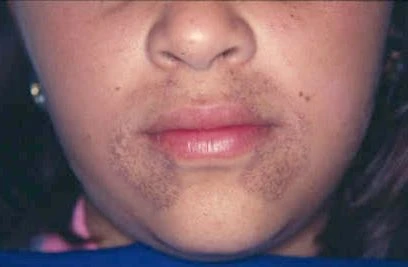
Congenital erythropoietic porphyria
A rare porphyria causing severe photosensitivity and erythrodontia.
Last updated
Congenital erythropoietic porphyria, also known as Günther disease, is a rare autosomal recessive metabolic disorder of heme synthesis. It results from deficiency of the enzyme uroporphyrinogen cosynthetase, leading to accumulation of porphyrins in the body. The condition is notable for causing severe cutaneous photosensitivity and reddish discoloration of tissues.
Quick Facts
- Prevalence
- 1 in 1,000,000 or less
- Inheritance
- Autosomal recessive
- Gene
- UROS
- Chromosome location
- 10q25.2-q26.3
- Enzyme deficient
- Uroporphyrinogen III synthase (uroporphyrinogen cosynthetase)
- Common mutation
- C73R (30–40% of cases)
Facts from the source article.
Signs and symptoms
Severe cutaneous sensitivity is present in most cases, with expressivity varying by mutation. Exposure to long-wave ultraviolet light causes skin thickening and vesicles prone to rupture and infection, which along with bone resorption can disfigure sun-exposed areas. Hemolytic anemia is common, though hemolysis may be absent. Porphyrins accumulate in bone and teeth, producing erythrodontia.
Attacks may include abdominal pain, vomiting, and constipation. Photomutilation and transfusion-dependent anemia are frequent complications; liver disease occurs in some cases. Early childhood-onset hematologic manifestations indicate a poor prognosis.
Causes
Günther disease is caused by mutations in the UROS gene on chromosome 10q25.2-q26.3, inherited in an autosomal recessive pattern. Two copies of the defective gene are required for the disorder. Homozygous mutation leads to deficient uroporphyrinogen III synthase activity. Normally this enzyme produces isomer III porphyrinogen for heme synthesis; when deficient, isomer I porphyrinogen forms, which oxidizes and imparts a reddish tint to the skin.
Diagnosis
Diagnosis requires excluding other porphyrias such as hepatoerythropoietic porphyria, rare homozygous variants of variegate porphyria, hereditary coproporphyria, and SAVI. Mild variants may resemble porphyria cutanea tarda. Evaluation includes history and physical exam focusing on sun-exposed skin, plus biochemical measurement of porphyrins and precursors in urine, feces, and blood. Specialized labs measure enzyme activity or perform DNA analysis; in CEP, uroporphyrinogen III synthase activity is markedly decreased.
Urine aminolavulanic acid and porphobilinogen are typically normal, while uroporphyrin and coproporphyrin are elevated in urine. Fecal protoporphyrin is mildly elevated. Red blood cells show elevated uroporphyrin, coproporphyrin, and protoporphyrin. Plasma analysis reveals elevated uroporphyrin and coproporphyrin.
Clues include photosensitivity, blistering, scarring, erythrodontia, hemolytic anemia, and red or violet staining of diapers.
Treatment
Limiting or eliminating sun exposure is crucial. Sunscreens containing zinc oxide and titanium dioxide provide protection as physical barriers against ultraviolet and visible light. Protective clothing and plastic films on windows and car windows help filter harmful wavelengths. Incandescent bulbs are recommended over fluorescent lamps to avoid porphyrin-exciting light.
Oral beta-carotene, activated charcoal, and cholestyramine have been used but require very large doses and are not beneficial. Erythrocyte transfusions can reduce disease manifestations by lowering erythropoiesis and circulating porphyrin levels, but chronic transfusions carry severe complications.
Topical lubrication addresses dry eye symptoms. Bone marrow transplantation has been reported successful in studies, though long-term effects are not yet documented; it is not relevant for patients with life-threatening infectious complications. Stem cell transplantation has shown success in a limited number of participants.
More in Skin Conditions Resulting from Errors in Metabolism
Sources
Compiled from Wikipedia and the sources listed below. Text from Wikipedia is available under CC BY-SA 4.0; this entry is adapted from it.
- Wikipedia: Gunther disease (CC BY-SA 4.0).
- Word definitions: the , each quoted from its Wikipedia article.
Spotted an error? Know more?
Reader corrections go straight into our review queue. Suggest an edit · How this site is sourced