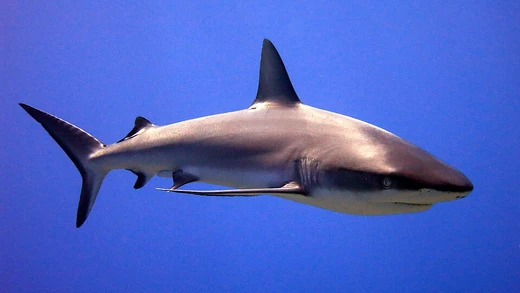
Zebra shark
A nocturnal carpet shark with striped juveniles and spotted adults.

The zebra shark, or *Stegostoma tigrinum*, is the only living member of its family, Stegostomatidae. This carpet shark lives across the tropical Indo-Pacific, often on coral reefs and sandy flats down to 62 meters deep. Adults are easily recognized by five ridges running along their cylindrical body, a tail fin that makes up nearly half their total length, and a pattern of dark spots on a pale background. Juveniles under 50–90 cm look completely different, with light vertical stripes on a brown body and no ridges. The species grows to about 2.5 meters.
Active at night, zebra sharks hunt molluscs, crustaceans, small bony fish, and possibly sea snakes by poking into reef holes and crevices. During the day, they rest motionless on the seafloor. While usually solitary, they gather in large seasonal groups. Females lay several dozen egg capsules, each with adhesive tendrils that anchor them to underwater structures. Harmless to people and hardy in captivity, these sharks are popular on ecotourism dives and in public aquariums. However, the IUCN lists them as Endangered worldwide because commercial fisheries across most of their range (except off Australia) take them for meat, fins, and liver oil, and evidence shows their numbers are declining.
The name "zebra shark" comes from the juvenile’s striped pattern, while adults are sometimes called leopard sharks—though that name more often refers to the houndshark *Triakis semifasciata* or the tiger shark. The genus name *Stegostoma* combines Greek words for "covered" and "mouth." The species was first described as *Squalus varius* in 1757, but no type specimen was kept. Over time, it has been placed in different genera and given various names, including *S. fasciatum* and *S. tigrinum*. Modern taxonomy accepts *Stegostoma tigrinum* as the valid name, based on a 1781 description by Forster, with *S. fasciatum* as a junior synonym.
Morphological evidence strongly links the zebra shark to the whale shark and nurse sharks in a single clade, though their exact relationships are debated. Some researchers suggest the whale shark is its closest relative; others place it closer to certain nurse sharks or as a sister group to a clade containing both.
The zebra shark has a cylindrical body, a large flattened head, and a short blunt snout. Its small eyes sit on the sides of the head, with spiracles behind them that are as large or larger. The last three of five short gill slits lie over the pectoral fin bases, and the fourth and fifth slits are much closer together. Each nostril has a short barbel and a groove leading to the mouth. The mouth is nearly straight, with three lobes on the lower lip and furrows at the corners. Upper jaws hold 28–33 tooth rows, lower jaws 22–32; each tooth has a large central cusp flanked by two smaller ones. Adults have five ridges along the body: one along the back and two on each side. The back ridge merges into the first dorsal fin, which sits about halfway along the body and is twice the size of the second dorsal fin. The pectoral fins are large and broad; the pelvic and anal fins are much smaller but still larger than the second dorsal. The caudal fin is nearly as long as the rest of the body, with a barely developed lower lobe and a strong notch near the tip of the upper lobe.
- Scientific name
- Stegostoma tigrinum
- Family
- Stegostomatidae
- Maximum length
- 2.5 m (8.2 ft)
- Depth range
- Intertidal to 62 m (200 ft)
- Conservation status
- Endangered (World Conservation Union)
- Distribution
- Tropical Indo-Pacific
- Distinctive feature
- Juveniles striped, adults spotted with five ridges
Lore & Background
The genus name derives from Greek *stego* meaning 'covered' and *stoma* meaning 'mouth', and the specific epithet *fasciatum* means 'banded', referring to the striped pattern of juveniles. This juvenile coloration is also the origin of the common name "zebra shark". The name "leopard shark" is sometimes applied to the spotted adult, but that name usually refers to a different houndshark species and is also occasionally used for the tiger shark. Early taxonomists mistakenly described juveniles and subadults as separate species due to their differing color patterns and body proportions. The species was first described as *Squalus varius* by Seba in 1757, though no type specimen was designated. Müller and Henle placed it in the genus *Stegostoma* in 1837. A 2019 taxonomic review argued that *Stegostoma tigrinum* is the valid name, as *Squalus tigrinus* was described by Forster in 1781, predating *S. fasciatus*; this older name has been used in tens of publications since 1899 and is not a forgotten name. The zebra shark is the only living member of the family Stegostomatidae. It is found throughout the tropical Indo-Pacific, frequenting coral reefs and sandy flats. Adults have five longitudinal ridges on a cylindrical body, a low caudal fin making up nearly half the total length, and a pattern of dark spots on a pale background. Juveniles under a certain length have light vertical stripes on a brown background and lack the ridges. The species attains a maximum length. It is nocturnal, resting on the sea floor by day and hunting molluscs, crustaceans, small bony fishes, and possibly sea snakes at night. Though usually solitary, it forms large seasonal aggregations. Females produce several dozen large egg capsules anchored to underwater structures. The World Conservation Union has assessed it as Endangered worldwide due to commercial fishing for meat, fins, and liver oil.
Reader's Guide
The zebra shark is significant as the only extant member of its family and a key species in coral reef ecosystems. It is nocturnal, resting motionless on the sea floor by day and hunting molluscs, crustaceans, small bony fishes, and possibly sea snakes at night. Though solitary most of the year, it forms large seasonal aggregations. The species is oviparous, with females producing several dozen large egg capsules anchored to underwater structures. Its hardiness in captivity makes it a staple of public aquaria and ecotourism dives. However, the World Conservation Union has assessed it as Endangered worldwide due to commercial fishing for meat, fins, and liver oil across most of its range, except off Australia. Evidence indicates its numbers are dwindling. The species also shows a rare sandy morph in Kenya and a partially albino individual has been recorded, highlighting its biological variability.
Did You Know?
- Juvenile zebra sharks have light vertical stripes on a brown background, while adults have dark spots on a pale background.
- The zebra shark is the only extant member of the family Stegostomatidae.
- The species is oviparous, with females anchoring egg capsules to underwater structures via adhesive tendrils.
Common Misconceptions (Editorial)
1. The zebra shark is not the same as the leopard shark (Triakis semifasciata) found along the Pacific coast of North America; the common name "leopard shark" is sometimes applied to adult zebra sharks but can cause confusion with other species, and the zebra shark’s scientific name is Stegostoma tigrinum. 2. Despite the names "zebra shark" and "leopard shark," juveniles have light vertical stripes on a brown background (like a zebra), while adults have dark spots on a pale background (like a leopard), meaning both names refer to different life stages of the same species, not two separate animals.
Why It Matters (Editorial)
The zebra shark endures as a species of fascination because its remarkable color shift from stripes to spots mirrors a transformation that captivates divers and aquarium visitors alike. As a placid, slow-swimming creature that poses no threat to humans, it serves as a flagship for ecotourism and marine conservation, yet its Endangered status reminds us that even such resilient-looking animals need protection from overfishing and habitat loss.
Frequently Asked Questions
Who is Zebra shark?
The zebra shark is a carpet shark native to tropical Indo-Pacific waters and the only surviving species in the family Stegostomatidae. It is also commonly referred to as the Indo-Pacific leopard shark.
Why does Zebra shark's appearance change between juvenile and adult?
Young individuals show light vertical stripes on a brown body, but once they reach maturity the pattern flips to dark spots scattered across a pale background. Adults also develop five raised ridges along their back and a long caudal fin that makes up nearly half their total body length.
Where does Zebra shark live in the wild?
This species ranges across tropical Indo-Pacific coral reefs and sandy flats, from the intertidal zone down to roughly 62 metres. It is a shallow-water cruiser rather than a deep-sea or open-ocean shark.
Is Zebra shark dangerous to humans?
No, the zebra shark is entirely innocuous to people and poses no meaningful threat. Its docile temperament is one reason it has become a popular resident of public aquariums.
What is Zebra shark's conservation status?
The World Conservation Union classifies the species as Endangered. Its dependence on healthy tropical reef and sandy-flat habitats makes it especially vulnerable to coastal degradation and overfishing pressure.
More in Sharks 1-22
Spotted an error? Know more?
This is a living reference — every entry is fact-audited, and reader corrections feed straight into our audit queue. Suggest an edit · See this site's audit record