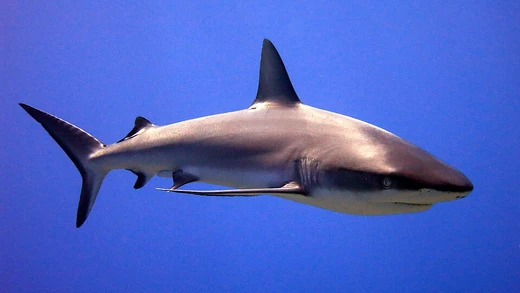
Tiger shark
A large, solitary predator with the broadest diet of any shark.

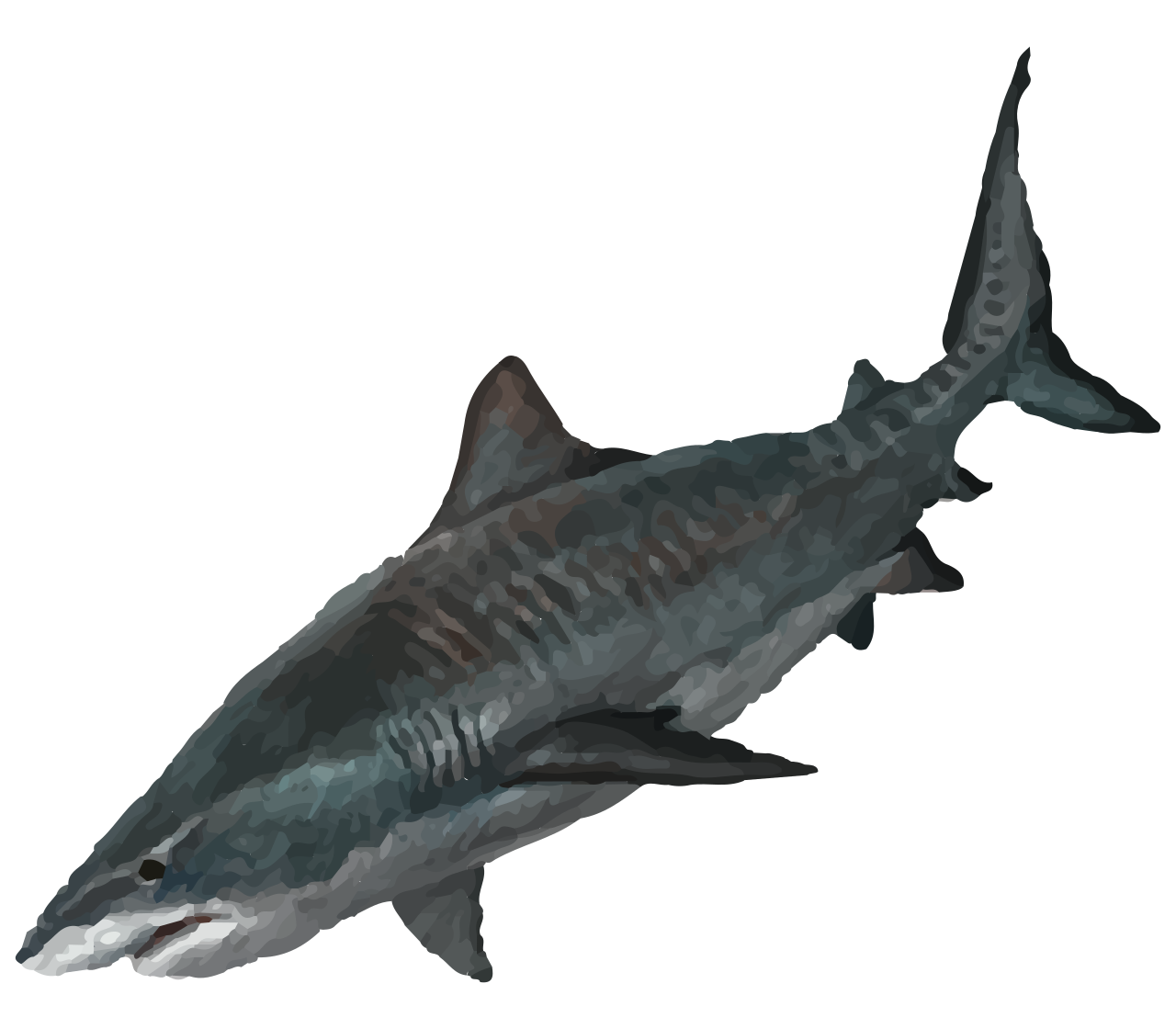
Vectorization by Megan Maurer, CutterAgent; original artist unknown · Public domain
The tiger shark (Galeocerdo cuvier) is a large ground shark and the only living species in its genus and family. Females can grow over 5 meters long. Its name comes from the dark stripes along its body, which look like a tiger's pattern and disappear as the shark gets older. It hunts alone, mostly at night, and has the broadest diet of any shark—eating crustaceans, fish, seals, birds, squid, octopuses, sea turtles, sea snakes, dolphins, and smaller sharks. It is also known for eating trash, swallowing many man-made objects that stay in its stomach. Its only known natural predator is the orca. Humans threaten it through finning and fishing, making it near-threatened. Although it ranks second only to the great white in recorded fatal attacks on people, such incidents are very rare.
The species was first described in 1822 as *Squalus cuvier*, then renamed *Galeocerdo tigrinus* in 1837. The genus name comes from Greek words for shark and fox, and the species name honors naturalist Georges Cuvier. It is often called the man-eater shark. It belongs to the order Carcharhiniformes, the largest shark order with over 270 species, including catsharks and hammerheads. Members have a nictitating membrane over the eyes, two dorsal fins, an anal fin, and five gill slits. The tiger shark is the largest member of this order, commonly called ground sharks. It is the only living member of its genus and family. The oldest *Galeocerdo* fossils date to the Eocene, while the modern tiger shark's oldest fossils are from the Middle Miocene, about 13.8 million years ago.
Adults typically reach 3.5 to 4.7 meters long and weigh 300 to 900 kilograms. The all-tackle record is 810 kilograms. Females are larger than males. Mature females often exceed 3.7 meters, while males rarely do. Exceptionally large females can surpass 5 meters, and the largest males reach 4 meters. Big females may weigh over 1,300 kilograms. One pregnant female caught off Australia measured 5.5 meters and weighed 1,524 kilograms. Unconfirmed catches claim even larger sizes, including a reported 7.4-meter, 3,110-kilogram shark, but this needs verification. A 2019 study suggested Pliocene tiger sharks could have reached 8 meters. Juvenile growth rates vary by region, with some growing nearly twice as fast as others. Among living sharks, the tiger shark averages in size only behind the whale shark, basking shark, and great white, making it the second-largest predatory shark. Other species like megamouth, Pacific sleeper, Greenland, and bluntnose sixgill sharks overlap in size, but their typical mature size compared to the tiger shark is unclear. The great hammerhead, in the same order, has a similar average length but is lighter, with a maximum known weight of 580 kilograms for a 4.4-meter pregnant individual.
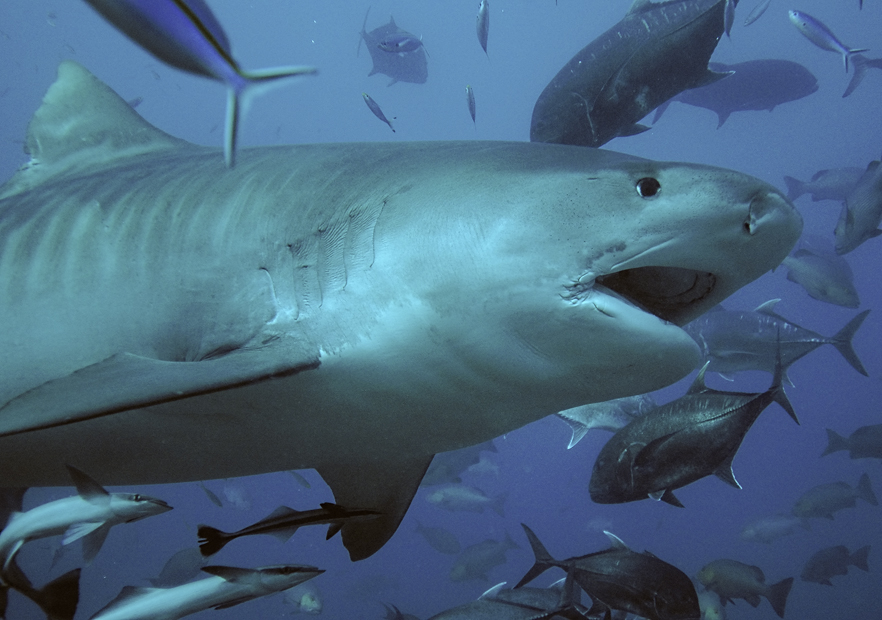
Tiger shark teeth are unique: very sharp, strongly serrated, and with a sideways-pointing tip. This shape helps slice through flesh, bone, and tough materials like turtle shells. Like most sharks, teeth are continually replaced throughout life. Compared to great white teeth, tiger shark teeth are shorter but nearly as wide at the root, and better suited for cutting hard-surfaced prey. The shark has long fins for lift and a long upper tail for bursts of speed, and it normally swims with small body movements.
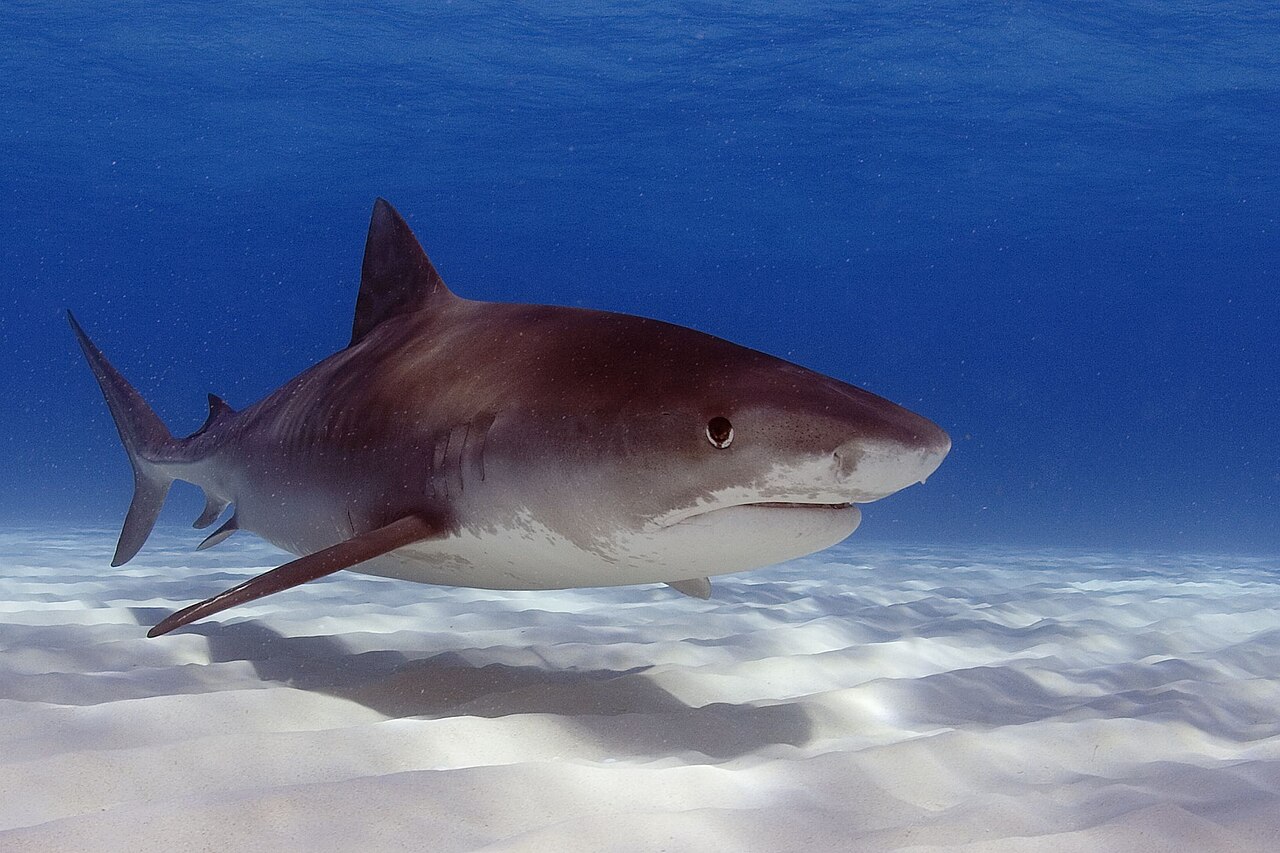
The skin ranges from blue to light green, with a white or light-yellow belly. This countershading camouflages it: darker above to blend with deeper water when seen from above, and lighter below to match the sunlit surface when seen from below. Dark spots and stripes are most visible in young sharks and fade with age. Its head is wedge-shaped, allowing quick turns. Small pits on the snout hold electroreceptors called ampullae of Lorenzini, which detect electric fields from prey.
- scientific_name
- Galeocerdo cuvier
- average_adult_length
- 3.5 to 4.7 m (11 ft 6 in – 15 ft 5 in)
- conservation_status
- Near-threatened
- known_for
- Widest food spectrum of all sharks; second only to great white in fatal attacks on humans
Lore & Background
The genus name Galeocerdo derives from Greek galeos (shark) and kerdo (fox), and the species name honors naturalist Georges Cuvier. It is a member of the order Carcharhiniformes, the most species-rich order of sharks, but it is not the largest member of that order—that title belongs to the great hammerhead shark (Sphyrna mokarran), which can reach lengths of up to 6 m (20 ft). The oldest remains of Galeocerdo extend back to the Eocene epoch, while the oldest fossils of the modern tiger shark date to the Middle Miocene, around 13.8 million years ago. The tiger shark is a solitary, mostly nocturnal hunter. It is an apex predator with a reputation for eating almost anything, including crustaceans, fish, seals, birds, squid, octopuses, sea turtles, sea snakes, dolphins, and smaller sharks. It also consumes inedible man-made objects, earning it the label 'garbage eater'. Its only recorded natural predator is the orca. Tiger sharks are considered near-threatened due to finning and fishing by humans.
Reader's Guide
The tiger shark is one of the largest extant sharks, ranking in average size behind only the whale shark, basking shark, and great white shark, making it the second-largest predatory shark. Its teeth are unique, with very sharp, pronounced serrations and a sideways-pointing tip, adapted to slice through flesh, bone, and turtle shells. The shark's skin exhibits countershading—blue to light green above and white or light-yellow below—which camouflages it from both above and below. A nictitating membrane protects its eyes, and a tapetum lucidum enhances low-light vision. Tiger sharks are found in tropical and temperate waters worldwide, especially around central Pacific islands. Its significance lies in its role as an apex predator with an exceptionally broad diet, its near-threatened status due to human exploitation, and its occasional but rare fatal interactions with humans.
Did You Know?
- The tiger shark is the only extant member of the genus Galeocerdo and family Galeocerdonidae.
- Its teeth have very sharp, pronounced serrations and a sideways-pointing tip, ideal for slicing through turtle shells.
- The oldest fossils of the modern tiger shark date to the Middle Miocene, around 13.8 million years ago.
Taxonomy & Evolutionary Legacy
The genus name itself is a fascinating blend of Greek roots: galeos meaning shark and kerdo meaning fox, while the species epithet pays tribute to the renowned naturalist Georges Cuvier. Today, this creature stands as the sole surviving representative of both the genus Galeocerdo and the family Galeocerdonidae, making it a true evolutionary one-of-a-kind. Fossil evidence pushes the lineage of Galeocerdo back to the Eocene epoch, though the earliest confirmed fossils of the modern species date to roughly 13.8 million years ago in the Middle Miocene.
Physical Design & Sensory Arsenal
The tiger shark's body is a masterclass in predatory engineering. Its skin displays classic countershading: a blue-to-light-green dorsal surface that blends into the dark water when viewed from above, paired with a pale white or yellow underbelly that vanishes against sunlight when seen from below. Young individuals sport bold dark stripes and spots that gradually fade with maturity, earning the species its evocative name. The head is distinctly wedge-shaped, granting rapid lateral turning, while small pits along the snout house ampullae of Lorenzini, electroreceptors that detect the faint electrical fields emitted by hidden prey. A lateral line running along the flanks picks up minute water vibrations, enabling effective hunting even in total darkness. The teeth are a signature feature: broad at the base, tipped with a pronounced sideways point, and edged with heavy serrations evolved to slice through flesh, bone, and even turtle shells. Long pectoral fins generate lift during maneuvers, and an elongated upper tail lobe delivers explosive bursts of speed. A clear nictitating membrane protects the eyes, compensating for the shark's lack of movable eyelids.
The Ultimate Generalist Hunter
Few predators on Earth match the tiger shark's dietary range. Operating as a solitary, predominantly nocturnal hunter, it preys on an astonishingly broad menu: crustaceans, fish, seals, seabirds, squid, octopuses, sea turtles, sea snakes, dolphins, and even smaller shark species. This makes it the most dietarily versatile of all shark species. Its reputation extends beyond biological prey; the tiger shark has earned the nickname garbage eater because its stomachs regularly contain man-made, inedible objects that have drifted through its range. Despite this fearsome versatility, the tiger shark has only one confirmed natural predator: the orca. The species is currently classified as near-threatened, primarily due to human activities such as finning and commercial fishing. Its wide distribution across tropical and temperate waters, with particularly strong populations around central Pacific islands, underscores how deeply embedded this apex predator is in ocean ecosystems worldwide.
Size Records & the Human Story
The tiger shark is the second-largest predatory shark alive, trailing only the great white in average size, and it is sexually dimorphic with females consistently outgrowing males. Colloquially dubbed the man-eater shark, the tiger shark ranks second only to the great white in recorded fatal attacks on humans, though such events remain exceedingly rare. This combination of immense size, powerful jaws, and a reputation that far outstrips actual danger has cemented the tiger shark as one of the ocean's most iconic and misunderstood predators.
Common Misconceptions (Editorial)
Some people believe the tiger shark is the largest shark in the order Carcharhiniformes, but the great hammerhead can reach lengths of up to 6 m (20 ft), surpassing the tiger shark’s maximum of over 5 m. Another common misconception is that tiger sharks are primarily dangerous to humans; while they are second only to the great white in recorded fatal attacks, such events are exceedingly rare.
Why It Matters (Editorial)
The tiger shark’s legendary appetite, eating everything from sea turtles to man-made garbage, makes it a vivid symbol of the ocean’s raw opportunism. Its near-threatened status reminds us that even apex predators are vulnerable to human activities like finning, underscoring the need to protect the balance of marine ecosystems.
Gallery



Frequently Asked Questions
What is the Tiger shark?
The Tiger shark (Galeocerdo cuvier) is a large ground shark and the sole surviving member of its genus and family. It is instantly recognizable by the dark vertical stripes along its flanks, a pattern that gradually fades as the animal matures.
What makes the Tiger shark's diet unique?
It holds the record for the broadest range of prey among all shark species, consuming everything from crustaceans to marine mammals. This extreme dietary flexibility sets it apart from every other shark in the ocean.
Is the Tiger shark dangerous to humans?
It ranks second only to the great white in confirmed fatal attacks on people, though such incidents remain extraordinarily rare. Its wide-ranging habitat and indiscriminate feeding habits are thought to contribute to these occasional encounters.
What is the Tiger shark's conservation status?
The species is currently classified as Near-threatened, reflecting declining populations in several regions. Overfishing and habitat pressure are the primary drivers behind its vulnerable position on the conservation scale.
More in Sharks 1-22
Spotted an error? Know more?
This is a living reference — every entry is fact-audited, and reader corrections feed straight into our audit queue. Suggest an edit · See this site's audit record