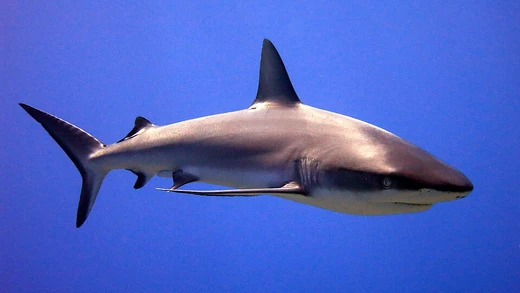
Goblin shark
A rare deep-sea shark with a distinctive long snout and protrusible jaws.

Wikimedia Commons · CC BY-SA 3.0
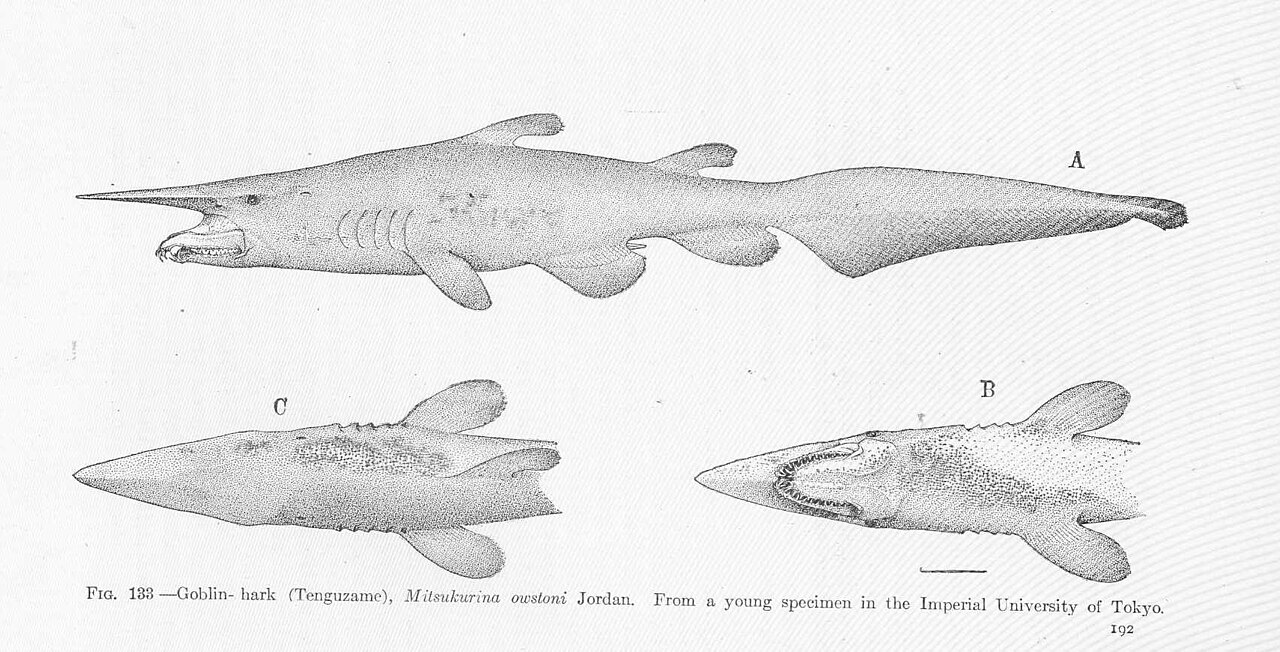
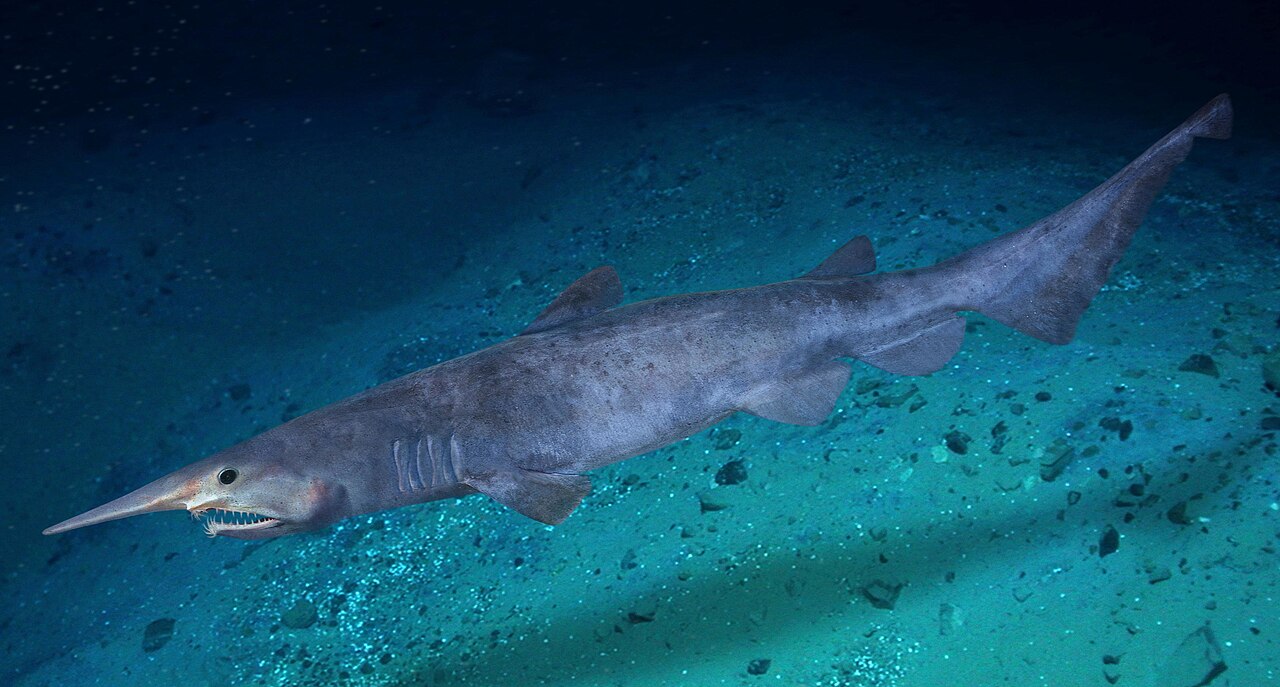
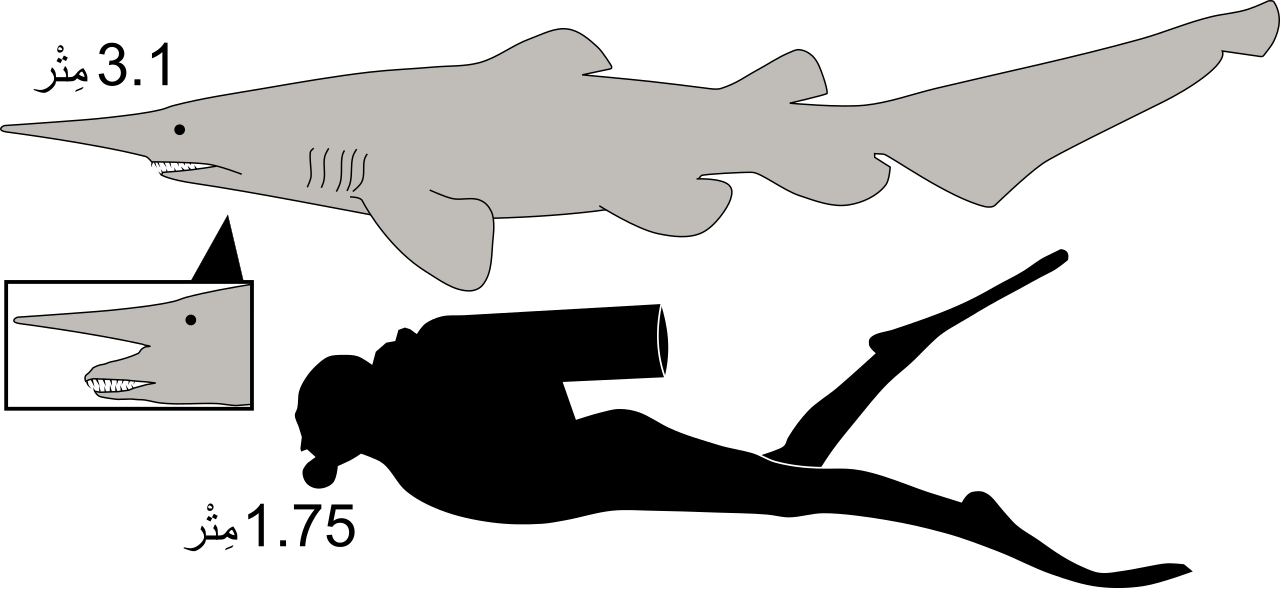
Often called a "living fossil," the goblin shark is a rare deep-sea species and the only surviving member of the family Mitsukurinidae, a lineage that dates back roughly 125 million years. Its most striking features are its pink skin, a long, flattened snout shaped like a blade, and jaws that can extend dramatically forward to snatch prey. The snout is covered with special sensory organs that detect the faint electrical fields of nearby animals. When hunting, the shark rapidly shoots its jaws out almost to the tip of the snout to capture teleosts, cephalopods, and crustaceans near the sea floor or in the water column. Its body is flabby, with small fins, suggesting a sluggish lifestyle. Adults typically reach 3 to 4 meters in length, though one specimen captured in 2000 was believed to be around 6 meters. These sharks live benthopelagically on upper continental slopes, submarine canyons, and seamounts worldwide, with adults found deeper than juveniles. Footage from 2024 confirmed an adult swimming at a depth that suggests their range extends deeper than previously thought. The goblin shark was first scientifically described in 1898 by American ichthyologist David Starr Jordan, based on a male caught in Sagami Bay, Japan. He named it *Mitsukurina owstoni* after Professor Kakichi Mitsukuri and naturalist Alan Owston. Its common name comes from the Japanese word *tenguzame*, referencing a mythical creature with a long nose and red face. Small numbers are unintentionally caught by deepwater fisheries, but the IUCN lists it as Least Concern due to its wide distribution and low capture rate.
- scientific_name
- Mitsukurina owstoni
- family
- Mitsukurinidae
- typical_length
- 3–4 meters (10–13 feet)
- maximum_recorded_weight
- 800 kg (1,800 lb) for a 4.7-meter female in 2023
- depth_range
- 100–2,000 meters (330–6,560 feet)
- conservation_status
- Least Concern (IUCN)
Lore & Background
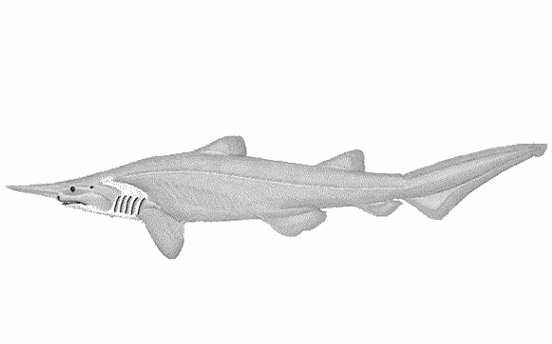
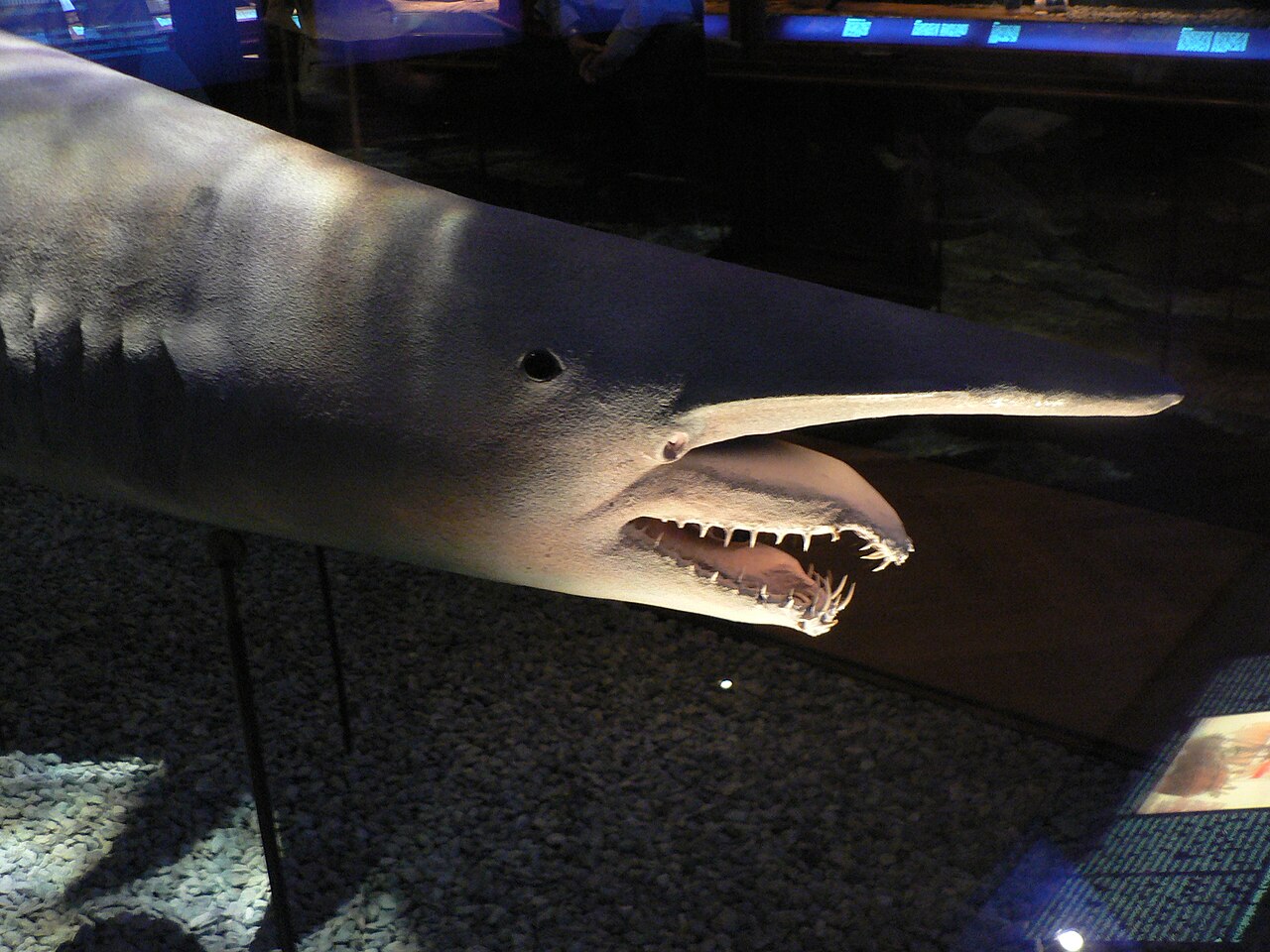
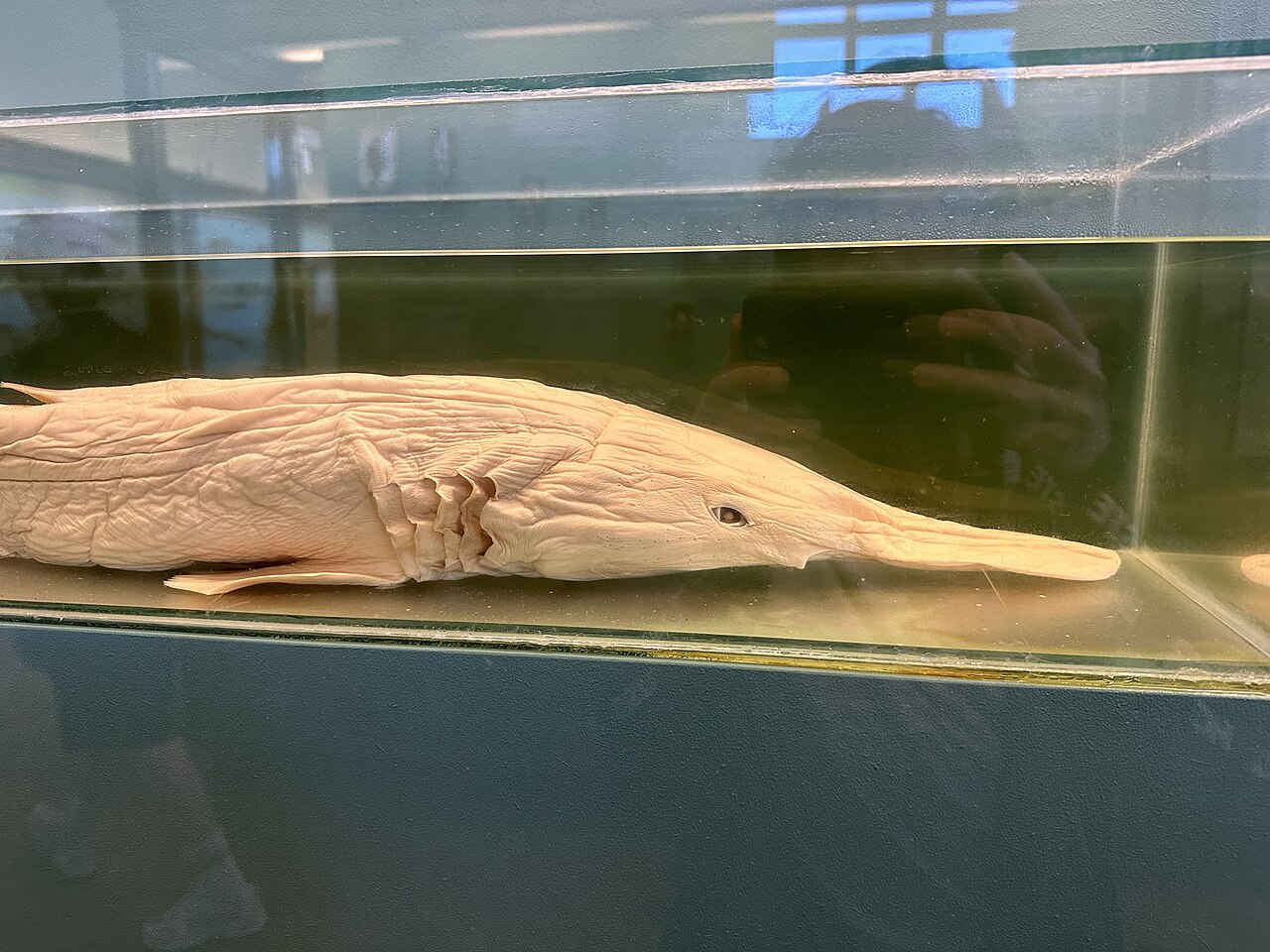
The goblin shark (Mitsukurina owstoni) is a rare, deep-dwelling shark often called a living fossil, as it is the only surviving member of a family that dates back roughly 125 million years. Its most striking feature is a long, flattened, blade-like snout, which becomes proportionally shorter as the animal ages. The skin is pinkish, soft, and semi-translucent, covered in rough, spine-like dermal denticles. The eyes are small and lack a protective nictitating membrane, with spiracles located behind them. The mouth is large and parabolic, and the jaws are highly protrusible, normally held against the underside of the head but able to extend nearly to the snout’s tip when seizing prey. The teeth are long, narrow, and nail-like, with fine lengthwise grooves; those near the jaw midpoint are especially elongated, while rear teeth are smaller and flattened for crushing. Tooth count ranges from 35 to 53 in the upper jaw and 31 to 62 in the lower, with individual variation in cusplets and gaps. The body is slender and flabby, with two small, rounded dorsal fins of similar size, small rounded pectoral fins, and larger pelvic and anal fins with long bases. The caudal fin is asymmetric, with a long upper lobe bearing a shallow notch near the tip and an indistinct lower lobe; the caudal peduncle lacks keels or notches. The five gill slits are short, with the fifth pair positioned above the pectoral fin origins. Adults typically reach 3 to 4 meters in length, though a 2000 specimen was estimated at about 6 meters. This benthopelagic species inhabits upper continental slopes, submarine canyons, and seamounts worldwide, with adults found deeper than juveniles; a 2024 sighting confirmed an adult at depths suggesting a greater range than previously known. Its long snout is covered with ampullae of Lorenzini, which detect electric fields from prey such as teleosts, cephalopods, and crustaceans. The shark is sluggish, using rapid jaw extension to snatch food near the sea floor or in midwater.
Reader's Guide
The goblin shark is significant as the last surviving member of an ancient lineage of sharks that dates back to the Cretaceous period, making it a 'living fossil.' Its anatomy—including a flabby body, small fins, and reduced skeleton—indicates a sluggish, slow-swimming lifestyle adapted to deep-sea environments. The species hunts teleosts, cephalopods, and crustaceans using its long snout covered with ampullae of Lorenzini to detect electric fields, then rapidly extends its jaws to capture prey. Despite its rarity, the IUCN lists it as Least Concern due to its wide global distribution and low incidence of capture. The goblin shark's unique morphology and evolutionary history continue to provide insights into deep-sea adaptation and shark phylogeny.
Did You Know?
- Its pink or tan coloration comes from visible blood vessels beneath the skin; the color fades to gray or brown after death.
A Peculiar Fish and the Men Behind Its Name
The specimen behind this announcement was an immature male just over a meter long, hauled from Sagami Bay off Yokohama, Japan. Its path to Jordan's desk traced a chain of naturalist generosity: shipmaster Alan Owston acquired the strange fish, passed it to Professor Kakichi Mitsukuri at the University of Tokyo, and Mitsukuri delivered it to Jordan for formal study. The binomial Mitsukurina owstoni honors both men. The English name "goblin shark" translates the Japanese tenguzame, evoking the tengu, a mythical figure drawn with a long nose and ruddy face. The species is also called the elfin shark. Early taxonomy was turbulent. Soon after Jordan's paper, several researchers argued the animal was merely a junior synonym of the extinct Mesozoic genus Scapanorhynchus. That view held until more complete fossils exposed enough anatomical divergence to restore Mitsukurina as distinct. Much of the confusion stemmed from a practical problem: preparers had pinned the protrusible jaws at varying angles, making identical heads look proportionally different.
A Lineage Stretching Back 125 Million Years
The goblin shark occupies a singular position in the tree of life. Both morphological and genetic phylogenetic studies place it as the most basal member of the order Lamniformes, the mackerel sharks. The genus itself first appears in the fossil record during the Middle Eocene, about 49 to 37 million years ago, with extinct members such as M. lineata and M. maslinensis. Striatolamia macrota, a Paleogene shark from warm shallow waters, may also belong to Mitsukurina. As the sole surviving representative of a family that has endured since the mid-Cretaceous, and one that retains several anatomical traits considered primitive among lamniforms, the goblin shark has earned the label "living fossil." Its continued existence makes it a remarkably direct window into a lineage that has persisted, with only gradual modification, through more than one hundred million years of Earth's history.
Built for the Deep: Anatomy and the Art of the Ambush
The goblin shark's body is a study in deliberate, low-energy design. Its slender, flabby frame and small, rounded fins suggest a sluggish cruising style rather than sustained speed. The most striking feature is the long, blade-like snout, whose proportional length actually shrinks as the shark ages. The mouth is large and parabolic, and the jaws are extraordinarily protrusible, capable of extending almost to the tip of the snout before snapping shut on prey. Tooth rows number between 35 and 53 above and 31 to 62 below; the main teeth are long, narrow, and finely grooved, while smaller flattened teeth at the jaw corners are built for crushing. Hunting relies on a sensory trick: the snout is studded with ampullae of Lorenzini, electroreceptors that detect the faint electric fields emitted by nearby teleosts, cephalopods, and crustaceans. The shark then lunges, extending its jaws in a flash to seize its meal. Skin is soft and semi-translucent, roughened by dermal denticles shaped like short upright spines. Living sharks glow pink or tan from visible blood vessels beneath the surface, a hue that deepens with age and fades quickly to dull gray after death.
Rarity, Depth, and a Surprising Conservation Verdict
Goblin sharks are benthopelagic animals found on upper continental slopes, in submarine canyons, and around seamounts across the world's oceans, typically at depths beyond 100 meters. Adults tend to occupy deeper water than juveniles. Despite its genuine rarity, the International Union for Conservation of Nature classifies the goblin shark as Least Concern. The reasoning is twofold: its distribution is geographically broad, and it is only incidentally caught in small numbers by deepwater fisheries rather than targeted by any commercial operation. The species therefore faces no immediate threat of population collapse, even though encounters remain uncommon and each sighting, whether a beach-cast specimen or a deep-sea camera frame, continues to remind researchers how little is still known about the creatures inhabiting the ocean's mid and lower depths.
Common Misconceptions (Editorial)
Some people believe the goblin shark is gray or brown in life, but its pink or tan coloration is due to visible blood vessels beneath the skin, and it only fades to gray or brown after death. Others mistakenly think the species is synonymous with the extinct shark *Scapanorhynchus*, but more complete fossils have since shown them to be distinct genera.
Why It Matters (Editorial)
The goblin shark endures as a symbol of the ocean’s hidden strangeness, a living link to ancient seas that reminds us how little we still know about deep-ocean life. Its grotesque, protrusible jaws and strange pink skin captivate public imagination, while its status as a “living fossil” underscores the value of preserving even seemingly obscure species for future discoveries.
Gallery
Frequently Asked Questions
How does a goblin shark hunt?
Rather than chasing prey, it extends its protrusible jaws outward in a rapid strike to engulf fish, squid, or crustaceans, then snaps them shut with rows of thin, nail-like teeth. This ambush-style feeding lets it capture food efficiently in the dim light of the deep ocean.
More in Sharks 1-22
Spotted an error? Know more?
This is a living reference — every entry is fact-audited, and reader corrections feed straight into our audit queue. Suggest an edit · See this site's audit record