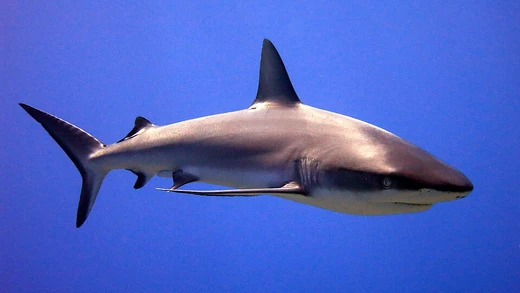
Oceanic whitetip
A slow-moving, opportunistic shark dangerous to shipwreck survivors.

The oceanic whitetip shark (Carcharhinus longimanus) is a large, stocky requiem shark that lives in the open ocean across tropical and warm temperate seas. Its most recognizable features are its long, rounded fins, each tipped in white. While generally a solitary hunter, it will congregate in large groups where food is abundant. The IUCN Red List classifies this species as critically endangered, as heavy fishing for its fins and meat has driven steep population declines.
This shark is also known by several common names, including the brown shark, shipwreck shark, whitetip shark, and lesser white shark. It was first scientifically described in 1831 by naturalist René-Primevère Lesson, who named it *Carcharhinus maou*. Zoologist Felipe Poey later described it in 1861 as *Squalus longimanus*, and the name *Pterolamiops longimanus* has also been used. Although the rules of taxonomic priority favor Lesson’s original name, *Carcharhinus maou*, the name *Carcharhinus longimanus* remains widely accepted because Lesson’s name was forgotten for so long. The species epithet *longimanus* comes from Latin, meaning “long hands,” a reference to the size of its pectoral fins. Fossil teeth of this species have been found from the Early Miocene of Odisha, India, as well as from the Pliocene of Italy and Spain.
The oceanic whitetip is found worldwide between 45°N and 43°S latitude. It inhabits deep, open oceans where the water temperature exceeds 18 °C (64 °F), preferring temperatures above 20 °C (68 °F) and up to 28 °C (82 °F). It can tolerate waters as cool as 15 °C (59 °F) but avoids anything colder. Once extremely common across a wide band of the globe, its numbers have drastically declined in recent years. The shark spends most of its time in the upper 150 meters (490 feet) of the ocean, favoring offshore, deep-water areas. Longline capture data show that populations increase with distance from land, though the shark is occasionally found close to shore in waters as shallow as 37 meters (120 feet), especially around oceanic islands and narrow continental shelves.
The most distinctive features of *C. longimanus* are its long, wing-like pectoral and dorsal fins, which are significantly larger than those of most other sharks and have conspicuously rounded tips. Its snout is rounded, and its eyes are circular with nictitating membranes. The body is countershaded—grey-bronze on top and white underneath. As the name suggests, most fins (dorsal, pectoral, pelvic, and caudal) have white tips, which may also be mottled; young sharks can have black marks. A saddle-shaped patch sometimes appears between the first and second dorsal fins. The shark has two tooth morphs: those in the lower jaw are thinner with serrated tips, while those in the upper jaw are triangular, much larger, wider, and fully serrated. The lower jaw holds 13 to 15 teeth on each half, and the upper jaw holds 14 or 15. The dermal denticles are nearly flat and wide, typically with five to seven ridges, and they overlap little, leaving some bare skin. This is a robust, large-bodied shark. The largest specimen ever caught measured over 4 meters (13 feet) in length, though most grow to about 3 meters (10 feet) and weigh 150 kilograms (330 pounds). The International Game Fish Association lists an all-tackle record of 167 kilograms (368 pounds) for a 2.2-meter (7.2-foot) individual, suggesting that larger sharks weigh much more. Females are typically about 10 centimeters (3.9 inches) larger than males. In the Gulf of Mexico during the 1950s, the average weight was 86.4 kilograms (190 pounds), but by the 1990s, the average had dropped to 56.1 kilograms (124 pounds).
The oceanic whitetip is usually solitary, though it gathers where food is plentiful. It swims both day and night, generally moving slowly while cruising near the surface in open water. During summer, when the ocean surface is warmer, it tends to swim faster and at greater depths. It has been observed breaching out of the water, similar to a whale. Its diet consists mainly of pelagic cephalopods, such as squid, and bony fish like lancetfish, threadfins, oarfish, barracuda, jacks, mahi-mahi, marlin, tuna, and mackerel. However, it is an opportunistic feeder and will also eat stingrays, sea turtles, seabirds, gastropods, crustaceans, and marine mammal carcasses. It feeds by swimming through schools of frenzied tuna with its mouth open, waiting for fish to swim in before biting down. When whaling was common in warm waters, oceanic whitetips were the most frequent scavengers of floating carcasses, which may explain why they are sometimes called “whaler sharks.” They often compete for food with silky sharks, which may account for their leisurely swimming style combined with aggressive displays. They are known to follow pilot whales, as both species feed on squid. Sucker scars on the skin of an individual filmed off Hawaii suggest that this shark may also dive deep enough to battle large squid.
- Scientific name
- Carcharhinus longimanus (widely accepted); also Carcharhinus maou (first-published)
- Maximum length
- More than 4 m (13 ft)
- Typical length
- Up to 3 m (10 ft)
- Gestation period
- Nine months to one year
- Lifespan
- Up to 22 years
Lore & Background
The species epithet longimanus refers to the size of its pectoral fins, meaning 'long hands' in Latin. Fossil teeth of this species are known from the Early Miocene of Odisha, India, and from the Pliocene of Italy and Spain. The shark is found worldwide between 45°N and 43°S latitude in deep, open oceans with temperatures above 18 °C. Its diet consists mainly of pelagic cephalopods and bony fish, but it also eats stingrays, sea turtles, seabirds, and marine mammal carcasses. The species is viviparous, with females giving live birth after a gestation period of nine months to one year. During World War II, the oceanic whitetip was implicated in many deaths following the sinking of the RMS Nova Scotia and the USS Indianapolis.
Reader's Guide
The oceanic whitetip shark holds significant historical and ecological importance. It was once extremely common and widely distributed, but recent studies show steeply declining populations due to fishing pressure for its fins and meat. The species is now listed as critically endangered on the IUCN Red List. Its reputation as a danger to shipwreck survivors, particularly during World War II, has cemented its place in maritime lore. The shark's distinctive long, wing-like fins and white tips make it easily recognizable. Its slow-moving yet aggressive nature, combined with its opportunistic feeding habits, has made it a subject of both fear and fascination. The species' decline highlights broader issues of overfishing and the need for conservation of pelagic sharks.
Did You Know?
- The oceanic whitetip shark is also known as the brown shark, shipwreck shark, whitetip shark, or lesser white shark.
- The largest specimen ever caught measured more than 4 m (13 ft) in length.
- The species is viviparous, with embryos developing in utero and fed by a placental sac.
Common Misconceptions (Editorial)
A common misconception is that the oceanic whitetip shark is a fast, sleek predator like the great white, when in fact it has a stocky body and iconic elongated rounded fins. Another is that the species is always found alone, but while typically solitary, it may gather in large numbers at food concentrations. Some may also assume its name refers to fin markings alone, but the species epithet *longimanus* actually means "long hands" in Latin, referring to the size of its pectoral fins.
Why It Matters (Editorial)
The oceanic whitetip shark endures in public memory largely because of its infamous role in World War II shipwrecks, such as the sinkings of the RMS *Nova Scotia* and the USS *Indianapolis*, where it was implicated in many deaths. Today, its critically endangered status underscores the urgent need for conservation, as overfishing for its fins and meat continues to threaten a species that has roamed the world’s warm oceans since at least the Early Miocene.
Frequently Asked Questions
Who is Oceanic whitetip?
The oceanic whitetip (Carcharhinus longimanus) is a large requiem shark that patrols the open ocean across tropical and warm temperate seas. It is instantly recognizable by its stocky frame and the long, rounded fins that end in a pale white tip.
What are Oceanic whitetip's powers/role?
It is a slow-swimming, opportunistic hunter that operates in the pelagic zone and will sometimes form loose aggregations around a concentrated food source. Despite its unhurried pace, it is a genuine threat to shipwreck survivors stranded in open water.
How does Oceanic whitetip's story end?
The species is currently classified as critically endangered on the IUCN Red List. Sustained commercial fishing for its fins and meat is the primary driver pushing its populations toward collapse.
Why is Oceanic whitetip important?
As one of the larger open-ocean predators, it helps keep mid-level fish populations in check throughout the pelagic zone. Its rapid decline is also a warning sign that the broader tropical and temperate marine food web is under severe stress.
More in Sharks 1-22
Spotted an error? Know more?
This is a living reference — every entry is fact-audited, and reader corrections feed straight into our audit queue. Suggest an edit · See this site's audit record