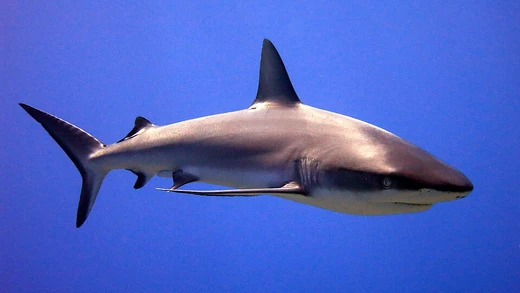
Greenland shark
Longest-lived vertebrate, inhabiting cold deep northern waters.

The Greenland shark (Somniosus microcephalus), also called the grey shark or gurry shark, is a large member of the sleeper shark family (Somniosidae), making it a close relative of the Pacific and southern sleeper sharks. It lives in the North Atlantic and Arctic Oceans and is famous for its extremely long life, though scientists know little about it because its habitat is deep and remote.
This species has the longest lifespan of any vertebrate, estimated at 272 to 510 years. It ranks among the largest living sharks, with a confirmed maximum length of 6.4 meters (21 feet) and a weight over 1,000 kilograms (2,200 pounds). Greenland sharks reach sexual maturity at about 150 years old, and females give birth to live pups after a gestation period estimated at 8 to 18 years. They are generalist feeders that eat a wide range of available food, including carrion.
The shark’s meat is toxic to mammals due to high levels of trimethylamine N-oxide, though a treated version is eaten in Iceland as the pungent dish kæstur hákarl. Because they live deep in remote northern waters, they are not considered a threat to humans. A possible attack on two British fishermen occurred in August 1936, but the shark species was never identified.
Adults typically grow to about 4 to 5 meters (13 to 16 feet). The largest confirmed specimen was 6.4 meters long and weighed around 1,023 kilograms (2,255 pounds). The International Game Fish Association record for the species is 775 kilograms (1,709 pounds). It rivals the Pacific sleeper shark (possibly up to 7 meters or 23 feet) for the largest in the family Somniosidae. Genetic data show that Greenland sharks split from ancestral sleeper sharks in the Canadian Arctic about 1 to 2.34 million years ago during the Pleistocene, likely due to glacial changes that isolated marine populations, driving adaptations for cold, deep water.
The shark has a thick body, a short rounded snout, small eyes, and small dorsal and pectoral fins. Its five gill openings are very small for its size. Females are usually larger than males, and males mature at a smaller size. Coloration ranges from pale creamy-gray to blackish-brown, usually uniform, though whitish spots or faint dark streaks sometimes appear on the back.
The shark is often infested with the copepod *Ommatokoita elongata*, a crustacean that attaches to its eyes. This copepod may glow, possibly attracting prey in a mutualistic relationship, but this idea is unconfirmed. The parasites can damage the eyes, causing ulceration, mineralization, and corneal edema, leading to near blindness. This does not seem to affect the shark’s lifespan or hunting ability, as it relies heavily on smell and hearing. The Greenland shark’s genome, published in 2024, is 6.45 billion base pairs long.
When feeding on large carcasses, the shark rolls its jaw. The 48 to 52 upper teeth are thin, pointed, and lack serrations, acting as anchors while the lower jaw cuts chunks. The 48 to 52 lower teeth are broad, square, interlock, and have short, smooth cusps pointing outward; teeth in the two halves of the lower jaw pitch in opposite directions.
Like other elasmobranchs, the Greenland shark has high levels of urea and trimethylamine N-oxide (TMAO) in its tissues, which aid buoyancy and act as osmoprotectants. TMAO also counteracts the protein-destabilizing effects of urea and deep-water pressure. Its presence increases with depth in both elasmobranch and teleost fish. The shark’s blood contains three main types of hemoglobin, each with two copies of alpha globin and two copies of three very similar beta subunits. These types have very similar oxygen and carbon monoxide binding properties, unaffected by urea. They show identical electronic absorption and resonance in Raman spectroscopy, suggesting identical or very similar heme-pocket structures. The hemoglobins have a lower affinity for oxygen than those of temperate sharks, an adaptation to deep water.
When hauled onto a deck, the shark thrashes its tail violently, making it dangerous to approach. Sailors typically kill it quickly. Cut pieces continue to contract for some time after death, making the shark extremely hard to kill and unsafe to touch near its mouth even after the head is cut off. According to Crantz, this movement can be seen three days later if the part is stepped on or struck.
The Greenland shark prefers cold water (−1.1 to 7.4 °C or 30.0 to 45.3 °F) and deep water (100 to 1,200 meters or 330 to 3,940 feet). As an ectotherm in near-freezing conditions, it is sluggish and slow, with the lowest swim speed and tail-beat frequency for its size of any fish, likely linked to its slow metabolism and extreme longevity. It swims at an average of 0.34 meters (1 foot 1 inch) per second, with a fastest cruising speed of about 0.74 meters (2 feet 5 inches) per second.
- maximum confirmed length
- 6.4 m (21 ft)
- maximum confirmed weight
- over 1,000 kg (2,200 lb)
- gestation period
- 8 to 18 years
- habitat
- North Atlantic and Arctic Oceans, depth 100–1,200 m
- known for
- longest-lived vertebrate, slow metabolism, parasitic eye copepods
Lore & Background
The Greenland shark is a thickset species with a short, rounded snout, small eyes, and small dorsal and pectoral fins. Females are typically larger than males. Coloration ranges from pale creamy-gray to blackish-brown, with occasional whitish spots or faint dark streaks. The shark is often infested by the copepod Ommatokoita elongata, which attaches to the eyes and can cause near-blindness, but this does not seem to reduce life expectancy or predatory ability due to reliance on smell and hearing. As a generalist feeder, it consumes a variety of available foods, including carrion, fish (herring, salmon, cod, halibut, and others), seals, and even minke whale. When feeding on large carcasses, it employs a rolling motion of its jaw, using thin upper teeth as anchors while broad lower teeth cut chunks. The shark is sluggish and slow-moving, with an average swim speed of 0.34 m per second, and is thought to ambush sleeping seals. It contains many transposable elements, but also unique DNA repair genes that may mitigate damage. Its blood has three major types of hemoglobin adapted to deep-water pressure, and its vision relies on rod-dominated retinas and a tapetum lucidum for low-light conditions.
Reader's Guide
Its habitat in deep, cold waters of the North Atlantic and Arctic Oceans has made it poorly studied, but recent genomic research provides clues to its DNA repair mechanisms and low-oxygen adaptations. The shark's role as an apex predator and scavenger in Arctic ecosystems, along with its unusual parasitic relationship with the copepod Ommatokoita elongata, highlights the complexity of deep-sea food webs. Culturally, its toxic meat, treated to produce the Icelandic delicacy kæstur hákarl, underscores human adaptation to extreme environments. The Greenland shark's legacy lies in challenging assumptions about vertebrate aging, metabolism, and sensory biology, while remaining a symbol of the mysterious deep northern oceans.
Did You Know?
- The copepod Ommatokoita elongata attaches to the shark's eyes, often causing near-blindness, but the shark relies on smell and hearing.
- Greenland shark meat is toxic to mammals due to high levels of trimethylamine N-oxide, but is eaten in Iceland as kæstur hákarl after treatment.
Common Misconceptions (Editorial)
Some people assume the Greenland shark’s near-blindness from eye copepods shortens its lifespan or cripples its hunting ability, but the facts show the shark relies on smell and hearing and that the condition does not reduce life expectancy or predatory ability. Others may think it is a fast, agile predator, but the record notes it is sluggish and slow-moving, averaging just 0.34 m per second, and likely ambushes sleeping seals.
Why It Matters (Editorial)
The Greenland shark endures as a symbol of biological resilience, surviving in extreme cold and darkness while outliving every other vertebrate on the planet. Its unique adaptations—from DNA repair genes to hemoglobin suited for crushing depth pressures—remind us how much we still have to learn from species hidden in the ocean’s most remote corners.
Frequently Asked Questions
What is the Greenland shark?
The Greenland shark (Somniosus microcephalus), sometimes called the grey or gurry shark, is a large member of the sleeper shark family found in cold northern waters. It ranks among the biggest living shark species and holds the record for the longest lifespan of any known vertebrate.
Where do Greenland sharks live?
They inhabit the North Atlantic and Arctic Oceans, typically at depths ranging from about 100 to 1,200 meters. Their remote, deep-water habitat makes them one of the least-studied shark species.
How big can a Greenland shark get?
The largest confirmed individuals measure around 6.4 meters (21 feet) in length and weigh over 1,000 kilograms (2,200 pounds). They are among the largest extant shark species.
How do Greenland sharks reproduce?
These sharks have an extraordinarily long gestation period lasting between 8 and 18 years before giving birth. Combined with their slow maturation, their full reproductive cycle spans decades to centuries.
More in Sharks 1-22
Spotted an error? Know more?
This is a living reference — every entry is fact-audited, and reader corrections feed straight into our audit queue. Suggest an edit · See this site's audit record