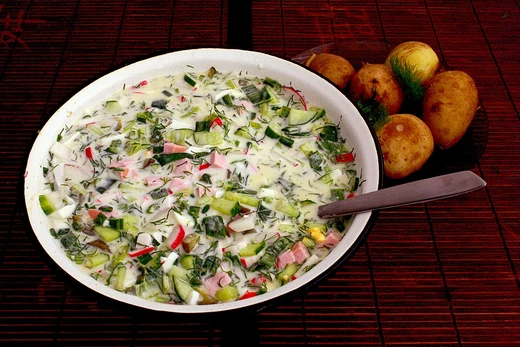
Russian cuisine
A diverse cuisine shaped by climate, class, and cross-cultural exchange.

Russian cuisine is a collection of the different dishes and cooking traditions of the Russian people as well as a list of culinary products popular in Russia, with most names being known since pre-Soviet times, coming from all kinds of social circles. Its foundations were laid by the peasant food of the rural population in an often harsh climate, with a combination of plentiful fish, pork, poultry, caviar, mushrooms, berries, and honey, and crops of rye, wheat, barley and millet providing ingredients for breads, pancakes, pies, cereals, beer and vodka. Soups and stews centered on seasonal or storable produce, fish and meats remained the staple for the vast majority of Russians well into the 20th century.
- key_periods
- Old Russian (9th–16th c.), Old Moscow (17th c.), Peter and Catherine the Great (18th c.), Petersburg (early 18th c.–1860s)
Lore & Background
The history of Russian cuisine was divided into four groups: Old Russian cuisine (9th to 16th century), Old Moscow cuisine (17th century), the cuisine during the ruling of Peter and Catherine the Great (18th century), and Petersburg cuisine from the early 18th century to the 1860s. In the Old Russian period, main food groups were bread, grains, and other starchy foods; women baked pies with fillings such as mushrooms or berries, and kasha represented wellbeing. Many current dishes were inspired from Asian cultures, such as pelmeni. In the 17th century, cuisine separated by economic class, with the rich having meat and caviar while the poor had simple dishes; more food appeared as new countries were annexed. During the Peter and Catherine era, minced meat was incorporated and other European cuisines mixed in. In the Petersburg era, French, German, Dutch, and Italian meals were incorporated, and potatoes and tomatoes became common later in the 19th century, often via Southern European or Crimean influences. Due to long cold weather, many dishes were made to be preserved.
Reader's Guide
Russian cuisine evolved in a multicultural and multiethnic state, with strong mutual influence from the cuisines of other ethnic groups within its borders. The 16th through 18th centuries brought more refined techniques, including smoked meats and fish, pastry cooking, salads, green vegetables, chocolate, ice cream, wines, and juice imported from abroad, opening doors for creative integration with traditional dishes. The early 20th century Revolution saw a rapid decline of elite cuisine, giving rise to distinct Soviet cuisine emphasizing fusion of national cuisines, a scientific approach to diet, and industrial food preparation. After the fall of the Soviet Union, the end of the state monopoly on food service led to diversification, and as prosperity grew, demand for fresh culinary experiences prompted a renaissance of Imperial-era elite cuisine and the birth of New Russian cuisine. Soups have always played an important role, with traditional staples such as shchi, borscht, ukha, rassolnik, solyanka, botvinya, okroshka, and tyurya, enlarged in the 18th to 20th centuries by European and Central Asian staples.
Did You Know?
- Russian cuisine's history is divided into four periods: Old Russian (9th–16th c.), Old Moscow (17th c.), Peter and Catherine the Great (18th c.), and Petersburg (early 18th c.–1860s).
- In the Old Russian period, women baked pies with fillings such as mushrooms or berries, and kasha represented wellbeing to the household.
- Tomatoes became common in Russian cuisine later in the 19th century, often via Southern European or Crimean influences, not through French popularization during the Petersburg era.
- Okroshka is a cold soup based on kvass or sour milk, often made with two types of vegetables and boiled meat or fish.
Ancient Roots of a Culinary Tradition
Indian cuisine traces its culinary lineage back roughly eight thousand years, a span that encompasses the slow diffusion of agriculture from the Fertile Crescent into the Indus Valley around 7000 BCE. By that era, wheat and barley were taking root in local farming communities, while sesame and humped cattle were being domesticated. The site of Mehrgarh stands as one of the earliest pieces of evidence for organized farming and herding anywhere in South Asia. Centuries later, by 3000 BCE, the subcontinent was already cultivating turmeric, cardamom, black pepper, and mustard—spices that would become the backbone of its cooking. Trade connections extended far beyond the region: Akkadian records reference timber, carnelian, and ivory imported from Meluhha, the Indus Valley, while cloves from the distant Moluccas turned up in Terqa. Even the ancient epic Mahabharata references rice and vegetables cooked together, and the word "pulao" appears in the Yājñavalkya Smṛti, showing that layered grain-and-vegetable dishes were already part of the culinary vocabulary millennia ago.
Faith, Region, and the Mosaic of Flavour
Rather than a single ethnic cuisine, Indian food functions as a national culinary identity stitched together from the regional and ethnic traditions of the entire subcontinent. Madhur Jaffrey has noted that India, larger than Europe excluding Russia, harbours state-level cuisines as varied as those found across European nations, shaped by climates that stretch from coconut-palm-rich tropical coasts to the high Himalayas. Yet Alan Davidson identifies an underlying unity: meals typically centre on a cereal base of rice or wheat, paired with savoury dishes featuring pulses and vegetables, all seasoned with ginger and garlic. Religion plays a defining role in what ends up on the plate. Hindus traditionally refrain from eating beef, Muslims avoid pork, and Jains observe strict lacto-vegetarianism. Many dishes are prepared specifically for religious festivals, and the widespread vegetarianism across the country remains a distinctive hallmark that sets Indian cuisine apart on the world stage.
The Art of Layered, Labour-Intensive Cooking
Indian cooking relies on deceptively simple equipment—a burner fed by gas, charcoal, or dried cowpats—yet demands extraordinary manual effort. Herbs, spices, and garlic are routinely crushed by hand with a stone rolling pin or a pestle and mortar, and pressure cookers have become widespread to shorten cooking times. Two techniques are considered unique to the region. In the first, a paste of onion, garlic, and ginger is fried in oil until soft; meat or vegetables are then browned in that same oil; and liquid is added gradually while stirring continuously. Colleen Taylor Sen observes that this process effectively merges sautéing, stir-frying, and stewing into a single sequence. The second technique, known by names such as bagar, chhauk, or takar, involves frying whole spices in ghee or oil and then folding them into an already-cooked dal or curry. Dishes are commonly served alongside pickles made by soaking meat, vegetables, or fruit in vinegar or concentrated brine, and the cook may work with anything from traditional earthenware pots to a modern two-handled karahi.
Waves of Foreign Influence and Colonial Exchange
Indian cuisine has never existed in isolation. Arrivals from Arabia, Central Asia, and centuries of trade and cultural exchange reshaped regional cooking, and the tandoor itself migrated from northwestern India into the Middle East. The Mughal dynasty left perhaps the deepest imprint, blending Persian and Hindu traditions to produce signature dishes like pilau, biryani, and kebabs. The Portuguese, arriving in the sixteenth century, brought chilli pepper from Mexico, which quickly became the most frequently used spice in Indian kitchens. They also introduced New World vegetables—tomato, potato, sweet potato, peanut, squash, and chilli—that are now so embedded in everyday cooking they seem indigenous. The British, during their colonial period, added baking techniques and European ingredients; cauliflower, for instance, was introduced in 1822. Even the Scotsman Robert Lindsay, writing around the late eighteenth century, recorded a Sylheti man preparing a curry for his household. Meanwhile, Indian culinary influence radiated outward, shaping cuisines as far away as the Philippines.
Frequently Asked Questions
Who is Russian cuisine?
Russian cuisine is the broad collection of cooking traditions, staple dishes, and popular food products developed by the Russian people across many centuries. It grew out of peasant rural kitchens, aristocratic banquets, and cross-cultural exchanges, with most well-known dish names already in circulation well before the Soviet era.
What are Russian cuisine's signature dishes?
The core repertoire centers on rye breads, thin blini, an assortment of pies and pastries, and hearty soups or stews built around whatever seasonal vegetables, fish, pork, poultry, mushrooms, or berries are at hand. Caviar, honey, millet, barley, and wheat porridges round out the table, while beer and vodka serve as the traditional beverages.
When did Russian cuisine's story begin?
Its earliest foundations were laid during the Old Russian period (9th–16th centuries), when rural households in a harsh northern climate cooked with locally caught fish, foraged wild ingredients, and whatever grain harvests the land produced. The tradition then evolved through the Old Moscow era of the 17th century, the court kitchens of Peter and Catherine the Great in the 18th century, and the Petersburg period lasting into the 1860s.
What shaped Russian cuisine's development?
The long, cold winters and short growing seasons pushed cooks toward preservation, fermentation, and calorie-dense preparations, while the country's vast geography created distinct forest, steppe, and coastal regional styles. Social class also left a lasting imprint, as peasant kitchens and noble households maintained very different repertoires before the two eventually influenced one another.
Why is Russian cuisine important?
It is a living record of how a large, multi-ethnic population adapted its food culture to extreme weather, limited arable land, and centuries of cultural exchange. Its influence stretches far beyond modern borders, with dishes such as borscht, pelmeni, and blini becoming widely recognized staples across the former Soviet space and in food cultures worldwide.
More in Russian cuisine 1-24
Spotted an error? Know more?
This is a living reference — every entry is fact-audited, and reader corrections feed straight into our audit queue. Suggest an edit · See this site's audit record