Cossack cuisine
Cossack cuisine blends the bold flavors of the steppes: hearty fish from the Don and Dnieper, grains from the Kuban, and a legacy of trade across Europe and Asia.

Cossack cuisine comes from the Cossack people, who live in what is now Ukraine and Russia. It developed alongside the settlement of the Eastern European steppes and blends cooking styles from Europe, the Caucasus, and Central Asia.
Fish and seafood are central to the Cossack diet. Many Cossack groups took their names from rivers where they settled, like the Dnieper, Don, or Kuban, and this shaped what they ate. The poem *Eneida* by Ivan Kotliarevsky mentions sturgeon, herring, and roach as foods of its Zaporozhian Cossack-inspired heroes. Ukrainian ethnographer Mykola Markevych wrote about fish dishes popular among Ukrainian Cossacks, including borshch with fish, loaches with horseradish, and cutlets made from pike or crucian carp. Wealthy Cossack leaders in the Hetmanate also ate imported fish like Dutch herring, eels, flounders, lampreys, salmon, and cuttlefish. Local fish such as carp, catfish, common bream, and sander were common too. Much of the fish eaten in Ukrainian Cossack lands was salted or dried. The chumaks controlled fish trade between Ukraine and the Black Sea, but most fishing happened locally in rivers like the Dnieper and Desna, or in ponds. Among Don Cossacks, baked carp or bream remain popular, and they make soups and stews like ukha and kulesh. Their fish dishes also include sturgeon, balyk, Don herring, scherba (a type of ukha), and small fish fried with onions and eggs.
Other typical foods for Zaporozhian Cossacks included milled grains and flour, with dishes like kasha, kulish, teteria, and solomakha. On campaigns, the hetman administration gave them basic rations of flour, breadcrumbs, groats, and meat. In the Pereyaslav regiment from 1722 to 1723, a Cossack artilleryman got about 200 kilograms of rye, 50 kilograms of wheat, 50 kilograms of buckwheat flour, 50 kilograms of millet, 15 kilograms of salo, and 55 grams of salt each year. Borshch was a universal food for all classes in Ukraine at that time. The diet of the Hetmanate’s Cossack elite was much richer. In 1726, while campaigning in the Caucasus, Lubny colonel Yakiv Markovych asked his wife in Ukraine to send olives, butter, ham, dried tongues, chicken, turkeys, olive oil, and various appetizers. During the Cossack era, beef and game were mostly for the upper classes, while mutton was the most common meat for lower classes. Don Cossacks traditionally eat porridges, noodles,
- region
- Ukraine and Russia
- influences
- European, Caucasian, Central Asian
- key_fish
- sturgeon, herring, roach, carp, catfish, bream, sander
- key_grains
- rye, wheat, buckwheat, millet
- common_drinks
- coffee, uzvar, kvass, kissels, iryan
- traditional_alcohol
- wine, horilkas, prune brandy
Lore & Background
Cossack food culture was shaped by the rivers along which Cossack hosts settled—Dnieper, Don, Volga, Kuban, Terek, and Yaik—resulting in a diet dominated by fish. Ivan Kotliarevsky's Eneida mentions sturgeon, herring, and roach among fish consumed by heroes inspired by Zaporozhian Cossacks. Ukrainian ethnographer Mykola Markevych recorded dishes such as borshch with fish, loaches with horseradish, and cutlets of pike or crucian carp. The Hetmanate's social elite imported Dutch herring, eels, flounders, lampreys, salmon, and cuttlefish, while local fish included carp, catfish, common bream, and sander. Much fish was salted or dried, and trade with the Black Sea region was controlled by chumaks.
Reader's Guide
Cossack cuisine reflects the historical mobility and resourcefulness of the Cossack people. Zaporozhian Cossacks relied on milled grains and flour for dishes like kasha, kulish, teteria, and solomakha, and received basic rations of flour, breadcrumbs, groats, and meat during campaigns. The diet of the Hetmanate's Cossack elite was more luxurious, including olives, butter, ham, dried tongues, chicken, turkeys, and olive oil. Don Cossacks traditionally eat porridges, noodles, bread, pies, stuffed cabbage rolls, aspic, and pickled watermelon. Kuban Cossacks eat borscht, varenyky, pancakes, shish kebabs, and goulash. Desserts include dewberry, fried berries, honey, and nardek (watermelon honey). Drinks such as coffee, juice, tea, uzvar, kvass, kissels, and iryan are common. Winemaking on the Don dates to Greek colonies, was disrupted by Polovtsians and Tatar-Mongols, and revived under Peter the Great.
Did You Know?
- Many Cossack hosts were named after rivers, influencing their fish-heavy diet.
- Don Cossacks eat watermelon pickled in brine as an appetizer for strong drinks.
- A traditional Don Cossack dessert is nardek, or watermelon honey, eaten with bursak.
- Winemaking on the Don emerged with Greek colonies around the sixth century B.C.E.
Four Centuries at the Table: A Historical Arc
Russian culinary tradition unfolds across four distinct phases, each layering new flavors onto the last. The earliest, spanning the ninth through sixteenth centuries, was defined by humble staples: bread, grains, and starch-rich foods anchored daily eating. Women shaped pies filled with foraged mushrooms or wild berries, while buckwheat and oat porridge signaled a household's prosperity. At every gathering, a loaf of bread paired with salt sat at the table's center, and honey mixed with berries produced the gingerbread still beloved today. Even pelmeni carried an Asian inspiration into the pantry. The seventeenth century sharpened class divisions at the table: caviar and fine meats for the wealthy, the simplest preparations for the poor. Annexation of new territories broadened available ingredients. Under Peter and Catherine the Great, minced meat entered the repertoire and European techniques blended into local dishes. The Petersburg era, from the late eighteenth century into the 1860s, merged French, German, Dutch, and Italian influences with Russian traditions, introducing lamb, pork, and—thanks to French popularization—potatoes and tomatoes. Throughout, Russia's brutal winters drove cooks to develop preservation methods that kept food viable through long, frozen stretches.
Seven Bases of the Russian Soup
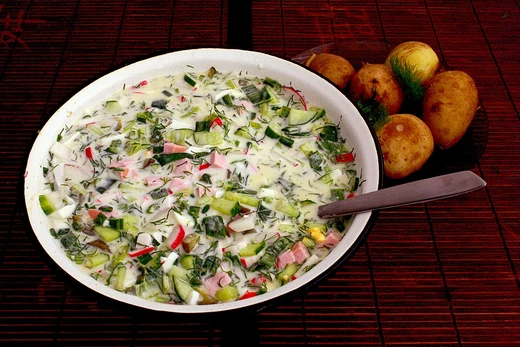
Few elements define Russian cooking more than its soup culture, a tradition so central that the cuisine can be mapped through at least seven major categories. The oldest staples—shchi, borscht, ukha, rassolnik, solyanka, botvinya, okroshka, and tyurya—were expanded between the eighteenth and twentieth centuries by European and Central Asian additions such as clear broths, puréed preparations, and stews. The categories range from chilled kvass-based soups like tyurya and botvinya, to light vegetable broths, noodle soups with meat or mushrooms, cabbage-centered dishes most famously shchi, thick meat-broth soups with a salty-sour profile like rassolnik and solyanka, fish soups such as ukha, and grain-and-vegetable preparations. Okroshka exemplifies the chilled tradition. Built on a base of kvass or, more commonly today, kefir, it is equally a soup and a salad. The recipe calls for two vegetable types in equal measure with cold boiled meat or fish: one group must be neutral in flavor—boiled potatoes, turnips, rutabagas, carrots, or fresh cucumbers—while the second must be spicy and aromatic, such as radishes, green onion, dill, parsley, chervil, celery, or tarragon. Beef alone or paired with poultry is the most common protein, though a mild bologna-like sausage or fish can substitute.
A Mosaic of Landscapes and Peoples
Russian cuisine is not a single monolithic tradition but a mosaic shaped by geography, climate, and the many ethnic groups within the nation's borders. While deep mutual influence exists, distinct national cuisines—Bashkir, Tatar, Sakha, Yamal—retain their own identities even as they cross-pollinate with the broader Russian table. Geographically, the north draws on local berries like cloudberry and crowberry, cod, elk, and even edible moss called yagel. Siberia centers on the coregonus family of fish—arctic cisco and muksun among them—and borrows local methods that produce raw fish eaten frozen or tossed with spices. Further east, the palette expands to include eagle fern, kolomikta fruit, scallops, and Kamchatka crabs. The foundation of the broader Russian table was laid by peasant cooking in a harsh climate, relying on plentiful fish, pork, poultry, caviar, mushrooms, berries, and honey. Crops of rye, wheat, barley, and millet supplied the raw materials for countless breads, pancakes, pies, cereals, beer, and vodka. Soups and stews built around seasonal or storable produce, fish, and meats remained the daily staple for the vast majority of Russians well into the twentieth century.
Rupture, Industrialization, and the New Russian Renaissance
The trajectory of Russian cuisine in the modern era is one of dramatic rupture and rebirth. Between the sixteenth and eighteenth centuries, refined techniques arrived: smoked meats and fish, pastry work, salads, green vegetables, chocolate, ice cream, wines, and juice were imported from abroad. For the urban aristocracy and provincial gentry, these new ingredients opened the door to creatively integrating foreign elements into traditional Russian dishes. Then came the Revolution. The early twentieth century saw a rapid collapse of elite cuisine, driven by the new egalitarian state ideology and the simple disappearance of the Imperial elites who had been its primary consumers. In their place, a distinct Soviet cuisine emerged, emphasizing the fusion of the Union's many national cuisines, a scientific approach to diet, and an industrial method of food preparation and serving. The fall of the Soviet Union shattered the state's monopoly on food service, unleashing a wave of diversification. As average prosperity grew from the second decade after the collapse, demand for fresh culinary experiences surged. This prompted a renaissance of Imperial-era elite cooking, a search for novelty and local specialties, and creative reinterpretations of old recipes, giving birth to what is now called New Russian cuisine.
Frequently Asked Questions
What is Cossack cuisine and where did it develop?
Cossack cuisine is the food tradition of the Cossack communities who settled the Eastern European steppes in present-day Ukraine and Russia. It grew alongside river-based settlement, with groups such as the Dnieper, Don, and Kuban Cossacks each building their cooking culture around the waters they called home.
What fish are most important in Cossack cooking?
River and sea fish sit at the very heart of the Cossack table, with sturgeon, herring, roach, carp, catfish, bream, and sander all playing starring roles. This aquatic emphasis is so deep-rooted that even Kotliarevsky's *Eneida* celebrates these species as the fare of its Zaporozhian heroes.
What cultural influences shaped Cossack food?
Cossack cooking is a three-way blend of European, Caucasian, and Central Asian culinary traditions. That fusion mirrors the Cossacks' frontier position at the crossroads of trade routes linking those regions, so their kitchens absorbed techniques and flavors from all three worlds.
What grains and drinks are staples of Cossack cuisine?
The grain backbone of Cossack cooking rests on rye, wheat, buckwheat, and millet, while everyday drinks include coffee, uzvar, kvass, assorted kissels, and iryan. On the stronger side, traditional Cossack alcohol spans wine, various horilkas, and a distinctive prune brandy.
Why is Cossack cuisine considered a unique blend?
It captures a foodway that belongs to no single modern nation, sitting squarely in the overlap of Ukrainian and Russian culinary heritage. The tradition preserves centuries of steppe-and-river cooking knowledge and shows how proximity to waterways like the Don and Dnieper literally determined what Cossack families ate.
More in Russian cuisine 1-24
Spotted an error? Know more?
This is a living reference — every entry is fact-audited, and reader corrections feed straight into our audit queue. Suggest an edit · See this site's audit record