Bashkir cuisine
Traditional cuisine of the Bashkirs, shaped by cattle breeding.

Bashkir cuisine is the traditional cuisine of the Bashkirs, a people whose way of life and predominance of cattle breeding shaped their culture, traditions, and food. The cuisine is characterized by an abundance of meat, a limited use of spices (only black and red pepper), and a wide range of long-term storage products developed from a semi-nomadic, cattle-ranching lifestyle.
- field
- Traditional cuisine
- nationality
- Bashkir
- known_for
- Horse sausage (Qazı), koumiss (Qımıð), beshbarmak, chak-chak, Bashkir honey
Lore & Background
Bashkir cuisine reflects a semi-nomadic pastoralist heritage, with many dishes designed for long storage and portability. Key products include boiled, dried, and smoked horse meat and lamb, dairy products, dried berries, dried cereals, and honey. Notable dishes are Qazı (horse sausage), Qaqlanğan et (jerky), Qımıð (koumiss), Qurut (dry kashk), and ayran. The love for horse meat and horse fat is distinctive, often eaten with thick slices of fat and washed down with sour Qurut to neutralize the fat.
Reader's Guide
Bashkir cuisine holds significance for its preservation of traditional foodways tied to a semi-nomadic lifestyle. It features a unique set of preserved foods like Qazı, Qurut, and Qımıð, the latter a healing drink made from mare's milk. Modern Bashkir dishes retain traditional originality while diversifying ingredients and presentation. Festive tables always include beshbarmak, Qaðı, and chak-chak, the latter a mandatory wedding ritual item. Table etiquette emphasizes hospitality: food is served immediately, the host eats minimally to ensure guests are full, and guests take the worst food from shared dishes. Food bans, rooted in religious tradition, prohibit pork, carnivorous animals, swans, cranes, and scaleless fish.
Did You Know?
- Bashkir dishes use only black and red pepper as classic spices.
- Qımıð (koumiss) was traditionally prepared by tying a vessel of mare's milk to a saddle and hanging it during the day.
- Bashkirs always drink tea with milk, and the tradition is so old that the order of adding milk is debated in some regions.
- At a festive feast, each guest is offered ulush, a proportion of game such as ram or goose.
Distinct Identity Within a Multicultural Tapestry
The culinary landscape of the Russian Federation is defined by a complex interplay between shared traditions and individual ethnic expressions. Within this mosaic, Bashkir cuisine stands out as one of several national cuisines that have preserved their distinct character despite centuries of deep mutual exchange with neighboring food cultures. The broader Russian culinary tradition itself is not a monolithic entity but rather a gathering of dishes, techniques, and products drawn from every social stratum, many of whose names trace back to the pre-Soviet era. Because the state has always been multicultural and multiethnic, the cuisines of its constituent peoples—including Bashkir, Tatar, Sakha, and Yamal—have continuously borrowed from and contributed to one another. Yet the evidence shows that this exchange never erased individuality. Bashkir cooking retains its own recognizable identity, a testament to the resilience of local foodways even within a framework of constant cross-pollination. This balance between shared heritage and unique expression remains a defining feature of how Bashkir cuisine is understood and valued today.
Roots in Peasant Tradition and Harsh Climate
The deep foundations of the culinary world in which Bashkir cuisine developed were laid by the everyday food of rural communities living under often punishing climatic conditions. In these settings, the pantry was built around what the land and surrounding waters could reliably provide: plentiful fish, pork, poultry, caviar, wild mushrooms, foraged berries, and honey gathered from local hives. Grains such as rye, wheat, barley, and millet formed the backbone of daily sustenance, yielding a wide range of breads, flat pancakes, filled pies, porridges, as well as fermented beverages like beer and vodka. Because long, freezing winters made frequent foraging or market trips impractical, a great deal of cooking was oriented toward preservation—curing, fermenting, and storing foods so that households could survive the snowy months without venturing out. Soups and stews, centered on whatever seasonal or storable produce was available alongside fish and meat, became the practical heart of the table. For the overwhelming majority of the population, this peasant-based diet remained the daily reality well into the twentieth century, and it continues to underpin the ingredient logic of regional cuisines including Bashkir.
Cross-Cultural Currents and Culinary Evolution
The culinary history surrounding Bashkir cuisine unfolded across four broad eras, each introducing new influences that reshaped the broader food culture. In the earliest period, stretching from the ninth to the sixteenth century, the diet was dominated by bread, grains, and starch-rich staples, with women preparing pies filled with mushrooms or berries and households making kasha from buckwheat or oats. Honey and wild berries were transformed into gingerbread, a treat that persists to this day, while dishes like pelmeni reveal the reach of Asian culinary traditions into the local repertoire. The seventeenth century introduced a sharper class divide at the table, with the wealthy enjoying caviar and other delicacies while the poor subsisted on the simplest preparations; annexation of new territories also widened the ingredient pool. Under Peter and Catherine the Great, minced meat entered the kitchen and European techniques began blending with local ones. By the Petersburg era, French, German, Dutch, and Italian dishes—lamb, pork, potatoes, tomatoes—had been absorbed into the mainstream. The twentieth century brought the Revolution's dismantling of elite cuisine, the Soviet emphasis on fusing the Union's diverse national cuisines, and the post-Soviet renaissance sparking a search for local specialties and creative reinterpretation.
The Soup Tradition and Seasonal Cooking
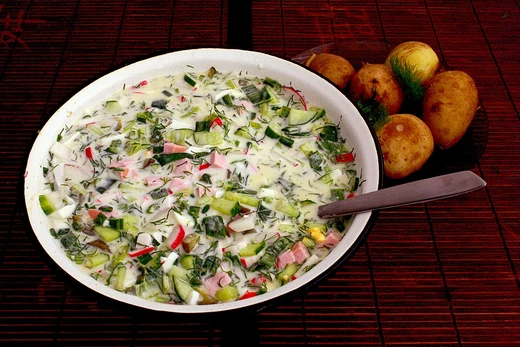
Soups occupy a central and enduring place in the culinary tradition that frames Bashkir food culture. The broader Russian soup repertoire, which Bashkir cuisine both draws upon and distinguishes itself from, can be organized into at least seven major categories: chilled preparations based on kvass such as tyurya, okroshka, and botvinya; light vegetable broths; noodle soups with meat, mushrooms, or milk; cabbage-based soups most famously shchi; thick, salty-sour broths like rassolnik and solyanka; fish soups such as ukha; and grain-and-vegetable combinations. Okroshka, for instance, is a cold soup built on kvass or kefir, combining two vegetable groupings—one neutral (boiled potatoes, turnips, carrots, cucumbers) and one aromatic (radishes, green onion, dill, parsley, chervil, celery, tarragon)—mixed with cold boiled meat, poultry, or fish in equal proportion. The tradition of making soups from whatever seasonal or storable produce was at hand, combined with the practical need to preserve food through long freezing winters, gave this category a functional as well as cultural importance. The eighteenth through twentieth centuries further enriched the soup table with European clear broths, puréed preparations, and stews, adding layers of technique that coexisted with the older, simpler forms still found in regional and ethnic cuisines.
Frequently Asked Questions
What is Bashkir cuisine?
Bashkir cuisine is the traditional food culture of the Bashkir people, deeply rooted in their semi-nomadic cattle-ranching way of life. It is defined by a heavy reliance on meat and dairy, minimal seasoning (typically just black and red pepper), and a wide array of preserved products designed for long storage on the steppe.
What dishes is Bashkir cuisine most famous for?
The most iconic items include Qazı (a horse-meat sausage), Qımıð (koumiss, a fermented mare's-milk drink), beshbarmak (boiled meat over hand-cut noodles), chak-chak (a honey-dipped pastry), and Bashkir honey.
How does Bashkir cuisine differ from neighboring Russian or Tatar cuisines?
Where many neighboring traditions lean on a broader spice palette and more grain-based staples, Bashkir cooking keeps seasoning extremely restrained and centers on meat and dairy from cattle and horses. The emphasis on long-term preservation products reflects a semi-nomadic lifestyle rather than a settled agricultural one.
What is Qımıð (koumiss) and why is it significant?
Qımıð is a lightly fermented drink made from mare's milk, and it is one of the most recognizable symbols of Bashkir culinary identity. It has been consumed for centuries across the steppe region and is valued both as a daily beverage and for its perceived health benefits.
Why is horse meat so central to Bashkir cooking?
The Bashkirs historically kept horses as the backbone of their semi-nomadic economy, so horse meat and mare's milk became primary food sources rather than occasional delicacies. Dishes like Qazı sausage and beshbarmak showcase this tradition, making horse meat a staple rather than a specialty.
More in Russian cuisine 1-24
Spotted an error? Know more?
This is a living reference — every entry is fact-audited, and reader corrections feed straight into our audit queue. Suggest an edit · See this site's audit record