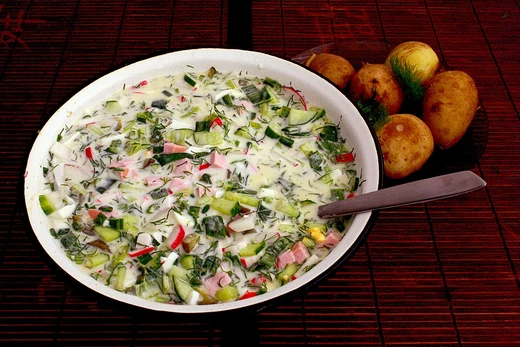
Baked potato
A versatile potato dish baked and served with various toppings.

A baked potato, also known in the United Kingdom as a jacket potato, is a preparation of potato that originated in South America and was cultivated by ancient Andean civilizations. It is a versatile dish served with various fillings, toppings, or condiments, and can be part of a healthy diet despite the misconception that potatoes are fattening.
- Origin
- South America (Andean region)
- Internal temperature when done
- 93 °C (200 °F)
Lore & Background
Potatoes originated in South America and were cultivated by ancient Andean civilizations, who used earth ovens like the huatia for cooking various foods. The baked potato became popular in the United Kingdom in the mid-19th century, where jacket potatoes were sold on the streets during autumn and winter. In the United States, the Idaho baked potato was heavily promoted by the Northern Pacific Railroad in the early 20th century, using Hollywood movie stars and a slogan that lasted about 50 years.
Reader's Guide
The baked potato is a significant dish globally, with regional variations reflecting local tastes. In Turkey, kumpir is a popular fast food, while in the United Kingdom, jacket potatoes are commonly filled with items like baked beans, tuna mayonnaise, or chili con carne. In North America, loaded baked potatoes with butter, sour cream, chives, cheese, and bacon bits are common, often served as a side or entrée. The dish's legacy includes the Hasselback potato from Stockholm and the Idaho baked potato's role in promoting railroad passenger service. Despite concerns about vitamin C loss during baking, small potatoes retain more nutrients, and the skin is rich in dietary fiber. The baked potato remains a staple comfort food, adaptable to many cuisines.
Did You Know?
- A baked potato is fully cooked when its internal temperature reaches 93 °C (200 °F).
- In the mid-19th century, baked potatoes were a popular street food in London, though exact daily sales figures are not well-documented.
- The Hasselback potato originated at the Hasselbacken hotel and restaurant in Stockholm.
- Potatoes baked in their skins may lose between 20 and 40% of their vitamin C content.
Ancient Roots: From Inca Pits to Modern Kitchens
Potatoes trace their culinary history back to South America, where the Inca Empire cultivated them for generations. One of the earliest known methods of preparing these tubers was baking them in a huatia, an underground cooking pit. This ancient technique represents one of humanity's oldest approaches to transforming a raw potato into a cooked staple, predating modern ovens by centuries. The Inca practice of burying potatoes in heated earth is, in essence, the ancestral form of what we now call a baked potato. While the tools and settings have evolved dramatically, the fundamental principle—surrounding the potato with dry, radiant heat until its interior softens—remains unchanged. This lineage connects a farmer in the Andes to a diner in a modern restaurant, bridging millennia of culinary tradition in a single, humble dish that has traveled from indigenous South American kitchens to tables around the world.
The Science and Technique Behind a Perfect Bake
Baking a potato well involves several critical steps that separate a successful dish from a kitchen disaster. After scrubbing, drying, and removing eyes or blemishes, the cook may rub the surface with oil, butter, or salt. Pricking the skin is essential to allow steam to escape; without it, accumulated internal pressure can cause the potato to rupture explosively, a risk especially acute in microwave ovens where heat fluctuates rapidly. In a conventional oven at roughly 200 degrees Celsius, a large potato needs one to two hours, while a microwave handles it in six to twelve minutes but sacrifices the crisp skin that bakers prize. Wrapping in aluminium foil traps moisture for a softer result, whereas leaving the potato bare produces that desirable crackling exterior. The tuber is fully cooked once its internal temperature reaches 99 degrees Celsius. The skin itself carries a distinct flavor and texture and provides dietary fiber, though baking in air can strip 20 to 40 percent of vitamin C, with smaller potatoes retaining more of this nutrient due to their shorter cooking time.
The Great Big Baked Potato: A Railroad Marketing Legend
In the early 1900s, the Northern Pacific Railroad turned an agricultural problem into one of America's most memorable food marketing campaigns. In 1908, dining car superintendent Hazen Titus visited Yakima Valley farmers struggling to sell their enormous potatoes—some weighing two to five pounds—because buyers preferred smaller tubers and the thick, rough skin made them seem inedible. Titus and his staff discovered that baking these large potatoes in a slow oven produced a delicious result. He contracted to buy every oversized potato the farmers could grow, and by 1909, the North Coast Limited was serving what became known as Netted Gem Bakers. The railroad adopted the slogan The Great Big Baked Potato to promote its passenger service, a campaign that endured for roughly fifty years. In 1914, a 40-foot-long, 18-foot-diameter electrically lit potato with winking eyes was mounted atop the Seattle commissary building, complete with a glowing cube of butter in its split top. Premium merchandise like postcards and spoons were produced, and a song titled Great Big Baked Potato was composed in the railroad's honor.
A Global Canvas: From Jacket Potatoes to Hasselback Slices
The baked potato serves as a remarkably versatile canvas across cultures. In the United Kingdom, the dish is commonly called a jacket potato and has been a street food staple since at least the mid-19th century, when they were sold on autumn streets. British fillings range from baked beans and curried chicken to coronation chicken, chili con carne, tuna mayonnaise, and coleslaw, while in Scotland, haggis finds its way into the mix. Across the Atlantic, North American restaurants typically present baked potatoes with an array of optional toppings—butter, sour cream, chives, shredded cheese, and bacon bits—allowing diners to customize their plate. When loaded with multiple toppings, these become loaded potatoes, which can function as either a side to a steak entrée or a standalone stuffed dish featuring barbecued meat or chili. Another celebrated variation is the Hasselback potato, named after the Hasselbacken hotel in Stockholm, where the tuber is sliced thinly but not through, fanning out during baking and sometimes topped with cheese. The twice-baked method—scooping out the flesh, mixing it with cheese or bacon, and returning it to the skin shell—adds yet another dimension to this humble preparation.
Frequently Asked Questions
What is Baked potato?
Baked potato is a simple, widely enjoyed preparation in which a whole potato is cooked in an oven until tender. In British English it goes by the name jacket potato, and it is a staple that slots easily into Russian home cooking.
Where does Baked potato actually come from?
The potato lineage stretches back to the Andean highlands of South America, where ancient civilizations first domesticated the tuber. The baking technique later traveled the world and became a familiar comfort dish in Russian kitchens.
How do you know Baked potato is fully cooked?
The accepted doneness benchmark is an internal temperature of 93 °C (200 °F), at which point the flesh is uniformly soft and fluffy. Poking the center with a fork should meet no resistance at all.
What can you put on or in Baked potato?
The dish is celebrated for its versatility, accepting a wide range of fillings, toppings, and condiments without losing its identity. From a simple spread of butter to more elaborate savory additions, the base stays the same while the accompaniments change.
Is Baked potato really fattening?
That is a common misconception; the potato itself, when simply baked, can be part of a perfectly healthy diet. The caloric load only climbs if you layer on heavy, calorie-dense toppings.
More in Russian cuisine 1-24
Spotted an error? Know more?
This is a living reference — every entry is fact-audited, and reader corrections feed straight into our audit queue. Suggest an edit · See this site's audit record