Mount Cayley
An eroded stratovolcano sacred to the Squamish people.
Last updated
Where it is
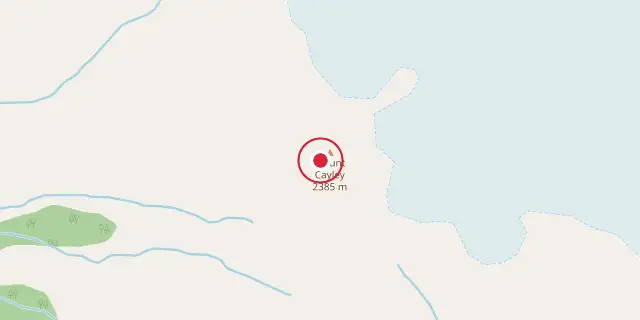
Coordinates: 50°07′12″N 123°17′28″W (50.1200, -123.2910) · Open in OpenStreetMap
Coordinates and connected clubs: the infobox of Wikipedia: Mount Cayley (CC BY-SA 4.0). Map: drawn by Codexery from OpenStreetMap tiles.
Mount Cayley is an eroded, potentially active stratovolcano in the Pacific Ranges of southwestern British Columbia, Canada. It forms part of the Garibaldi Volcanic Belt and towers over the Cheakamus and Squamish river valleys. The volcano is considered sacred by the Squamish people, who have inhabited the surrounding area for more than 7,000 years.
Geography and geology
The volcano lies within the Mount Cayley volcanic field, a north–south trending zone of volcanism that includes subglacially formed volcanoes such as Pali Dome, Slag Hill, Ring Mountain and Ember Ridge. This field is part of the Garibaldi Volcanic Belt, which extends north from the Cascade Volcanic Arc.
Volcanism here results from the Juan de Fuca Plate subducting beneath the North American Plate at the Cascadia subduction zone. The Mount Cayley massif comprises three main summits: Mount Cayley at 2385 m, Pyroclastic Peak at 2341 m, and Wizard Peak at 2240 m. Pyroclastic Peak features a jagged ridge of slender rock pinnacles, the largest called Vulcan's Thumb.
The northeastern flank of Mount Cayley abuts the Powder Mountain Icefield, an irregularly shaped glacier 9 km long and 5 km wide. The volcano is built of solidified lava and ash, predominantly dacitic with common rhyodacite. Its current volume is estimated at 8 km³, reduced by glacial erosion from a possible original volume of 13 km³. Streams flowing from its slopes include Turbid Creek, Dusty Creek, Avalanche Creek and Shovelnose Creek.
Deep seismic profiling 12.5 to 13 km below the volcano has identified a bright spot interpreted as a mid-crustal magma chamber.
Volcanic history
Mount Cayley has erupted sporadically over the last 4,000,000 years, making it one of the most persistent eruptive centers in the Garibaldi Volcanic Belt. Three primary eruptive stages have been identified. The Mount Cayley and Vulcan's Thumb stages, between 4,000,000 and 600,000 years ago, built the stratovolcano and plug domes. A 300,000-year quiescent period followed, during which erosion destroyed much of the original structure.
The third Shovelnose stage, about 300,000 to 200,000 years ago, emplaced parasitic lava domes and flows; however, one dome dated at 310,000 years may be in error from excess argon, and Shovelnose rocks could be less than 15,000 years old. Eruptions produced andesite, dacite and rhyodacite. The lack of evidence for volcano-ice interactions suggests all stages likely occurred before glacial periods. Initial volcanism 4,000,000 years ago coincided with the separation of the Explorer and Juan de Fuca plates, shifting volcanism westward from the Pemberton Volcanic Belt to the Garibaldi Volcanic Belt.
The early Mount Cayley stage erupted felsic lava flows and pyroclastic rocks onto a crystalline basement, forming a southwesterly-dipping prism of dacite flows and tephra cut by dikes and sills, now exposed in the southwestern cliffs.
Human history
The Squamish people have inhabited the area for thousands of years. They call Mount Cayley and The Black Tusk taḵ'taḵmu'yin tl'a in7in'axa7en, meaning 'Landing Place of the Thunderbird' in their language. The Thunderbird is a legendary creature in North American indigenous cultures; when it flaps its wings, thunder is created, and lightning originates from its eyes. These peaks are considered sacred and have played an important part in Squamish history.
Berry fields on and near the massif provided mountain bilberries, Canadian blueberries and oval-leaved blueberries, a favored food. Glassy rhyodacite from small outcrops on the slopes has been found in goat hunting sites and the Elaho rockshelter, collectively dated between about 8,000 and 100 years old. This rhyodacite has only been found in the northern parts of Squamish Nation territory. The first ascent of the massif occurred in July 1928 by an Alpine Club of Canada party.
The mountain was named for Beverley Cochrane Cayley, a mountaineer who died in June 1928, and the name became official on April 2, 1929.
Volcanic hazards
Although currently quiet, Mount Cayley poses potential hazards to nearby towns, logging areas and recreational sites. Seismic data from the Geological Survey of Canada suggest the volcano still contains magma, indicating possible future eruptive activity and associated hazards such as landslides. A 2000 eruption scenario organized by GSC scientists, based on past Garibaldi Volcanic Belt activity and involving both explosive and effusive activity, was published in 2003 in the journal Natural Hazards.
If eruptive activity resumed, scientists would likely detect increased seismicity as magma rises. The existing Canadian National Seismograph Network in the area would alert the GSC, possibly triggering expanded monitoring. As magma nears the surface, the volcano would likely swell and fracture, increasing hot spring activity and creating new springs or fumaroles. Minor or large landslides could occur, potentially blocking the Squamish River.
Eventually, near-surface magma might cause phreatic explosions and debris flows, leading to closure of Highway 99, evacuation of Squamish, and consideration of evacuating Whistler.
Did You Know?
- At least three major debris avalanches have occurred from the western slope in the last 10,000 years, all blocking the Squamish River and forming temporary lakes.
- The first and largest debris avalanche about 4,800 years ago produced a 200,000,000 to 300,000,000 m³ debris fan.
- A debris avalanche about 500 years ago deposited two diamicton units along Turbid Creek, representing separate surges within the same event.
More in Religious Places of the Indigenous Peoples of North America
Sources
Compiled from Wikipedia and the sources listed below. Text from Wikipedia is available under CC BY-SA 4.0; this entry is adapted from it.
- Wikipedia: Mount Cayley (CC BY-SA 4.0).
Spotted an error? Know more?
Reader corrections go straight into our review queue. Suggest an edit · How this site is sourced