Blue Hills Reservation
Large conservation park near Boston with diverse terrain and history.
Last updated
Where it is
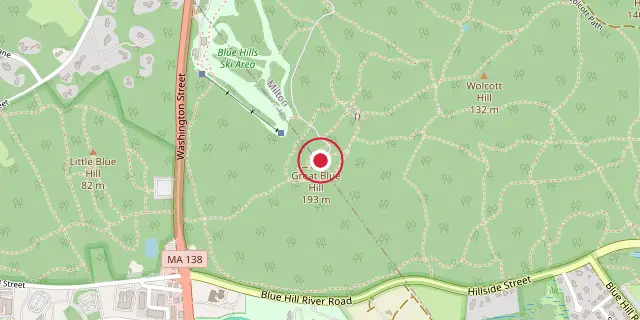
Coordinates: 42°12′43″N 71°06′50″W (42.2120, -71.1140) · Open in OpenStreetMap
Coordinates and connected clubs: the infobox of Wikipedia: Blue Hills Reservation (CC BY-SA 4.0). Map: drawn by Codexery from OpenStreetMap tiles.
Blue Hills Reservation is a 7,000 acre state park in Norfolk County, Massachusetts, managed by the Massachusetts Department of Conservation and Recreation. It spans parts of several towns about 10 miles south of downtown Boston and is one of the largest undeveloped conservation areas in the Greater Boston region. The park's varied terrain and scenic views draw many hikers from the Boston area.
History
The name Blue Hills comes from the bluish hue of the mountains, caused by riebeckite, noted by sailors along the coastline. The state name Massachusetts derives from the Massachusett Indian tribe's name for the hill: massa-adchu-es-et. In 1893, the Metropolitan Parks Commission bought the lands as one of the state's first public recreation areas.
Points of interest
At the top of Blue Hills Reservation sits Great Blue Hill, home to the Blue Hill Meteorological Observatory. Founded in 1885, it holds the title of the nation's oldest weather recording station still in operation. Its tower offers sweeping views of Boston and beyond, and both the observatory and tower are on the National Register of Historic Places. The reservation also includes Houghton's Pond and the Blue Hills Trailside Museum, run by Mass Audubon since 1974, which displays indoor and outdoor animal exhibits.
Activities and amenities
Blue Hills Reservation is mainly used for hiking and mountain biking, with additional activities including snowshoeing, downhill skiing, snowboarding, cross-country skiing, rock climbing in certain areas, and horseback riding during permissible months. Great Blue Hill offers a ski area between approximately December and March. Houghton's Pond and Ponkapoag Pond are popular for swimming and recreation in summer. Other opportunities include non-motorized boating, camping, fishing, picnicking, playing fields, ice skating, interpretive programs, and a children's playground.
Did You Know?
- The reservation hosts endangered species such as the timber rattlesnake and copperhead snake.
- Its ecology includes an Atlantic white cedar bog.
- The climate is humid continental (Köppen: Dfa), typical of most of New England.
More in Religious Places of the Indigenous Peoples of North America
Sources
Compiled from Wikipedia and the sources listed below. Text from Wikipedia is available under CC BY-SA 4.0; this entry is adapted from it.
- Wikipedia: Blue Hills Reservation (CC BY-SA 4.0).
Spotted an error? Know more?
Reader corrections go straight into our review queue. Suggest an edit · How this site is sourced