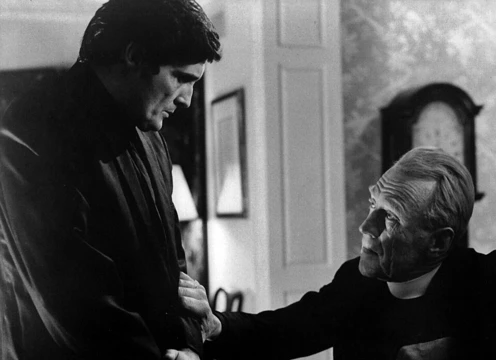
Possession (1981 film)
A 1981 psychological horror drama about a disintegrating marriage.

Possession (1981) is a psychological horror drama directed by Andrzej Żuławski, who co-wrote the screenplay with Frederic Tuten. The story loosely tracks a spy (Sam Neill) and his wife (Isabelle Adjani); after she asks for a divorce, her behavior grows increasingly strange. A joint production of France and West Germany, the film was shot in West Berlin in 1980. It is one of Żuławski’s English-language features, alongside La Femme publique (1984) and others, and debuted at the 34th Cannes Film Festival, where Adjani took home the Best Actress prize. The script emerged from Żuławski’s own painful divorce from actress Małgorzata Braunek. Though it failed commercially in both Europe and the United States—where it first appeared in a heavily censored version—the film later gained a cult following and has been reassessed more favorably over time.
Quick Facts
- Director
- Andrzej Żuławski
- Producer
- Marie-Laure Reyre
- Starring
- Isabelle Adjani / Sam Neill / Heinz Bennent
- Music
- Andrzej Korzyński
- Cinematography
- Bruno Nuytten
- Editing
- Marie-Sophi Dubus / Suzanne Lang-Willar
- Studio
- Oliane Productions / Marianne Productions / Soma Film Produktion
- Distributor
- Gaumont Distribution
- Released
- 25 May 1981 · Cannes · 1981 · 5 · 27 · France · 1983 · 10 · 28 · United States
- Runtime
- 124 minutes
- Country
- France / West Germany / United States
- Language
- English
Facts from the source article.
Lore & Background
The screenplay was written during the painful divorce of Żuławski from actress Małgorzata Braunek. Żuławski recalled returning home late to find his five-year-old son Xavier alone and smeared with jam, a scene directly reflected in the film. After the authorities halted work on his film On the Silver Globe in 1978, Żuławski faced a de facto ban and was forced to leave Poland, and while emigrating he continued to linger on suicidal thoughts. Possession was one of Żuławski's English-language films, along with La Femme publique (1984) and others.
Reader's Guide
Possession was not commercially successful either in Europe or the United States, with the latter only receiving a heavily edited cut on its initial release. The film eventually acquired cult status and has been more positively appraised in later years. Critics have drawn parallels with Roman Polanski's Repulsion and David Cronenberg's The Brood, though the film's genre remains a matter of controversy, with some calling it psychological drama, psychological horror, or supernatural horror. Scholar Bartłomiej Paszylk writes that the metaphors in the film represent a disintegrating country, with the Berlin Wall symbolizing disconnection and the Iron Curtain, and Germany symbolizing Poland, a country Żuławski had to leave to keep making movies.
Did You Know?
- Isabelle Adjani won the Best Actress award at the 34th Cannes Film Festival for her performance.
- The screenplay was written during Żuławski's painful divorce from actress Małgorzata Braunek.
- The film was not commercially successful in Europe or the United States but later acquired cult status.
Frequently Asked Questions
What is Possession (1981)?
Possession is a 1981 psychological horror drama directed by Andrzej Żuławski, who co-wrote the screenplay with Frederic Tuten. It is a Franco-West German co-production filmed in West Berlin, and it falls into the genre of psychological horror rather than traditional supernatural terror.
Who stars in Possession (1981) and what did they win?
Isabelle Adjani and Sam Neill lead the cast, playing a couple whose marriage is tearing apart. Adjani's performance earned her the Best Actress award at the 34th Cannes Film Festival, where the film made its world debut.
What is the plot of Possession (1981)?
The story follows a spy and his wife who begin to fracture after she requests a divorce, and her behavior spirals into increasingly violent and erratic territory. The film uses the disintegrating relationship as a vehicle for escalating psychological and physical horror.
How does Possession (1981) end?
The film concludes with the wife in a grotesquely transformed, disfigured state, and the husband left trapped beside her in a final, harrowing tableau. The ending is deliberately unresolved and deeply unsettling, refusing to offer the audience any comfort or catharsis.
Why is Possession (1981) considered important in horror cinema?
It stands as one of Andrzej Żuławski's few English-language features and is widely regarded as a landmark of extreme psychological horror. Its raw, unflinching depiction of domestic breakdown and bodily transformation has influenced countless later filmmakers exploring trauma through the horror genre.
More in Religious horror films 1-24
Spotted an error? Know more?
Reader corrections go straight into our review queue. Suggest an edit · How this site is sourced