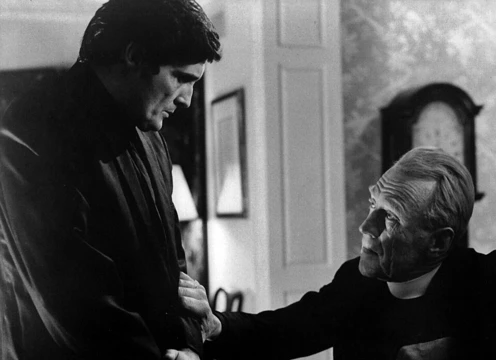
Cross (2012 film)
A Catholic serial killer believes he saves souls by murder.

Jebulon · CC0
Cross (also known as Smile For Me) is a 2012 Hong Kong horror thriller film written and directed by Daniel Chan, Steve Woo, Lau Kin-ping, and Hui Shu-ing. The film stars Simon Yam, Kenny Wong, Liu Kai-chi, and Nick Cheung. It centers on a Catholic serial killer who believes he is divinely appointed to kill suicidal people so they may enter heaven.
Quick Facts
- Director
- Daniel Chan / Steve Woo / Lau Kin-ping / Hui Shu-ning
- Producer
- Ramy Choi
- Starring
- Simon Yam / Kenny Wong / Liu Kai-chi / Nick Cheung
- Music
- Paul Wong
- Cinematography
- Wade Muller
- Distributor
- Fame Universal Entertainment
- Released
- 4 October 2012
- Country
- Hong Kong
- Language
- Cantonese
Facts from the source article.
Lore & Background
The film follows Lee Leung, played by Simon Yam, who brings luggage containing files, a scalpel, and a vial to a police station and confesses to murder. He claims he is not a serial killer but an angel of God, acting under a divine test after his wife's suicide from leukemia. Lee Leung believes that if suffering people end their own lives, they will go to hell; by murdering them instead, he ensures they enter heaven. He finds an online suicide discussion site, meets four suicidal people, and fulfills their wishes to be killed. His faith and plan of salvation eventually suffer an impact he cannot withstand.
Reader's Guide
Cross (2012) is a Hong Kong horror thriller that explores themes of faith, suicide, and moral justification. The film's plot centers on a Catholic serial killer who interprets his wife's death as a divine mission to murder suicidal individuals, believing this act grants them salvation. The narrative raises questions about the nature of mercy, the boundaries of religious conviction, and the psychological toll of assuming a godlike role. The film features a cast including Simon Yam, Kenny Wong, Liu Kai-chi, and Nick Cheung, and was directed by a team of four filmmakers. Its significance lies in its dark, philosophical approach to the horror genre, using a serial killer's perspective to examine the ethics of assisted death and religious delusion. The film's legacy is as a notable entry in Hong Kong's horror-thriller canon, distinguished by its moral ambiguity and focus on internal spiritual crisis rather than external violence.
Did You Know?
- The film is also known as Smile For Me.
- Simon Yam plays Lee Leung, a Catholic serial killer who believes he is an angel of God.
- Lee Leung's wife died by suicide to end the pain of leukemia.
- Lee Leung finds suicidal people through an online discussion site about suicide methods.
Genre Identity and Theological Framework
Cross (2012) operates within the religious horror subgenre, a category set apart from broader supernatural horror by its deep entanglement with organized religious belief systems. Rather than drawing loosely from folklore or unexplained phenomena, the film's narrative architecture is anchored in specific theological concepts—sin, divine authority, and the boundary between the sacred and the profane. This positions it alongside works where clergy, sacred texts, and ritual practices such as exorcism are not merely decorative but structurally central to how characters confront supernatural threats. The film inherits a lineage stretching back to medieval Christian conceptions of hell, punishment, and the devil, while also echoing older mythological traditions that feature demonic entities and visions of the afterlife. Within this framework, the story frames fear not as existential uncertainty but as moral and spiritual conflict, a defining distinction that separates it from cosmic horror's indifferent, unknowable universe.
Visual and Aesthetic Language
The cinematic grammar of religious horror, as embodied in Cross (2012), draws heavily on a visual vocabulary rooted in religious art. Iconography such as crucifixes, holy water, sacred texts, and relics populate the screen as both protective talismans and potential sites of corruption—desecrated altars or distorted imagery underscoring the tension between purity and evil. Settings lean toward sacred spaces: churches, monasteries, convents, or isolated abbeys and rural dwellings that amplify confinement and spiritual tension. Lighting follows a chiaroscuro logic, with bright illumination signaling divine presence or innocence, while deep shadow evokes mystery and corruption. Color symbolism reinforces this palette: white for innocence, red for sin or sacrifice, black for death. Sound design complements these visuals through strategic silence, ambient textures, and religious music, while ritual sequences—particularly exorcisms—employ slower pacing and close-up framing to intensify their perceived power.
Narrative Architecture and Thematic Concerns
At its narrative core, Cross (2012) engages with the thematic preoccupations that define religious horror: sin, guilt, redemption, and divine judgment. Plots in this tradition typically orbit around possession, exorcism, or direct encounters with demonic entities, all framed within a larger cosmic struggle between good and evil. Characters frequently undergo a crisis of faith, turning to religious practice as their means of confronting the supernatural, yet the stories simultaneously interrogate the tension between belief and doubt. The psychological and spiritual weight of encountering something that challenges one's understanding of the sacred is a recurring emotional register. These narratives are not purely didactic; they reflect and amplify broader cultural anxieties about the unseen and the unknown, while also serving as spaces where faith is tested, questioned, and sometimes reaffirmed through the very rituals meant to protect against evil.
Critical Positioning and Cultural Resonance
Scholarly discussion of religious horror, the genre to which Cross (2012) belongs, reveals a complex critical landscape. Some analysts argue the subgenre reinforces existing belief systems by portraying religious rituals and institutional authority as effective counters to supernatural threats, thereby validating the very structures it depicts. Others contend that the genre can function as a site of critique, particularly when narratives foreground doubt, institutional corruption, or the loss of faith. The subgenre also occupies a distinct position relative to other horror categories: unlike cosmic horror, which rejects religion in favor of an indifferent universe, religious horror insists on moral and spiritual stakes. Furthermore, while Western iterations lean heavily on Christian imagery, the broader tradition encompasses Islamic jinn narratives, Hindu and Buddhist concepts of karma and ancestral spirits, demonstrating that the marriage of faith and supernatural fear is a globally resonant storytelling impulse.
Gallery





Frequently Asked Questions
What is Cross (2012)?
Cross, also released under the title Smile For Me, is a 2012 Hong Kong horror thriller that blends Catholic imagery with serial-killer suspense. It was written and directed by a team of four filmmakers: Daniel Chan, Steve Woo, Lau Kin-ping, and Hui Shu-ing.
Who is the killer in Cross (2012) and what drives him?
The antagonist is a Catholic man who is convinced God has appointed him to put suicidal people to death. In his mind, each killing is an act of mercy that frees the victim's soul for heaven, which is why he presents his murders as a sacred duty rather than a crime.
Who stars in Cross (2012)?
Simon Yam headlines the cast, joined by Kenny Wong, Liu Kai-chi, and Nick Cheung. The ensemble carries the film's slow-burn tension across its thriller and horror sequences.
What genre and country does Cross (2012) belong to?
It is classified as a horror thriller produced in Hong Kong. The film leans more on psychological dread and religious symbolism than on jump-scares, setting it apart from many mainstream slasher entries.
Why do fans consider Cross (2012) a notable entry in religious horror?
Its central conceit—a murderer who genuinely believes his kills are a form of divine salvation—flips the usual villain motivation on its head. That theological justification gives the film a disturbing moral ambiguity that keeps it a frequent topic in discussions of faith-driven horror.
More in Religious horror films 1-24
Spotted an error? Know more?
Reader corrections go straight into our review queue. Suggest an edit · How this site is sourced