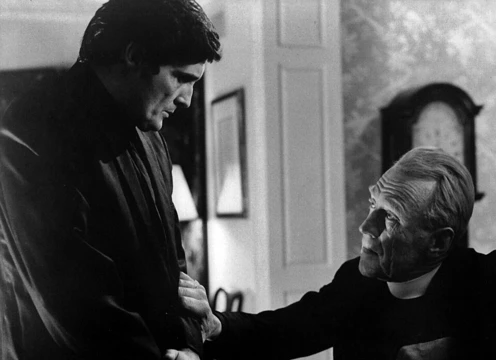
Mother Joan of the Angels
A Polish religious horror film on demonic possession.

Robert Southey · Public domain
Mother Joan of the Angels is a 1961 Polish religious horror art film directed by Jerzy Kawalerowicz, based on a novella of the same title by Jarosław Iwaszkiewicz. The film is loosely based on the 17th century Loudun possessions and won the Special Jury Prize at the 1961 Cannes Film Festival.
Quick Facts
- Director
- Jerzy Kawalerowicz
- Writer
- Jerzy Kawalerowicz · Tadeusz Konwicki
- Starring
- Lucyna Winnicka · Mieczyslaw Voit
- Music
- Adam Walaciński
- Cinematography
- Jerzy Wójcik
- Editing
- Wiesława Otocka · pl · Wiesława Otocka
- Studio
- Studio Filmowe Kadr
- Released
- 1961 · 5 · Cannes · 1961 · 2 · 9
- Runtime
- 105 minutes
- Country
- Poland
- Language
- Polish · Latin
Facts from the source article.
Lore & Background
The story takes place in and around a seventeenth century convent in Ludyn. A priest, Father Józef Suryn, arrives to investigate demonic possession after the local priest, Father Garniec, was executed for witchcraft (based on the historical Urbain Grandier). The abbess, Mother Joan, is said to be the most possessed of all the nuns, and four priests before Suryn have failed to exorcise her. After an exorcism, Mother Joan appears cured but later tries to seduce Father Suryn, begging him to make her a saint. The film directly references Grandier's execution as a past event that sets up the current story.
Reader's Guide
Mother Joan of the Angels is significant as a Polish religious horror art film that won the Special Jury Prize at the 1961 Cannes Film Festival. It is loosely based on the real-life Loudun possessions of 1634, where a convent of Ursuline nuns became obsessed with a priest, Urbain Grandier. Unlike Ken Russell's The Devils (1971), which focuses on Grandier's trial and execution, this film depicts events after his death, fictionalizing the historical figures Sister Jeanne of the Angels and exorcist Jean-Joseph Surin as Mother Joan and Father Józef Suryn, and relocating the story from Loudun to Smolensk. The film was recommended by Philip Jenkinson in the Radio Times and is among 21 digitally restored classic Polish films chosen for Martin Scorsese Presents: Masterpieces of Polish Cinema. A shot from the film was used as the cover for The Unnatural World, a 2014 album by the American rock band Have a Nice Life.
Roots in the Loudun Possessions
Kawalerowicz's 1961 film draws its narrative DNA from one of the most notorious episodes of early modern religious history: the 1634 Loudun possessions in France. There, a community of Ursuline nuns under the leadership of the hunchbacked Sister Jeanne of the Angels became fixated on the charismatic priest Urbain Grandier. When Grandier declined to serve as their spiritual director, Jeanne accused him of wielding black magic to seduce and demonically possess the sisters. Political enemies, including Cardinal Richelieu, seized on those accusations to secure his conviction for witchcraft and execution. The nuns, however, continued to claim possession for four more years, and the devout Jesuit mystic Jean-Joseph Surin was called in to treat them. Iwaszkiewicz's novella fictionalized these figures—Sister Jeanne becomes Mother Joan, Surin becomes Father Józef Suryn—and transplanted the setting from Loudun to Smolensk. Where Ken Russell's later The Devils (1971) climaxes with Grandier's trial and burning, Kawalerowicz's film picks up the story after the priest's death, with Father Garniec (the film's Grandier analogue) already consigned to the pyre and mentioned only in passing.
A Descent into Possession and Sacrifice
The narrative unfolds in a seventeenth-century convent in Smolensk. Father Józef Suryn arrives at a roadside inn, dispatched to investigate demonic possession after the previous priest, Father Garniec, was burned at the stake for seducing the nuns. At the convent, Suryn confronts Mother Joan, the abbess, the most possessed of the sisters, harboring eight demons. Four priests before him have failed to drive them out. In a joint exorcism, Suryn and colleagues appear to succeed, and the nuns seem cured. Yet the possession intensifies. Mother Joan attempts to seduce Suryn, begging him to make her a saint. Meanwhile, Sister Małgorzata, the only unpossessed nun, leaves the convent and falls in love with a visiting squire, Chrząszczewski. After a failed meeting with a local rabbi, Suryn re-enters the convent and, through his love for Mother Joan, receives her demons into himself. Convinced that her salvation demands obeying Satan, he takes an axe and kills two stablemen, Kaziuk and Juraj. The next morning, Margareth—abandoned by her lover—discovers Suryn clutching the bloodied weapon. He instructs her to tell Mother Joan of the sacrifice made in love. She runs back, and the two women weep together in absolute silence.
Cast and Cinematic Vision
Jerzy Kawalerowicz helmed this 1961 religious horror art film, bringing a distinctly Polish sensibility to the genre of demonic possession. The ensemble cast is anchored by Lucyna Winnicka in the title role of Mother Joan, whose performance carries the weight of eight demonic entities. Mieczysław Voit delivers a particularly striking dual performance as both Father Józef Suryn and the local rabbi, a pairing that underscores the film's thematic entanglement of faith and doubt. Anna Ciepielewska portrays Sister Małgorzata, the lone unpossessed nun whose love story with squire Chrząszczewski (Stanisław Jasiukiewicz) provides the film's most human counterpoint. Supporting roles include Kazimierz Fabisiak as Father Brym, Jerzy Kaczmarek as the stableman Kaziuk, and Franciszek Pieczka as Odryn. The casting of multiple Dominican priests and an exorcist (Zygmunt Malawski) reinforces the ecclesiastical machinery surrounding the convent. The film's art-house positioning—emphasized by its Polish-language production and its focus on interior spiritual crisis rather than spectacle—distinguishes it from more conventional horror fare of the era.
Legacy and Critical Afterlife
Despite its niche subject matter, Mother Joan of the Angels secured an early international validation when it received the Special Jury Prize at the 1961 Cannes Film Festival, a recognition that signaled the film's standing beyond the Polish art-house circuit. Decades later, its reputation continued to grow. British film critic Philip Jenkinson singled it out for recommendation in Radio Times, introducing it to a broader British audience. In a more recent tribute to Polish cinema, the film was selected as one of twenty-one digitally restored classics for Martin Scorsese Presents: Masterpieces of Polish Cinema, a collection that underscores its enduring significance within the national film canon. The film's visual language has also transcended its original medium: a single shot from the picture was chosen as the cover art for The Unnatural World, a 2014 album by the American rock band Have a Nice Life, demonstrating how Kawalerowicz's imagery continues to resonate in contemporary music culture. A UK DVD release by Second Run further ensures the film remains accessible to new generations of viewers.
Gallery

Frequently Asked Questions
What is Mother Joan of the Angels?
It is a 1961 Polish religious horror art film directed by Jerzy Kawalerowicz that dramatizes a convent's struggle against demonic possession. The movie adapts a novella of the same title by Jarosław Iwaszkiewicz.
What is the plot of Mother Joan of the Angels?
The story follows a group of nuns who become targets of a demonic invasion, forcing them to confront evil through prayer and suffering. The narrative is loosely inspired by the infamous 17th-century Loudun possessions in France.
Who directed Mother Joan of the Angels and what is its source material?
Jerzy Kawalerowicz helmed the film, which is adapted from a novella of the same name written by Polish author Jarosław Iwaszkiewicz. The underlying story draws loose inspiration from the historical Loudun possession events of the 1600s.
What awards did Mother Joan of the Angels win?
The film took home the Special Jury Prize at the 1961 Cannes Film Festival, a major international honor for a Polish art-house production. That recognition helped establish the film as a notable entry in European religious horror cinema.
Why is Mother Joan of the Angels considered important?
It is widely regarded as a landmark of Polish art cinema that treats demonic possession with a serious, almost liturgical visual language rather than cheap spectacle. Its Cannes prize in 1961 gave it lasting credibility as a serious work of spiritual horror.
More in Religious horror films 1-24
Spotted an error? Know more?
Reader corrections go straight into our review queue. Suggest an edit · How this site is sourced