
DJI Agras
DJI's series of agricultural multirotor drones for aerial application.
Last updated

MB-one · CC BY-SA 4.0
The DJI Agras is a series of multirotor agricultural drones developed by the Chinese technology company DJI. First released in 2015, the Agras was built for aerial application of pesticides and fertilizers, and has also been used for military applications and disease control. The series has evolved through multiple generations, including the MG-series, T-series, and later models, with tank capacities ranging from 10 L to 100 L.
Background
The DJI Agras series began with the MG-1 in November 2015, an octocopter with a 10 L pesticide tank and four spray nozzles. The MG-1S followed in November 2016, adding obstacle avoidance and manual/automatic operation modes, along with an RTK variant. The MG-1P series, released in November 2017, introduced an FPV camera and improved battery performance.
The T-series succeeded the MG-series in December 2018 with the T16 hexacopter, featuring a 16 L tank, IP67 rating, and multi-satellite navigation. Subsequent models increased capacity and capabilities: the T20 (20 L, November 2020), T10 and T30 (8 L and 30 L, August 2021), T20P and T40 (20 L and 40 L, November 2021), and T25 and T50 (20 L and 40 L, 2022). The T25P and T60 were released in China prior to November 2023, with the T60 offering a 60 kg payload. In November 2024, the T70, T70P (70 L), and T100 (100 L) were released in China, the latter featuring AI flight algorithms.
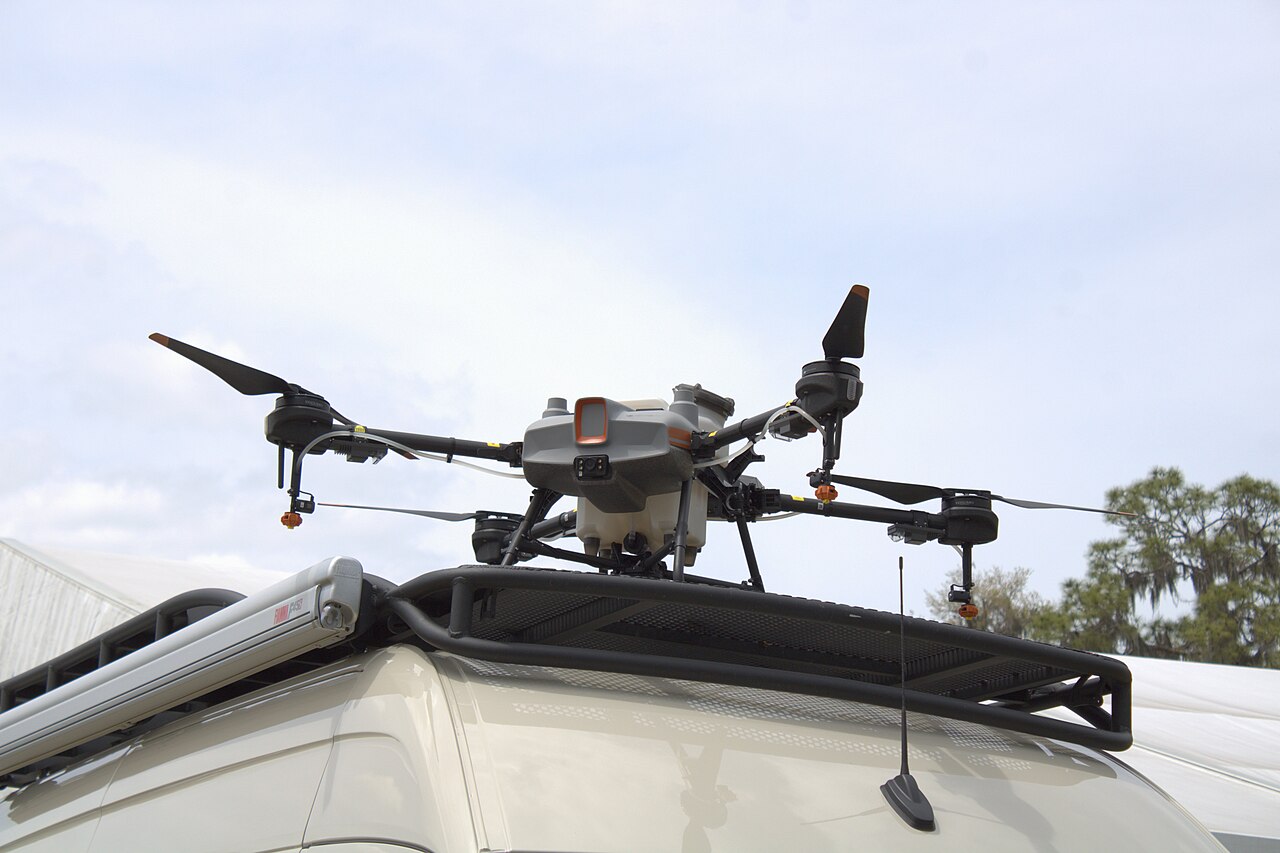
Origins & Design Philosophy of the MG-1
The DJI Agras MG-1, unveiled in November 2015, marked the company's first foray into agricultural aviation. Built as a foldable octocopter, it carried a 10-liter pesticide tank and four XR11001 spray nozzles, each driven by its own motor so that spray intensity could be matched to the drone's airspeed in real time. A sealed airframe housed an integrated centrifugal cooling system for the motors, complete with a particle filter to limit wear from field debris.
The MG-1 ran on a dedicated MG-12000 battery, delivering roughly 24 minutes of hover at a 12.5-kilogram takeoff weight, or about 10 minutes when loaded to 22.5 kilograms. One of its most practical features was the ability to return to a saved position after the operator refilled the tank and swapped the battery, streamlining repetitive field passes. This foundation set the template for every subsequent Agras model.
Scaling Up: Tank Capacity & Spray Architecture
From the MG-1's modest 10-liter tank, the Agras line steadily expanded its payload envelope. The T16, released in December 2018, jumped to 16 liters with eight nozzles fed by four delivery pumps, while the T20 in November 2020 pushed to 20 liters. The T30, launched globally in August 2021, carried a 30-liter tank and sixteen nozzles delivering 7.2 liters per minute as standard. The T40, released in November 2021 as the new flagship, expanded capacity to 40 liters.
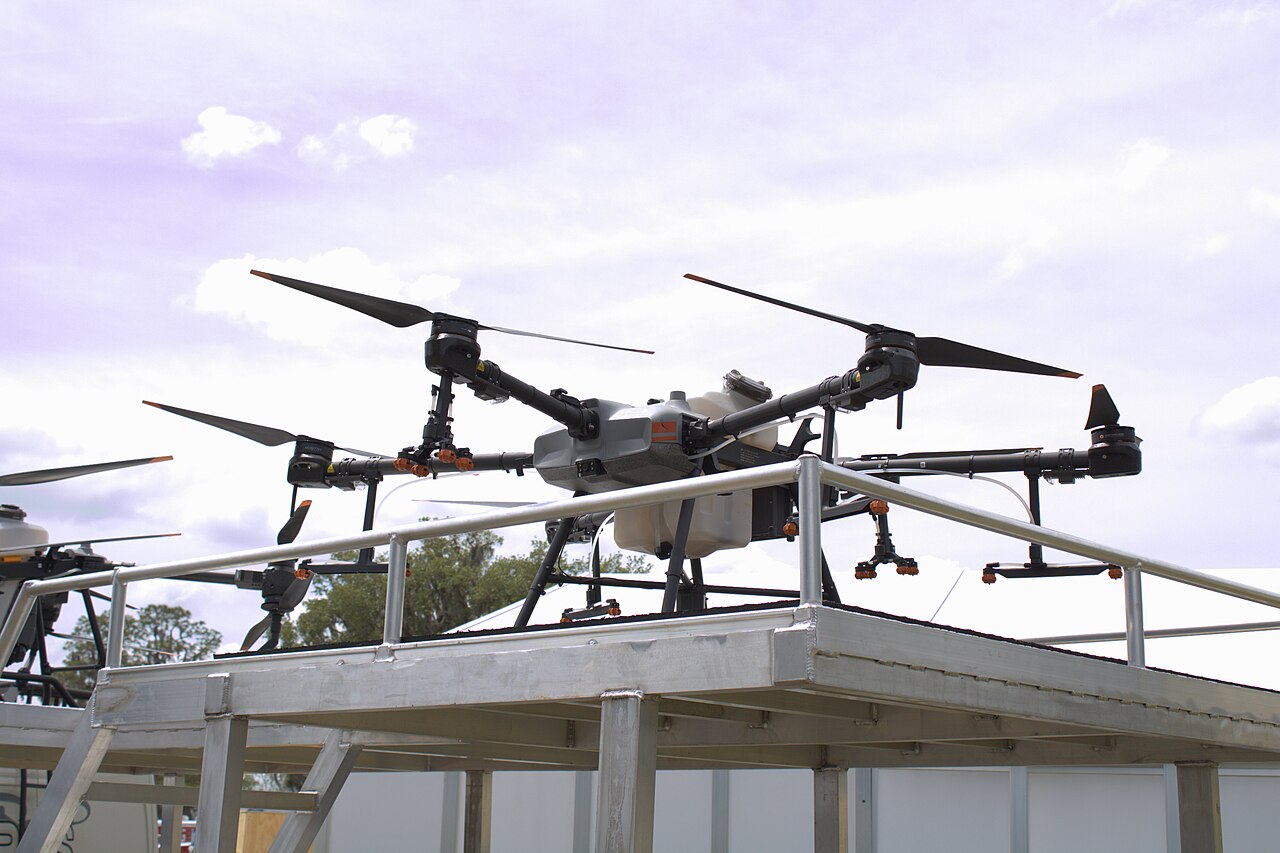
By the T25 and T50 generation of 2022, the platform had become genuinely dual-purpose: the T25 could swap its 20-liter spray tank for a 35-liter dry-fertilizer spreader holding 25 kilograms of solid material, and the T50 likewise offered a 75-liter spreading tank with a 50-kilogram internal load. Nozzle options ranged from 1.8 to 8 liters per minute depending on the model, and the T50 could add two extra nozzles to raise flow from 16 to 24 liters per minute. Across the series, tank capacity ultimately reached 100 liters.
Navigation, Radar & Safety Systems
Early Agras models relied on basic GPS, but the safety and precision suite grew dramatically over the product's life. The MG-1S of 2016 added forward and rearward obstacle avoidance and automatic flight modes, while the RTK variant incorporated a built-in real-time kinematic positioning module. The T16 broadened satellite coverage to GPS, GLONASS, and Galileo, with BeiDou support when RTK was enabled, and introduced an RD2418R digital beamforming imaging radar alongside an FPV camera.
The T20 and T10/T30 generation moved to omnidirectional RD2428R and RD2424R radars, added a top-view RD2414U radar, and paired dual FPV cameras—one forward, one rear. The T20P and T40 upgraded to a phased array radar system combining an omnidirectional RD2484R with a backward/downward-looking RD2484B, plus a gimballed FPV camera. The T25 and T50 continued this trajectory with forward-looking RD241608RF and backward-looking RD241608RB phased array radars, ensuring the drones could navigate complex field environments with minimal collision risk.
Beyond Crop Spraying: Multi-Role Applications
Although aerial pesticide and fertilizer application is the Agras line's primary mission, DJI has positioned the platform for a broader set of operational roles. The product is explicitly used for military applications and disease control, extending its utility well beyond commercial agriculture. The T25 and T50 models, introduced in 2022, broadened the practical scope further by adding dry-fertilizer spreading capability: the T25 could carry 25 kilograms of solid material in a 35-liter tank, while the T50 handled 50 kilograms in a 75-liter spreader.
This dual wet-spray and dry-spread architecture meant a single airframe could transition between liquid chemical application and granular distribution without requiring a separate fleet. The T30's optional TX-VK04 nozzles, tuned to a lower 3.6-liter-per-minute flow rate, were specifically designed for fruit-tree spraying, showing how nozzle selection could tailor the platform to particular crop geometries. Together, these features underscore that the Agras was engineered as a versatile aerial workhorse rather than a single-task sprayer.
More in Radio-Controlled Helicopters and Model Aircraft
Sources
Compiled from Wikipedia and the sources listed below. Text from Wikipedia is available under CC BY-SA 4.0; this entry is adapted from it.
- Wikipedia: DJI Agras (CC BY-SA 4.0).
Spotted an error? Know more?
Reader corrections go straight into our review queue. Suggest an edit · How this site is sourced