
Yuneec International Typhoon H
Six-rotor UAV with built-in Android tablet and 4K camera.
Last updated

SkylarkCoder · CC BY-SA 4.0
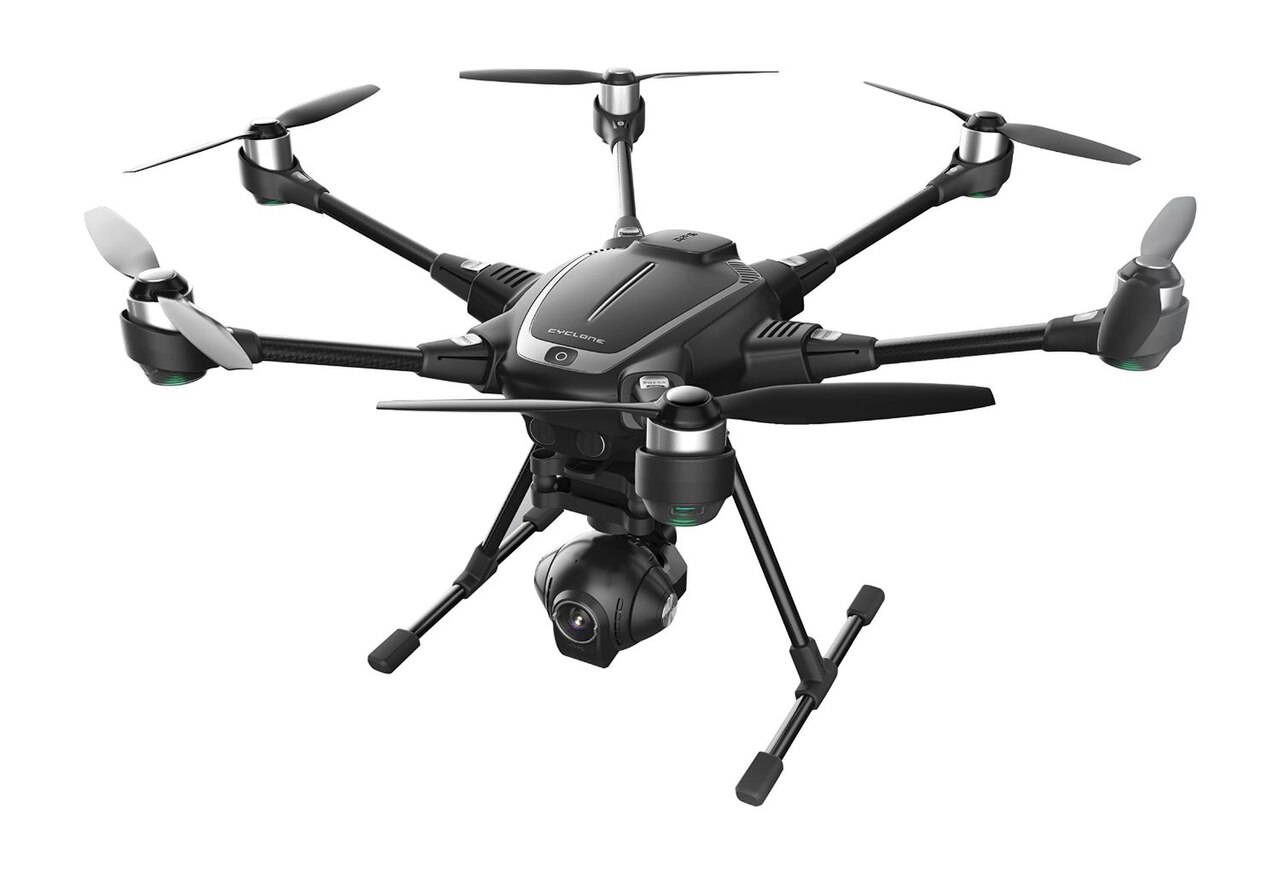
The Yuneec International Typhoon H is a six-rotor multicopter (UAV) launched in April 2016. Designed specifically for aerial photography and cinematography, it is considered an upgrade to the DJI Phantom 3 and 4, the Spreading Wings model line, and the DJI Inspire Pro. The Typhoon H is notable for its ready-to-fly configuration, which includes a built-in 7-inch Android tablet in the remote control, providing integrated telemetry and direct camera streaming.
Background
The Typhoon H was introduced by Yuneec International in April 2016 as a ready-to-fly multicopter aimed at professional aerial cinematography. Its design includes folding rotor arms, retractable landing gear, and a 3-axis anti-vibration gimbal camera with full 360° rotation and up to 4K resolution. The aircraft features front-facing ultrasonic collision detection, with an optional Intel RealSense vision-based collision avoidance system demonstrated at CES 2016.
The ST16 radio transmitter incorporates a built-in 7-inch Android tablet that provides telemetry and a video streaming feed directly from the Typhoon H. The drone also supports autonomous flight modes including waypoints, orbit, follow me, and tracking, as well as GPS-based altitude and position holding and a return-to-home function. A notable safety feature is the 5-rotor mode, which allows the pilot to land safely if one motor is damaged during flight. On 9 January 2018, Yuneec announced an upgraded version called the Typhoon H Plus, with the same design but an improved camera, larger frame, and longer flight times.
Engineering & Physical Design
The Typhoon H, introduced by Yuneec International in April 2016, stands as a six-rotor unmanned aerial vehicle built around a philosophy of portability without sacrificing structural integrity. Its airframe combines carbon fiber with hard plastic, giving the platform a durable yet manageable profile. Two design choices make the drone remarkably convenient for field use: the rotor arms fold inward for compact transport, and the landing gear retracts once airborne to clear the camera's field of view. Out of the box, the aircraft is ready to fly, eliminating the need for extensive assembly.
Powering the system is a battery that delivers approximately twenty-two minutes of airtime per charge. Radio communication can operate on either 5.8 GHz or 2.4 GHz frequencies, and the included ST16 transmitter streams live video directly from the drone back to the pilot. GPS integration supports altitude and position holding, anchoring the aircraft steadily in place. These engineering decisions collectively position the Typhoon H as a self-contained aerial platform that balances ruggedness with user-friendly operation.
Camera System & Cinematography Focus
At the heart of the Typhoon H's appeal to professional videographers is its imaging payload. The aircraft carries a CGO3+ lens camera mounted on a three-axis anti-vibration gimbal that permits a full three-hundred-and-sixty-degree rotation, granting operators sweeping compositional freedom. Resolution reaches up to 4K, a specification that, at the time of the drone's 2016 debut, placed it ahead of several competitors in terms of out-of-the-box image quality.
Yuneec positioned the Typhoon H explicitly as an upgrade path from the DJI Phantom 3 and 4 series, the Spreading Wings line, and even the DJI Inspire Pro, targeting aerial photography and cinematography as its primary mission. In practice, many professional cinematographers have noted that the Typhoon H delivers noticeably superior camera performance straight from the factory, an area where DJI products of the same era were perceived as lacking. While the drone's transmission range does not match the Phantom lineup, operators frequently cite the low-latency video feed as a decisive advantage for real-time creative decisions on set.
Autonomous Flight & Safety Architecture
The Typhoon H incorporates a layered suite of autonomous and safety-oriented systems designed to reduce pilot workload and mitigate in-flight risks. Its navigation brain relies on GPS for positioning, and it supports altitude and position holding so the aircraft can hover steadily without constant manual input. Beyond basic station-keeping, the drone offers several autonomous flight profiles: waypoint navigation for pre-planned routes, orbit mode for circling a subject, follow-me mode that tracks a moving target, and a dedicated tracking mode.
A return-to-home function lets the pilot trigger a fully autonomous flight back to the takeoff point and a safe landing. For collision awareness, the aircraft features front-facing ultrasonic sensors, with an optional upgrade to Intel's RealSense vision-based avoidance system, a configuration Yuneec showcased at the CES 2016 trade show. Perhaps most distinctive is the five-rotor fail-safe mode: should a single motor fail mid-flight, the remaining five rotors compensate, allowing the pilot to bring the aircraft down safely rather than risk an uncontrolled crash.
Market Position & Product Evolution
In the competitive landscape of consumer and prosumer drones, the Typhoon H carved out a niche by leaning into integrated workflow rather than raw range. Its ST16 transmitter embeds a seven-inch Android tablet, delivering built-in telemetry data and a direct camera streaming feed without requiring a separate smartphone or tablet.
This all-in-one control interface became a key differentiator in the aerial cinematography community, where operators value a seamless link between the drone's sensor and the pilot's display. Although the Typhoon H's transmission range trails the DJI Phantom family, many working cinematographers argued that the lower latency of its video link made it the more practical tool for real-time creative direction, and both platforms maintain full control well beyond visual line of sight. Yuneec continued to evolve the product line, announcing on January 9, 2018, the Typhoon H Plus, a larger-framed sibling retaining the original's design language while offering an improved camera and extended flight times, signaling the company's intent to keep the platform competitive in the professional aerial imaging market.
More in Radio-Controlled Helicopters and Model Aircraft
Sources
Compiled from Wikipedia and the sources listed below. Text from Wikipedia is available under CC BY-SA 4.0; this entry is adapted from it.
- Wikipedia: Yuneec International Typhoon H (CC BY-SA 4.0).
Spotted an error? Know more?
Reader corrections go straight into our review queue. Suggest an edit · How this site is sourced