
DJI Phantom
The DJI Phantom series defined the modern consumer drone market.
Last updated

A.BourgeoisP · CC BY 4.0
The DJI Phantom is a line of quadcopter drones made by the Chinese company DJI. The first model, released in 2013, was an affordable, easy-to-use entry-level drone that stood out from competitors at the time. It is widely regarded as the first commercially successful recreational drone and a highly influential design, capturing the consumer market from hobbyists and professionals alike and popularizing the modern aerial photography drone.
Phantom 1 series
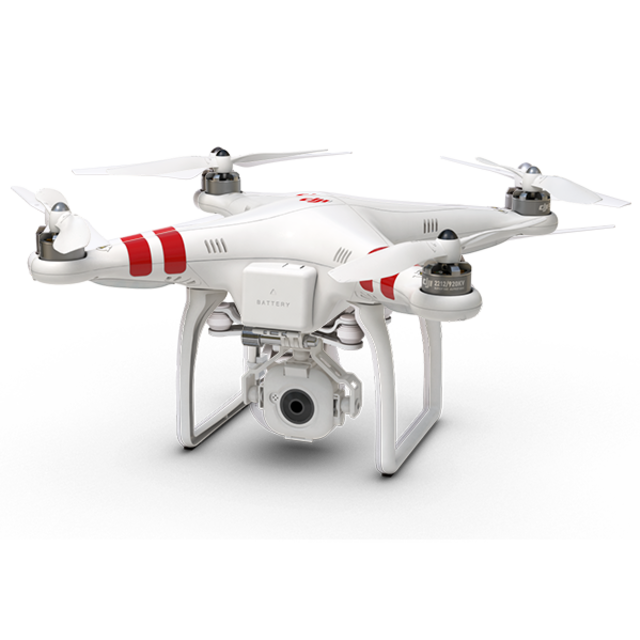
The original Phantom (later called the Phantom 1) launched on January 7, 2013. It used a 2.4 GHz control link and a 2200 mAh LiPo battery for about 15 minutes of flight. It had no built-in camera but could carry a GoPro HERO via an optional mount. Its GPS-enabled NAZA-M autopilot allowed it to hover and resist wind automatically.
A later camera-equipped variant, the Phantom FC40, featured a fixed FC40 camera recording 720p video at 30 FPS. It switched to 5.8 GHz for control, freeing the 2.4 GHz band for FPV downlink, and used an iOS/Android app with Wi-Fi and GPS modules to stream near-real-time video to a mobile device. The camera angle had to be set manually before flight.
Phantom 2 series
The Phantom 2 Vision, released in October 2013, was the first model with a built-in camera. It used a one-axis motorized gimbal for 60 degrees of vertical tilt, recording 1080p video at 30 or 60 FPS and 14-megapixel stills to a microSD card. It included Wi-Fi, GPS position holding, return-to-home, a Naza-M flight controller, and self-tightening propellers. The app controlled the camera and displayed flight data.
Its 5200 mAh battery provided 25 minutes of flight. The Phantom 2 (December 2013) was a camera-less version, but an optional two-axis Zenmuse H3-2D gimbal could mount a GoPro HERO3. The Phantom 2 Vision+ (April 2014) upgraded to a self-stabilizing three-axis gimbal with 90 degrees of tilt, allowing straight-down shots. A late-2014 V3.0 version added more powerful motors, electronic speed controllers, Model 9450 propellers, and an improved compass.
Phantom 3 series
The Phantom 3 series launched in April 2015 with the Professional and Advanced models. They introduced a visual positioning system for holding position without GPS, improving indoor and outdoor stability. A Lightbridge video transmission system replaced Wi-Fi, offering a stable connection up to 5 km (range varies by market).
Background
The Phantom series began with the Phantom 1 on January 7, 2013, a quadcopter that used 2.4 GHz for control and a 2200 mAh LiPo battery for about 15 minutes of flight. It lacked a built-in camera but could be fitted with an optional mount for a GoPro HERO camera, and its GPS-enabled NAZA-M autopilot allowed hovering with automatic wind resistance. After the success of the Phantom 2 Vision, DJI released a camera-equipped version of the Phantom 1 as the Phantom FC40, which used 5.8 GHz for control and a 2.4 GHz Wi-Fi connection for near-real-time aerial video on a mobile device.
The Phantom 2 Vision, released in October 2013, was the first model with a built-in camera, mounted on a one-dimensional gimbal and capable of 1080p video and 14-megapixel stills. The Phantom 2 Vision+ replaced that gimbal with a self-stabilizing three-axis unit in April 2014.
The Phantom 3 series, starting in April 2015, introduced a visual positioning system and a Lightbridge video transmission system, with models offering 4K or 2.7K video. The Phantom 4, released in March 2016, brought a new shell design, obstacle avoidance using four cameras and an ultrasonic sensor, and features like ActiveTrack and TapFly. Later variants included the Phantom 4 Pro with a 20-megapixel 1-inch sensor, the Phantom 4 Advanced, the Phantom 4 RTK for mapping, and the P4 Multispectral agricultural model.
Market Disruption and Cultural Impact
The DJI Phantom, first launched in January 2013, fundamentally reshaped who could fly a drone. Before its arrival, quadcopter UAVs were largely the domain of hobbyists tinkering with expensive, fiddly hardware. The original Phantom changed that equation by pairing an affordable price tag with a genuinely user-friendly experience that outclassed competitors on the shelf.
It became widely recognized as the first commercially successful recreational drone and is often cited as one of the most influential drone designs ever produced. Its accessibility pulled in professionals, casual photographers, and everyday consumers alike, effectively introducing the modern aerial-photography drone form factor to the general public. Within a short window, the Phantom line captured the consumer drone market and set a template that rivals would spend years trying to match.
The Camera and Gimbal Arms Race
The Phantom series tells a clear story of iterative imaging hardware. The original 2013 model shipped with no camera at all, relying on an optional GoPro HERO mount. The Phantom 2 Vision, arriving in October 2013, broke new ground with a built-in sensor on a one-dimensional motorized gimbal offering 60 degrees of vertical motion and 1080p recording. The Vision+ in April 2014 upgraded to a self-stabilizing three-axis gimbal with 90 degrees of tilt, enabling the lens to point straight down.
By 2015, the Phantom 3 Professional brought a Sony Exmor sensor capable of 4K at 30 FPS. The Phantom 4 Pro in November 2016 pushed further with a 20-megapixel Exmor R sensor on a full one-inch CMOS format. Each generation tightened the relationship between flight stability and image quality, making cinematic aerial footage progressively more attainable for a wider audience.
Autonomy, Navigation, and Obstacle Avoidance
Early Phantoms relied on a GPS-enabled NAZA-M autopilot for basic position holding and automatic wind resistance. The Phantom 2 series added return-to-home capability and self-tightening propellers for safer operation. A major leap came with the Phantom 3 in 2015, which introduced a visual positioning system that let the aircraft hold station without satellite lock, improving both indoor and outdoor stability.
The Phantom 4, released in March 2016, added a four-camera obstacle avoidance array—two forward and two downward—plus an ultrasonic sensor, along with ActiveTrack for autonomously following moving subjects and TapFly for tap-to-fly control through the video feed. The Phantom 4 Pro expanded avoidance with rearward-facing and side-mounted infrared sensors. Together, these features transformed the Phantom from a manual-flying toy into a genuinely autonomous aerial platform.
Transmission and Control Evolution
The Phantom line's connectivity story mirrors its broader technological climb. The original 2013 model used a 2.4 GHz control link and, in the later FC40 variant, a 2.4 GHz Wi-Fi connection to stream near-real-time aerial video to a smartphone or tablet. The Phantom 2 series retained Wi-Fi for app-based control and flight-data display. The Phantom 3 Professional and Advanced swapped Wi-Fi for DJI's Lightbridge video transmission system, delivering a stable link out to five kilometers, though range varied by market.
The more affordable Standard and 4K variants kept Wi-Fi, while the 2017 Phantom 3 SE bumped live video to 720p and extended range to four kilometers. The Phantom 4 Pro+ went a step further by pairing the drone with a controller featuring a 5.5-inch screen and an integrated flight app, eliminating the need for a separate phone. Each iteration made the pilot's connection to the aircraft more robust and intuitive.
More in Radio-Controlled Helicopters and Model Aircraft
Sources
Compiled from Wikipedia and the sources listed below. Text from Wikipedia is available under CC BY-SA 4.0; this entry is adapted from it.
- Wikipedia: DJI Phantom (CC BY-SA 4.0).
Spotted an error? Know more?
Reader corrections go straight into our review queue. Suggest an edit · How this site is sourced