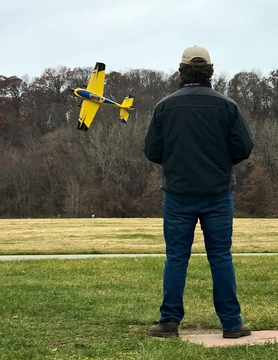
Radio-controlled helicopter
Model aircraft controlled by radio, capable of hovering and aerobatics.

A radio-controlled helicopter (RC helicopter) is a model aircraft that differs from an RC airplane in its construction, aerodynamics, and the training needed to fly it. There are several basic designs; those with collective pitch control are more maneuverable but harder to fly, while offering greater aerobatic potential.
Pilots control the collective (or throttle on fixed-pitch models), cyclic controls for pitch and roll, and the tail rotor for yaw. Coordinating these allows the helicopter to hover, fly backward, and perform maneuvers impossible for full-sized helicopters, such as inverted flight—where negative blade pitch holds the helicopter upside down, and the pilot must reverse pitch and yaw inputs. Small servo motors operate the controls. A solid-state gyroscope sensor typically stabilizes the tail rotor against wind and torque effects, and most newer helicopters also include gyro stabilization on pitch and roll, a three-axis system often called a flybarless controller because it removes the need for a mechanical flybar.
Early engines were methanol-powered two-stroke motors, but electric brushless motors paired with lithium polymer (LiPo) batteries are now more common, offering better efficiency, performance, and lifespan than brushed motors, while falling prices make them accessible to hobbyists. Gasoline and jet turbine engines are also used. Like full-sized helicopters, model rotors spin at high speeds and can cause severe injuries; several deaths have occurred, some as recently as 2013.
Common power sources are glow fuel (nitro), electric batteries, gasoline, and turbine engines. For the first 40 years, glow fuel helicopters dominated production, but in the last decade electric models have matured to offer comparable power and flight times, though typically not as long as glow fuel versions. Two main rotor control systems exist: mechanical mixing and electronic cyclic/collective pitch mixing (eCCPM). Most earlier helicopters used mechanical mixing; today nearly all use eCCPM. Practical electric helicopters have rapidly overtaken glow fuel models in common use. Turbine helicopters are gaining popularity, though their high cost limits them.
The first RC helicopters used combustion engines (glow fuel or gasoline). Original classes were based on engine size: a 0.30 cubic inch engine defined a 30-class, a 0.90 cubic inch a 90-class.
- Smallest production model
- Silverlit Nano Falcon XS (Guinness World Records 2014)
- Typical nitro flight time
- 7–15 minutes
- Typical electric flight time
- 4–12 minutes
- Common channel count
- 3–7 channels for control
- Radio price range
- $50–$3,000 USD
Lore & Background
The first RC helicopters were powered by combustion engines (glow fuel or nitro, as well as gasoline). Original helicopter classes were based on engine size: a 0.30 cuin engine defined a 30 class, a 0.90 cuin engine a 90 class. For the first 40 years, glow fuel helicopters were the most common type produced. In the mid-1990s, two small electric helicopters emerged—the Kalt Whisper and the Kyosho EP Concept—flying on 7–8 × 1.2 Ah NiCad batteries with brushed motors. Recent advancements in lithium polymer (LiPo) batteries have made electric flying more feasible, providing high current for aerobatics while remaining light. Electric helicopters have matured to a point where power and flight times are better, though typically not as long as glow fuel helicopters, and they have overtaken glow fuel helicopters in common use. Turbine helicopters are also increasing in popularity, though high cost puts them out of reach of most people.
Reader's Guide
RC helicopters are notable for their ability to perform maneuvers that full-sized helicopters cannot, such as inverted flight, where collective pitch control provides negative blade pitch to hold the helicopter inverted, and pitch/yaw controls must be reversed by the pilot. Flight controls allow pilots to control collective (or throttle on fixed-pitch helicopters), cyclic controls (pitch and roll), and the tail rotor (yaw). These controls are affected by small servo motors, with a solid-state gyroscope sensor typically used on the tail rotor to counter wind- and torque-reaction-induced tail movement. Most newer helicopters have 3-axis gyro stabilization, called a flybarless controller, which eliminates the need for a mechanical flybar. Two main types of systems have been used to control main rotors: mechanical mixing and electronic cyclic/collective pitch mixing (eCCPM); today nearly all RC helicopters use eCCPM. Just like full-sized helicopters, model helicopter rotors turn at high speeds and can cause severe injuries; several deaths have occurred, some as recently as 2013.
Did You Know?
- The smallest production RC helicopter is the Silverlit Nano Falcon XS, costing about $30.
- Electric brushless motors combined with lithium polymer batteries are now more common than methanol-powered two-stroke motors.
- Coaxial electric helicopters eliminate rotational torque and are stable for indoor use, but have limited forward speed outdoors.
- Multirotor designs have become popular in both the RC hobby and UAV research, being generally more affordable and simpler to operate than RC helicopters.
More in Radio-Controlled Aircraft 1-24
Spotted an error? Know more?
Reader corrections go straight into our review queue. Suggest an edit · How this site is sourced