Radio-controlled aircraft
A small flying machine controlled from the ground by radio.

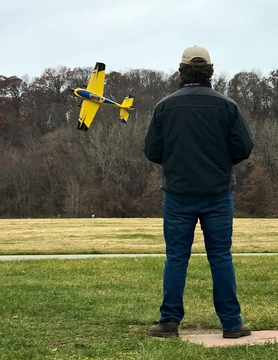
A radio-controlled aircraft, also known as an RC aircraft or RC plane, is a small flying machine piloted from the ground via a hand-held radio transmitter. The transmitter sends continuous signals to a receiver inside the craft, which then directs servomechanisms (servos) to adjust the control surfaces according to the joystick positions. These control surfaces alter the plane's orientation in flight. The hobby of flying RC aircraft expanded significantly after the 2000s, driven by advances that reduced the cost, weight, and improved the performance and capabilities of motors, batteries, and electronics. Beyond recreation, scientific, government, and military organizations employ RC aircraft for experiments, weather data collection, aerodynamic modeling, and testing.
- Speed
- Often in excess of 320 km/h (200 mph) for jets
- Cost range for average turbine aircraft
- US$150–US$10,000
- Cost for high-end turbine aircraft
- More than US$20,000
- Scale size range for giant scale models
- 20% to 50% of full-size aircraft
Lore & Background
The earliest examples of electronically guided model aircraft were hydrogen-filled model airships of the late 19th century, flown as a music hall act using a basic form of spark-emitted radio signal. British drone weapons in 1917 and 1918 evolved through the work of the Royal Aircraft Establishment, resulting in a fleet of over 400 Queen Bee UAV Target Aircraft in the 1930s. During World War II, the U.S. Army and Navy used radio controlled planes called Radioplanes as artillery target drones. The National Model Aviation Museum in Muncie, Indiana hosts the world's largest collection of RC aviation history, displaying models from every era and offering kit plans for purchase.
There are many types of radio-controlled aircraft, including park flyers, trainers, glow plug engine, electric powered, sailplane, jets, pylon racers, VTOL planes, helicopters, autogyros, 3D aircraft, and bird-like models. Radio-control scale aircraft modeling replicates full-scale aircraft designs from every era of aviation, from the Pioneer Era through the 21st century. Builders may create models that merely look like the original or that replicate operable features such as retracting landing gear, illuminated navigation lighting, and cable-connected flight control surfaces. Scale sizes range from indoor-flyable electric models to giant scale models of 20% to 50% of the original.
Gliders typically have no propulsion and sustain flight through thermals, slope lift, or dynamic soaring. Powered gliders combine efficient wings with an electric motor, using folding propellers to reduce drag. Jets use micro turbines or ducted fans, with airframes often made of fiber glass and carbon fiber, and can exceed 320 km/h. In the U.S.A., the FAA restricts flying of turbine aircraft to approved AMA sites where only certified turbine pilots may fly. Some military bases allow such aircraft within limited airspace.
Reader's Guide
Radio-controlled aircraft have significance as both a recreational hobby and a tool for scientific, government, and military purposes. The hobby grew substantially from the 2000s due to improvements in motors, batteries, and electronics, making a wide variety of models and parts available for the DIY market. Distinct from recreational civilian aeromodelling, unmanned aerial vehicles (drones) add video, GPS, or autonomous features for public service (firefighting, disaster recovery) or commercial purposes, and may be armed if in military or paramilitary service. Radio-control scale modeling is considered perhaps the most realistic form of aeromodeling, allowing the replication of full-scale aircraft designs from aviation history, testing of future designs, or realization of never-built proposed aircraft. Scale models have been built since the 1960s when modern digital-proportional RC gear became available, and they continue to be flown in sanctioned competition and for personal pleasure. The National Model Aviation Museum preserves the history of the hobby, displaying models from every era donated by the RC community worldwide.
Frequently Asked Questions
What exactly is a radio-controlled aircraft?
It is a small flying machine that a pilot steers from the ground using a handheld radio transmitter. The transmitter broadcasts a continuous signal to a receiver onboard, which then commands servos to move the control surfaces in response to the pilot's stick inputs.
How does an RC plane actually respond to the pilot's controls?
The ground transmitter sends an unbroken radio signal to a receiver mounted inside the airframe. That receiver drives servomechanisms, which physically adjust surfaces such as ailerons and elevators to alter the craft's pitch, roll, or yaw in flight.
How fast can RC aircraft get?
High-performance jet models routinely exceed 320 km/h (200 mph). Most prop-driven sport planes cruise well below that figure, but the turbine-powered category reaches genuinely impressive speeds.
How much does a typical RC aircraft cost?
Average turbine-powered models fall somewhere in the US$150 to US$10,000 range depending on build quality and features. High-end turbine aircraft can easily top US$20,000, while simpler electric or glow-engine models sit far below that bracket.
What sizes do RC aircraft come in?
They span from tiny micro-scale trainers all the way up to giant-scale models built at 20% to 50% the size of a full-size aircraft. The hobby grew substantially after the 2000s as motors, batteries, and electronics became lighter, cheaper, and more capable.
More in Radio-Controlled Aircraft 1-24
Spotted an error? Know more?
Reader corrections go straight into our review queue. Suggest an edit · How this site is sourced