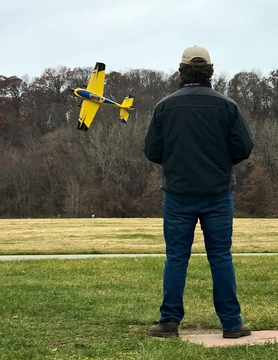
Radio-controlled glider
Unpowered model aircraft sustained by slope and thermal lift.

A radio-controlled glider is an unpowered model aircraft that stays aloft by riding the lift from slopes or thermals, guided by a pilot on the ground using a transmitter. Builders use materials such as wood, plastic, polymer foams, or composites, and the wing loading can range from very light to quite heavy, depending on what the glider is designed to do.
International competitions for these gliders are governed by the Fédération Aéronautique Internationale (FAI), though many countries also have their own national classes.
**Launching methods**
*Hand launch*: The simplest method—the pilot or an assistant gently throws the glider into the wind at an angle between horizontal and 45 degrees. With a little practice, it is possible to just hold the glider above the head at the right angle and let go, especially when slope soaring.
*Towline launch*: Another person runs across flat ground pulling a 50 to 150 meter line with the glider attached, while the pilot steers. A variation uses a pulley staked to the ground; the tow runner carries the pulley, doubling their effective speed. In F3J competition, two runners with a pulley generate even faster launches, allowing the model to “zoom”—pointing downward briefly to convert stored energy from the stretched monofilament line into speed, then rotating nose-high to convert that speed into extra height.
*Bungee/Hi-start launch*: Similar to a towline launch but done alone. An elastic cord or rubber tubing, combined with line, is staked upwind of the pilot. Launch height depends on rubber diameter, model weight, and headwind.
*Piggyback launch*: A powered radio-controlled aircraft carries the glider aloft in a cradle mounted on its top or bottom. This method is spectacular but requires an experienced pilot for the carrier, as the glider’s weight affects handling. Both pilots must take care to avoid a collision after release.
*Discus launch*: Used only with Discus Launch Gliders (DLGs). The pilot holds the model by a wingtip, spins 360 degrees, and releases it, sending the glider upward at high speed. DLGs are a newer type of glider gaining popularity for their easy launching and efficient flight. They are used in the FAI’s F3K contest class.
*Aerotow launch*: A radio-controlled tug tows the glider into the air, similar to full-size aerotowing. This is often used for larger scale gliders.
- Governing body
- Fédération Aéronautique Internationale (FAI)
- Towline length
- 50 to 150 m
- F3f course length
- 100 m per leg, 10 legs total (1 km)
- F3k class
- F3K (Discus Launch Glider contest class)
Lore & Background
International radio-controlled glider competitions are regulated by the Fédération Aéronautique Internationale (FAI), although many countries have their own national classes. Launching methods include hand launch, towline launch, bungee/hi-start launch, 'piggyback' launch, discus launch, aerotow launch, and winch launch. In towline launch, another person runs along the ground pulling a 50 to 150 m line with the glider attached, while the pilot steers. A variation uses a pulley staked to the ground to double the tow man's effective speed, as used in F3J competition. Discus launch is performed only on a special type of glider called a Discus Launch Glider (DLG), where the pilot holds the model by the tip of a wing, spins 360°, and releases it. DLG models are used in the F3K contest class. Winch launch uses a small electric motor and a reverse pulley staked to the ground upwind, with a parachute to prevent spool overrunning; regulations were put in place in the late 1980s by the FAI to limit winch power in FAI class competitions.
Reader's Guide
Radio-controlled gliders have established a significant presence in model aviation through diverse disciplines. Slope soaring exploits lift produced by wind blowing up the face of steep slopes, while dynamic soaring uses the leeward side of a hill to create high speeds. F3F racing involves timed runs over a 1 km course, with scoring based on percentage of the fastest time. Combat flying uses expanded polypropylene (EPP) foam models for impact resistance, where a 'kill' is scored only when an opponent's aircraft hits the ground. Ridge racing, or pylon racing, uses slope lift to race along the lift zone, with scoring similar to match racing in sailing. Power Scale Soaring (PSS) focuses on building and flying scale model gliders of full-sized jet-, rocket- or piston-powered aircraft, ranging from early biplanes to modern jet fighters. Slope aerobatics involves flying aerobatic figures with gliders optimized for inverted and knife-edge flight, often using all-moving control surfaces. Thermal soaring allows sustained flight using rising warm air. The variety of launching methods and competition classes has made radio-controlled gliders accessible to novices and challenging for experts, with EPP foam models being particularly popular for their durability and low cost.
Did You Know?
- Hand launching is the simplest method, often used when slope soaring.
- In bungee/hi-start launch, the running person is replaced by elastic cord or rubber tubing attached to the ground upwind.
- Discus Launch Gliders (DLGs) are gaining popularity due to their ease of launching and efficient flight characteristics.
- Combat gliders are usually made of expanded polypropylene (EPP) foam for impact resistance.
Frequently Asked Questions
What is a radio-controlled glider?
It is an unpowered model aircraft that remains airborne by exploiting lift from slopes or thermals, steered by a ground-based pilot through a radio transmitter.
How does a radio-controlled glider stay aloft without a motor?
The glider gains altitude and endurance from natural lift sources such as hillside updrafts or thermal columns, while the pilot fine-tunes its trajectory using control surfaces.
What materials go into building a radio-controlled glider?
Builders typically work with wood, plastic, polymer foams, or composite laminates, selecting materials to match the target wing loading and the glider's intended role.
Who regulates international radio-controlled glider competition?
The Fédération Aéronautique Internationale (FAI) sets the rules for international contest classes, alongside national bodies that run their own domestic categories.
How is a radio-controlled glider launched?
The most basic method is a hand launch, while competition formats also use towline systems with lines of 50 to 150 m or discus launches under the F3K class.
More in Radio-Controlled Aircraft 1-24
Spotted an error? Know more?
Reader corrections go straight into our review queue. Suggest an edit · How this site is sourced