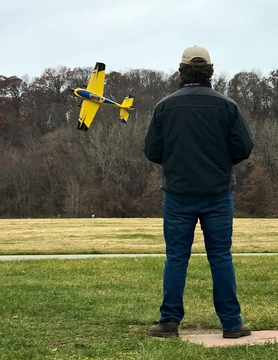
Radio-controlled aerobatics
Flying RC aircraft through maneuvers beyond normal flight attitudes.

Radio-controlled aerobatics involves flying model aircraft through attitudes and maneuvers not seen in normal flight. Skills range from simple moves for beginners to complex sequences requiring extensive practice.
A common starting point is the inside loop, where the pilot remains on the inside of a 360-degree circle. The pilot applies power and pulls back on the elevator, sending the aircraft upward into vertical flight, then through inverted flight, a dive, and back to level. A clean loop requires managing power to counteract gravity, which tends to shorten the climb and lengthen the descent. The maneuver begins from level flight with maximum power and up elevator, then reduces elevator input through the second and third quadrants. Power is cut in the fourth quadrant while adjusting elevator, and finally the pilot returns to level flight with neutral elevator and increased power.
An outside loop follows the same path but places the pilot on the outside of the circle. Starting upright, the pilot inputs down elevator, sending the aircraft below the original flight line before completing the circular path back to the start. This is sometimes called a bunt. Outside loops need more power and stronger control inputs than inside loops because lift pushes outward, tending to pull the aircraft out of the loop.
The Immelmann turn, named after flying ace Max Immelmann, is a popular airshow maneuver. The pilot pulls into a vertical climb, completes half a loop to invert the aircraft, then executes a half-roll to regain level flight. It can be reversed by starting with a half-roll into inverted flight, then using elevator to pull through a half loop back to level. In both cases, the aircraft changes course 180 degrees and exchanges speed for altitude.
Inverted flight occurs when the aircraft rotates 180 degrees about its longitudinal axis, so the cockpit and tail fin point at the ground. It is not a maneuver itself but an attitude for performing other moves. The simplest entry is from straight level flight: increase power if needed, roll with aileron while maintaining heading with rudder and elevator, neutralize aileron when inverted, and apply slight down elevator to hold level. In inverted flight, elevator and rudder inputs are reversed; aileron and throttle remain the same.
Lore & Background
The discipline includes a variety of maneuvers categorized by difficulty. Beginner maneuvers include the inside loop, where the pilot pulls back on the elevator to trace a 360-degree circle with the pilot on the inside, and the outside loop, which uses down elevator to place the pilot on the outside. The Immelmann turn, named after flying ace Max Immelmann, combines a half loop with a half roll to reverse direction. Inverted flight is an attitude rather than a maneuver, entered by rolling the aircraft 180 degrees about its longitudinal axis. Intermediate maneuvers, such as the stall turn (also called a Hammerhead), slow roll, four-point roll, snap rolls, and the Cuban-8, require skills gained through considerable practice and often involve stalls. Advanced maneuvers include the rolling circle, where the aircraft rolls continuously while turning, demanding precise pitch and yaw corrections.
Reader's Guide
Radio-controlled aerobatics is significant for its structured progression from simple loops to complex rolling circles, providing a clear path for skill development. The inside loop is often the first maneuver learned due to its simplicity, while the rolling circle is considered one of the most difficult to perfect. The Immelmann turn has become a popular aerial maneuver used in airshows globally. Intermediate maneuvers like the slow roll and snap roll require mastery of coordinated control inputs, and the Cuban-8 combines elements of inverted flight and Immelmann turns. The discipline's legacy lies in its systematic approach to teaching aerobatic flight, with each maneuver building on previous skills, and its emphasis on precise control management, such as power adjustments during loops and phased rudder and elevator inputs during rolling circles.
Did You Know?
- The inside loop is named because the pilot is on the inside of the 360-degree circle.
- An outside loop is sometimes referred to as a 'bunt'.
- The Immelmann turn is named after flying ace Max Immelmann.
- The stall turn is also known as a Hammerhead.
Frequently Asked Questions
What is radio-controlled aerobatics?
It is the discipline of flying a model aircraft through flight attitudes and maneuvers that go well beyond ordinary straight-and-level operation. The skill spectrum stretches from a handful of basic moves for newcomers all the way up to elaborate multi-element sequences that demand extensive practice.
What is the best first maneuver to learn in RC aerobatics?
The inside loop is the classic starting point, where the pilot stays on the inside of a full 360-degree circle. You add power, pull back on the elevator into a vertical climb, pass through inverted flight, dive, and roll back out to level.
Why is a clean inside loop so hard to fly?
Gravity constantly fights you: it shortens the climb phase while stretching the descent, so the loop shape distorts if you do nothing. Keeping the loop round and level requires actively managing throttle throughout all four phases of the maneuver.
How is RC aerobatics different from just flying an RC plane?
Regular RC flying typically keeps the model in normal, stable flight attitudes, whereas aerobatics specifically demands maneuvers and orientations—like sustained inverted flight or vertical climbs—that never occur in standard operation. That deliberate departure from normal flight is what defines the discipline.
Do I need advanced skills before trying RC aerobatics?
Not at all; the field is structured so beginners can start with a single simple move like the inside loop. Only after building comfort with those basics does a pilot graduate into the complex, multi-element sequences that require hours of dedicated practice.
More in Radio-Controlled Aircraft 1-24
Spotted an error? Know more?
Reader corrections go straight into our review queue. Suggest an edit · How this site is sourced