Coachella Valley Radio Control Club
Oldest AMA gold-certified club in the Coachella Valley.

The Coachella Valley Radio Control Club, located near Coachella in Riverside County, California, ranks among the oldest model aircraft clubs in the United States. It is also one of the longest-running non-profit service organizations in the Coachella Valley and holds a rare gold certification from the Academy of Model Aeronautics. This certification means the club follows strict safety rules set by the AMA and maintains a facility that meets high standards for both safety and quality.
The club’s origins go back to 1938, when a casual group of free flight model aircraft enthusiasts started meeting weekly at the now-closed La Quinta Airport. That site, situated between Eisenhower Drive and Washington Street south of Avenue 52, now lies within the La Quinta Cove residential area. It sits almost directly at the base of the Santa Rosa Mountains, an area prone to sudden strong winds that often caused the hobbyists to lose their models.
World War II halted these gatherings in 1941, but they resumed after the war at various open spots around the region. The postwar period brought three key developments: control line flying, small nitromethane-powered glow engines, and early single-channel radio control. This radio control technology used citizen’s band radio, another postwar innovation. Model aircraft were limited to a single frequency—27.255 MHz—so only one plane could fly at a time. These advances helped the club grow, with members meeting at nearly any available open field.
By the early 1990s, rapid growth in the central and western Coachella Valley had covered or privatized many of the club’s former flying fields. Finding spaces free from buildings and power lines became much harder. In 1992, the club moved to its fifteenth official site, leasing undeveloped land at Avenue 58 and Monroe Street in the unincorporated Vista Santa Rosa area.
On May 9, 1999, the club held its first formal meeting in years to discuss its future. Dan Metz, a radio control enthusiast who had flown with the club for fifteen years, was offered the presidency. He agreed to serve for three years, promising to step down if he could not secure a permanent site; he later returned to the role. Metz first approached local municipal governments, but the sites they offered had issues like excessive wind, access problems, and noise complaints.
- Founded
- 1938 (as loose-knit group)
- Location
- Near Coachella, Riverside County, California, United States
- Site area
- 240 acres (1 square kilometer)
- Runway length
- 865 feet (263.65 meters)
- Annual dues
- US$200
- Lease cost
- US$1 per year (initial 25-year lease)
- Gold certification
- Academy of Model Aeronautics gold-certified
Lore & Background
The club traces its roots to 1938 when a loose-knit group of free flight model aircraft enthusiasts began meeting weekly at the now-defunct La Quinta Airport. That site, between Eisenhower Drive and Washington Street south of Avenue 52, is today part of the La Quinta Cove residential district. It lies almost directly at the foot of the Santa Rosa Mountains and is prone to sudden high winds, resulting in loss of models. World War II halted practice in 1941, but it resumed after the war at other open sites. The postwar era saw the development of control line flying, small nitromethane-powered glow engines, and early single-channel radio control using citizen's band radio, with only one frequency (27.255 MHz) allocated, meaning only one plane could fly at a time.
By the early 1990s, central and western Coachella Valley growth led to many previous flying fields being built over or considered private property. In 1992, the club moved to its fifteenth official site on undeveloped land at Avenue 58 and Monroe Street in the unincorporated Vista Santa Rosa area. On May 9, 1999, the club held its first formal meeting in years to discuss its future. Dan Metz, a radio control enthusiast who had flown with the club for fifteen years, was offered the presidency. He agreed to serve for three years, stepping down if unable to procure a permanent site; he has since returned as president. Metz solicited local governments, but offered areas had problems such as excessive wind, access issues, and noise concerns. Member Ron Vincent, who had assisted in procuring land in Oregon, contacted the United States Bureau of Reclamation. These sites had problems with Desert Bighorn Sheep Habitat incursion and encroachment on Native American land. The Bureau eventually offered a 240-acre site alongside the All-American Canal off Avenue 54 and Pierce Street near Coachella, with an initial 25-year lease at US$1 per year and renewal options for another 25 years.
The site was littered with garbage, wrecked automobiles, and discarded tires. Donations from developers and large corporations, along with member labor, cleared and developed it. The 600'x70' (183x21m) runway, pit area, and parking area were completed in May 2002. Extensions later brought the runway to 865' (263.65m). A combination control line and helicopter pad was added in late 2007 when Avenue 54 was paved by the county; the pad may also be used by slow-flying park flyers. A flagpole was added in 2008, dedicated with a flag that had flown over the United States Capitol, donated by Congresswoman Mary Bono Mack. Maintenance is conducted in part by the Coachella Valley Parks and Recreation Department, with other costs offset by annual dues of US$200.
Reader's Guide
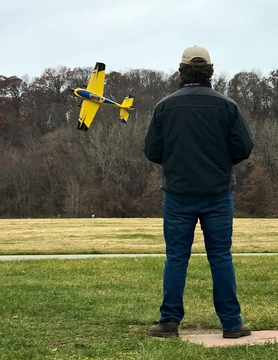
The Coachella Valley Radio Control Club operates as a 501(c)(3) organization and works closely with area school districts through its 'Delta Dart' program, which teaches young children the basics of flight and model construction. Delta Darts, provided by the Academy of Model Aeronautics, are rubber band-powered free flight models made of balsa, built over full-sized plans. A friendly competition is held to see whose Delta Dart flies farthest. Younger children can build 'catapult gliders' from sheet balsa, launched like a slingshot. At the high school level, the club works with each school's ROTC program to promote careers in aviation and aeronautics. 'Fun Flys' are held throughout the year, generally one Sunday per month; guests with no previous radio controlled flight experience can fly a large, stable model via a buddy box. At least one Fun Fly near year's end is a fundraiser for Toys for Tots. The club has been the site of the 'Best In The West Jet Rally,' a national meeting of model jet turbine enthusiasts that receives national press coverage in Model Aviation. Notable participant Colonel Robert E. Thacker, USAF (Ret.) entered his F-15, capable of speeds up to 150 mph, in the 2008 event. The January 2009 running saw national sponsorship from E-flite, Cermark, Century Jet Models, and Bob Smith Industries, with detailed coverage in the August 2009 edition of Model Aviation. Offsite work includes charity flight demonstrations and Delta Dart contests at the Palm Springs Air Museum, and flight demonstrations at the Jacqueline Cochran Regional Air Show. Club members and guests operating model aircraft at the field must hold current AMA membership in addition to club membership; no AMA membership is required for buddy box activities with an experienced instructor.
Did You Know?
- The club's original meeting site at La Quinta Airport is now part of the La Quinta Cove residential district.
- The club's current site was leased from the Bureau of Reclamation for US$1 per year for an initial 25-year term.
- Member Larry Eaks, a wheelchair user, drove the water truck needed to reduce particulate matter during construction.
- A flag that flew over the United States Capitol was donated to the club by Congresswoman Mary Bono Mack.
Frequently Asked Questions
What is the Coachella Valley Radio Control Club?
It is one of the longest-standing model aircraft clubs in the United States, operating as a non-profit service organization in the Coachella Valley. The club also holds a rare gold certification from the Academy of Model Aeronautics, which reflects its commitment to rigorous safety and facility standards.
When was the Coachella Valley Radio Control Club founded?
The club's history begins in 1938, when a small, informal group of free-flight model aircraft hobbyists started gathering to fly and share knowledge. Over the following decades that loose-knit circle evolved into a formal, long-running non-profit organization.
What does the AMA gold certification mean for the Coachella Valley Radio Control Club?
The gold designation confirms that the club enforces the Academy of Model Aeronautics' strict safety protocols and operates a facility that meets elevated benchmarks for both safety and quality. It is the oldest club in the Coachella Valley to carry that gold certification.
Where is the Coachella Valley Radio Control Club located and how large is the property?
The club sits near Coachella in Riverside County, California, on a 240-acre (one square kilometer) parcel of land. Its runway measures 865 feet (roughly 264 meters), giving members plenty of room for radio-controlled flight operations.
How much does it cost to join the Coachella Valley Radio Control Club?
Members pay $200 in annual dues. The club originally secured its 240-acre site under a 25-year lease at a nominal rate of just one dollar per year.
More in Radio-Controlled Aircraft 1-24
Spotted an error? Know more?
Reader corrections go straight into our review queue. Suggest an edit · How this site is sourced