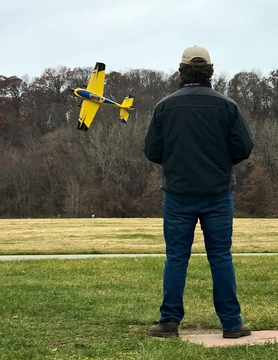
Discus Launch Glider
A hand-launched radio controlled sailplane using a discus-style launch.

A Discus Launch Glider (DLG), also known as a Side Arm Launch (SAL) glider, is a type of radio-controlled model sailplane. It is launched by holding the model by one wingtip and spinning rapidly before releasing it. With this technique, a typical pilot can reach launch heights over 100 feet, while contest fliers can more than double that, and record throws approach 300 feet. The discus launch has largely replaced the older javelin-style launch, where the glider was thrown overarm like a javelin, because it is easier, more efficient, and less physically demanding. After launch, pilots search for lift from thermals or other rising air to extend flight time. Competitions may judge launch height, flight duration, flying skill, precision landing, and timing.
While some DLG designs use traditional balsa wood and covering film, most are now built from composite materials such as Kevlar, carbon fibre, and glass fibre. Fuselages are moulded from Kevlar or carbon with epoxy, and wings are either hollow composite shells or vacuum-bagged over foam cores cut by wire or CNC. Most DLG models have aileron, rudder, and elevator controls. The ailerons also function as camber-changing flaps for different flight modes and as airbrakes for landing. Modern DLGs feature sophisticated aerodynamics and are very light. A typical 1.5-metre DLG weighs between 240 and 290 grams (8.5 to 10.2 ounces), while a 1-metre model weighs around 110 to 150 grams (3.9 to 5.3 ounces). Many pilots use programmable radio transmitters with full mixing and flight mode capabilities to optimise performance and set up the model as precisely as possible. DLGs are flown for both sport and contest flying.
F3K is the international contest class for radio-controlled, hand-launched gliders. Though hand-launched RC gliders trace back to the late 1970s, F3K is a relatively new discipline, officially recognised by the FAI in 2007. F3K gliders are limited to a 1.5-metre wingspan. Competitions involve groups of pilots completing predefined flight tasks that require launching, flying, and landing the model within timed durations. Only the hand launch and thermal rising air sustain the flight.
- Launch height average
- greater than 100 ft
- Launch height contest competitors
- more than double the average
- Launch height record
- approaching 300 ft
- Wingspan typical
- 1.5 m
- Weight 1.5m model
- 240-290 grams (8.5-10.2 ounces)
- Weight 1m model
- 110-150 grams (3.9-5.3 ounces)
- Price range
- $100 to $900 plus
Lore & Background
Although the roots of RC hand-launched gliders can be traced back to the late 1970s, the F3K international contest class for hand-launched gliders became officially recognised by the FAI in 2007. F3K gliders are limited to a 1.5 metre wingspan. Competitions consist of a group of fliers completing a number of pre-defined flight tasks involving launching, flying and landing the model in timed durations, using only the hand launch and thermal currents of rising air to sustain flight. Since thermals cannot be seen, pilots rely on ground signs such as surface wind velocity, temperature and direction; signs such as circling birds, bugs, or rising particulates; and changes of direction or attitude of the glider due to the thermal itself.
Most DLG models use aileron, rudder and elevator control, with the ailerons serving as camber changing flaps for different modes of flight and also as airbrakes for landing. Modern DLG models have sophisticated aerodynamics and are very light. Many pilots use programmable radio transmitters with full mixing and flight mode capabilities. Although some DLG designs utilise traditional built-up construction using balsa wood and covering film, most are now constructed from composite materials such as Kevlar, carbon fibre and glass fibre. Fuselages are moulded in Kevlar/carbon and epoxy, with wings either moulded as a hollow composite shell, or vacuum bagged over a wire-cut or CNC-formed foam core.
Reader's Guide
The discus launch glider represents a significant evolution in radio controlled hand-launched sailplanes, replacing the older javelin-style launch with a method that is easier, more efficient and less physically demanding. This launching technique allows average fliers to reach heights over 100 ft, while contest competitors can more than double that, with record throws approaching 300 ft. After launch, fliers search for lift in the form of thermals or other rising air currents to increase flight duration. Competitions may include tests of launch height, duration, glider flying skill, precision landing, and timing. The F3K class, officially recognised by the FAI in 2007, formalises these contests with a 1.5 metre wingspan limit and predefined flight tasks. DLG models are used for both general fun/sport flying and contest flying, with prices ranging from $100 to $900 plus. The construction has shifted from traditional balsa and film to advanced composites like Kevlar, carbon fibre and glass fibre, enabling very light weights—typically 240-290 grams for a 1.5 m model. The use of programmable transmitters with full mixing and flight modes allows pilots to optimise performance and set up the models for flight as near perfectly as possible.
Did You Know?
- The discus launch method is easier, more efficient and less physically demanding than the older javelin-style launch.
- Record discus launch throws can approach 300 ft.
Frequently Asked Questions
What is a Discus Launch Glider?
A Discus Launch Glider, commonly shortened to DLG or referred to as a Side Arm Launch (SAL) glider, is a radio-controlled model sailplane designed to be sent airborne via a spinning, discus-style throw rather than a traditional overarm toss. It sits in the hand-launched RC sailplane category and is popular with both casual fliers and competitive pilots.
How does the discus launch technique actually work?
The pilot grips the model by one wingtip and whips it in a fast circular motion—much like throwing a discus—then releases it to gain both altitude and forward speed. This method has largely supplanted the older javelin-style overarm throw because it is gentler on the body and transfers energy to the glider more efficiently.
How high can a DLG be launched?
An average club pilot can typically loft the glider above 100 feet, while seasoned contest competitors routinely push past 200 feet. The very best record throws are approaching 300 feet of initial altitude.
What are the typical wingspan and weight specs for a DLG?
Most production DLGs have a wingspan of roughly 1.5 meters and a flying weight in the 240-to-290-gram range (about 8.5 to 10.2 ounces). Smaller 1-meter versions are considerably lighter, usually falling between 110 and 150 grams (3.9 to 5.3 ounces).
Why is the Discus Launch Glider considered important in RC sailplane history?
The DLG became the defining hand-launch class because the discus technique made launching far less physically taxing and more energy-efficient than the old javelin throw, opening the sport up to a much broader pool of enthusiasts. It essentially set the standard for how modern hand-launched RC sailplanes are designed and flown.
More in Radio-Controlled Aircraft 1-24
Spotted an error? Know more?
Reader corrections go straight into our review queue. Suggest an edit · How this site is sourced