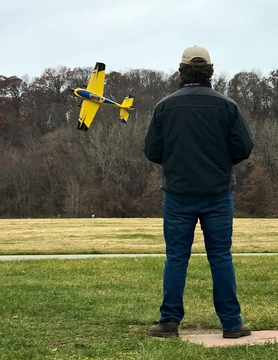
Outrunner
An electric motor with the rotor outside the stator, common in RC aircraft.

An outrunner is a type of electric motor where the rotor sits outside the stator, as if the motor has been turned inside out. Its outer shell rotates around the windings, much like the motor inside a standard CD-ROM drive. In fact, CD-ROM motors are often rewound into brushless outrunners for small park flyer model aircraft, and commercial conversion parts are available.
Outrunners typically have more poles than inrunners, causing them to spin slower while producing significantly more torque. They are still much faster than ferrite motors that use neodymium magnets. This high torque makes them ideal for directly driving propellers on electric aircraft, eliminating the extra weight, complexity, inefficiency, and noise of a gearbox. Some front-loading direct-drive washing machines also use outrunner motors.
These motors have quickly become popular in many sizes and are now common in personal electric transportation, such as bikes and scooters, due to their compact size and high efficiency.
The stator windings are excited by a standard DC brushless motor controller. Direct current, switched on and off at high frequency to modulate voltage, is passed through three or more non-adjacent windings at a time. The energized group is alternated electronically based on rotor position feedback. The number of permanent magnets in the rotor does not match the number of stator poles, which reduces cogging torque and creates a sinusoidal back electromotive force. The number of magnet poles divided by two gives the ratio of magnetic field frequency to motor rotation frequency.
Common stator pole and magnet pole configurations include: 9N,12P (very common in small outrunners and CD-ROM motors, winding pattern ABCABCABC); 9N,6P (common for helicopter motors and EDFs, winding pattern ABCABCABC); and 12N,14P (DLRK, common for higher torque, noted for smooth and quiet operation, winding pattern with lowercase indicating reverse direction).
- Common configurations
- 9N,12P; 9N,6P; 12N,14P (DLRK); 9N,8P; 9N,10P; 12N,16P; 12N,10P; 12N,8P
- Typical uses
- Radio-controlled model aircraft, electric bikes, scooters, front-loading direct-drive washing machines
Lore & Background
Outrunner motors have quickly become popular and are now available in many sizes. They are frequently used in radio-controlled model aircraft, where their design allows direct drive of propellers without a gearbox, reducing weight, complexity, inefficiency, and noise. CD-ROM motors are often rewound into brushless outrunner motors for small park flyer aircraft, and parts to aid in such conversions are commercially available.
Outrunners typically have more poles than inrunner motors, causing them to spin much slower while producing far more torque. This makes them well-suited for directly driving electric aircraft propellers. The stationary stator windings are excited by conventional DC brushless motor controllers, with direct current switched on and off at high frequency for voltage modulation. The number of permanent magnets in the rotor does not match the number of stator poles, which reduces cogging torque and creates a sinusoidal back emf.
Common stator pole and magnet pole configurations include 9N,12P (very common in small outrunners and CD-ROM motors), 9N,6P (common for helicopter motors and EDFs), and 12N,14P (DLRK, common for higher torque applications). Other configurations such as 9N,8P, 9N,10P, 12N,16P, 12N,10P, and 12N,8P are also used, each with specific characteristics regarding speed, torque, and vibration.
Reader's Guide
Outrunner motors have become significant in radio-controlled aircraft and personal electric transportation due to their compact size and high efficiency. Their design eliminates the need for a gearbox when driving propellers, reducing weight and mechanical complexity while improving efficiency and reducing noise. This has made them a popular choice for direct-drive applications in model aircraft, where torque at lower RPM is advantageous.
The availability of outrunners in many sizes has broadened their use beyond hobby aircraft to electric bikes and scooters. The ability to rewind CD-ROM motors into functional outrunner motors for small park flyers demonstrates the adaptability and DIY-friendly nature of the design. Various stator and magnet pole configurations allow tailoring of motor characteristics—such as speed, torque, and smoothness—to specific applications, from high-speed helicopter motors to high-torque setups. The DLRK winding pattern (12N,14P) is noted for smooth and quiet operation, while other configurations like 9N,10P are known for noisy running and are typically built only by hobbyists. The outrunner's legacy is one of enabling efficient, direct-drive electric propulsion in a compact form factor, influencing both hobbyist and practical transportation designs.
Did You Know?
- Some front-loading direct-drive washing machines use an outrunner motor.
- The 12N,14P (DLRK) configuration is noted for smooth and quiet operation.
More in Radio-Controlled Aircraft 1-24
Spotted an error? Know more?
Reader corrections go straight into our review queue. Suggest an edit · How this site is sourced