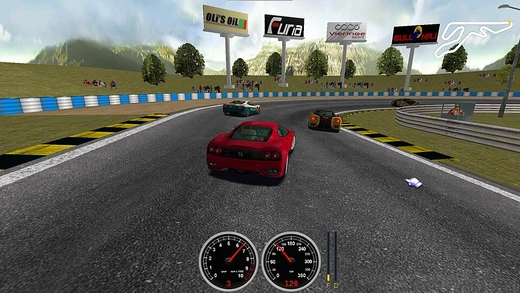
4x4 Off-Road Racing
A 1988 off-road racing game with vehicle customization.

IDS.photos from Tiverton, UK · CC BY-SA 2.0
4x4 Off-Road Racing, a racing game from 1988, was published by Epyx and developed by Ogden Micro Design. Players pick one of four environments—Mud, Ice, Desert, or Mountains—and choose a 4x4 vehicle to race against 16 other competitors. Each vehicle has unique stats for weight, top speed, and fuel tank capacity. Before a race, players can upgrade their car with different tires, a set of repair tools (or a heavier mechanic who works without tools), or an extra fuel tank. The vehicle can also be remodeled to carry more tools, but this adds weight, reducing speed and increasing fuel consumption.
During a race, players must avoid obstacles; each collision lowers the car’s endurance. Rivers are impassable obstacles that cannot be jumped over. Each map is split into three sections, with checkpoints between them where cars can be repaired or refueled without using the tools loaded onboard.
Compute! described the game as "an enjoyable drive." Microhobby magazine rated it with scores: Originality 50%, Graphics 50%, Motion 60%, Sound 50%, Difficulty 70%, Addiction 40%.
Quick Facts
- Title
- 4x4 Off-Road Racing
- Developer
- Ogdan Micro Design
- Publisher
- NA · Epyx · EU · U.S. Gold
- Released
- 1988
- Genre
- Racing
- Modes
- Single Player
- Platforms
- Commodore 64, MS-DOS, Amstrad CPC, ZX Spectrum, Atari ST, Amiga, MSX
Facts from the source article.
Lore & Background
4x4 Off-Road Racing was released in 1988 by Epyx and developed by Ogden Micro Design. The game features four race areas set in different environments: Mud, Ice, Desert, and Mountains. Players select a 4x4 vehicle with unique characteristics such as weight, top speed, and fuel tank capacity, then race against 16 other competitors.
Reader's Guide
The game includes vehicle upgrades before races, such as different tire sets, tool sets for repairs, an optional mechanic (which adds weight but eliminates tool requirements), and additional fuel tanks. Players can also remodel their vehicle to carry more tools, though this increases weight, reduces speed, and raises fuel consumption. During races, players must avoid obstacles that reduce endurance, though some obstacles can be used to jump over rivers. Each map is divided into three sections with checkpoints where cars can be repaired or refueled without using loaded tools.
Did You Know?
- The game was developed by Ogden Micro Design and published by Epyx in 1988.
- Players can choose from four environments: Mud, Ice, Desert, and Mountains.
- The Spanish magazine Microhobby rated the game's difficulty at 70% and addiction at 40%.
- Compute! magazine called the game 'an enjoyable drive'.
Origins of the Racing Game Genre
The vehicle racing video game genre traces its roots back to the mid- to late 1970s, a period when the broader video game industry was still finding its footing. During this formative era, developers began experimenting with the concept of placing a player behind the virtual wheel, transforming static screens into dynamic experiences of speed and competition. This early emergence laid the groundwork for what would become one of the most enduring and commercially significant categories in interactive entertainment. The fact that the genre appeared during this transitional window of the 1970s speaks to the creative ambition of those first-generation designers, who were pushing the boundaries of what a simple electronic display could convey. From those modest beginnings, the racing game category would grow to encompass an enormous variety of vehicle types, from open-wheel formula machines to rugged off-road trucks, and would spawn numerous sub-genres and spin-off franchises over the following decades. The mid-to-late 1970s origin point remains a foundational reference for anyone tracing the lineage of racing video games, marking the moment when the idea of digital motorsport first took shape on a screen.
Five Decades of Evolution
The history of vehicle racing video games is organized across five distinct chronological periods, each reflecting the technological and creative shifts of its era. The earliest entries cluster in the 1970s and 1980s, a combined period that captures both the genre's birth and its first major expansion. The 1990s then represent a standalone decade of growth, a period that coincided with the rise of new hardware and distribution formats. The 2000s and 2010s each receive their own dedicated sections, suggesting periods of significant innovation, graphical advancement, and the maturation of established franchises. The 2020s section indicates that the genre remains actively evolving in the current era, with new titles continuing to push the boundaries of what racing games can deliver. This five-decade span, from the mid-1970s through the present day, demonstrates that vehicle racing has maintained its position as a vital and continuously reinventing category within the broader video game landscape, never quite settling into a single formula but instead adapting to each new generation of technology and player expectations.
A Broader Racing Ecosystem
Vehicle racing video games do not exist in isolation; they form part of a rich interconnected ecosystem of motorsport-themed interactive entertainment. The genre's connections extend to highly specialized sub-categories, including dedicated Formula One video games, which capture the precision and speed of open-wheel circuit racing. Equally, the world of V8 Supercars has found its own representation in video games, bringing the distinctive muscle and power of touring car competition to players' screens. Beyond these specific series, the broader category of racing video games encompasses an enormous range of vehicle types and racing disciplines, while the sim racing sub-genre appeals to enthusiasts seeking the most faithful and technically demanding driving experiences possible. These related categories share a common DNA — the thrill of competition, the romance of speed, and the challenge of mastering a machine — yet each carves out its own unique identity within the larger family of racing games. For fans of 4x4 off-road racing, this ecosystem provides both context and contrast, showing how the rugged, unpredictable world of off-road competition fits into the wider spectrum of digital motorsport.
The Road Ahead: Unreleased and Beyond
Perhaps the most telling element of the vehicle racing video game landscape is the existence of a dedicated section for unreleased titles. This acknowledgment of games still in development or awaiting announcement underscores that the genre shows no signs of slowing down or retreating into nostalgia. Even as the 2020s section documents the titles already available to players, the unreleased category serves as a reminder that studios are actively working on the next wave of racing experiences, each promising to build upon the foundations laid over the preceding five decades. The very structure of the genre's history — moving from the 1970s and 1980s through the 1990s, 2000s, 2010s, and 2020s, and then extending into the unknown territory of unreleased projects — paints a picture of continuous momentum. For the 4x4 off-road racing community, this pipeline of upcoming titles suggests that the rugged, dust-churning world of off-road competition will continue to find new and exciting ways to captivate players, ensuring that the genre's story is far from reaching its final chapter.
Gallery



Frequently Asked Questions
What is 4x4 Off-Road Racing?
It is a 1988 off-road racing title published by Epyx and developed by Ogden Micro Design. Players pilot a four-wheel-drive vehicle against 16 opponents across terrain types such as mud, ice, desert, and mountains.
What upgrades can I add to my 4x4 before a race?
You can swap in different tire sets, add a repair toolkit (or hire a heavier mechanic who works without tools), and bolt on an extra fuel tank. Remodeling the vehicle to carry more tools is also possible, though the added weight will lower your top speed and increase fuel burn.
How many opponents do I face in a single race?
Every race puts your chosen 4x4 up against 16 other competitors. Each vehicle in the field carries its own unique combination of weight, top speed, and fuel-tank capacity.
Who developed and published 4x4 Off-Road Racing?
The game was created by Ogden Micro Design and released in 1988 under the Epyx publishing banner.
What terrain options does the game offer?
Players pick from four distinct environments: Mud, Ice, Desert, or Mountains. Each setting presents its own driving challenges for your customized 4x4.
More in Racing video games 1-24
Spotted an error? Know more?
Reader corrections go straight into our review queue. Suggest an edit · How this site is sourced