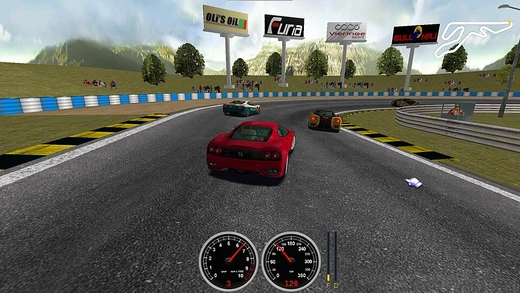
3D Pixel Racing
Voxel-based racing game for Wii and iOS.

3D Pixel Racing, an arcade-style racing title from developer VoxelStorm, hit the market in 2011. It was offered as a downloadable game through the Nintendo eShop on Wii and the iOS App Store. The game stands out for its visual approach: every object is built from multi-colored voxels, evoking the look of 8-bit games from the 1970s and 1980s.
The core driving mechanics are straightforward. Players pick a driver, a car, and a game mode, then compete in events to unlock additional cars, tracks, and drivers. Each track features checkpoints that record lap times, allowing players to replay for better results. On the Wii, controls mirror those of *Mario Kart Wii*—the Wii Remote is held sideways and used like a steering wheel. The iOS version relies on the device’s built-in accelerometer for steering, with on-screen buttons for gas and brake.
Four modes are available: Single Race, Championship, Time Trial, and Hot Pursuit. All support both single-player and multiplayer for up to four people.
In Single Race, players choose an unlocked driver, track, and vehicle to compete against up to three opponents over three laps. This mode does not count toward unlocking items or game completion.
Championship mode involves a series of eight races called a cup. Points are awarded based on finishing position, and the driver with the most points after the final race wins. Winning cups is the easiest way to unlock new content and is required to finish the game.
Time Trial pits players against a clock across multiple tracks. If time runs out before completing the required laps, the event is lost. In multiplayer, all racers share the same track but are timed and scored individually.
In Hot Pursuit, a police car chases the player around a course while a timer runs. The event ends if the player is caught or fails to outrun the police before time expires. In multiplayer, one player drives the police car while others try to escape.
According to Metacritic, the iOS version received “average” reviews, while the Wii version earned “generally unfavorable reviews.”
Quick Facts
- Title
- 3D Pixel Racing
- Released
- WiiWare / NA · July 14, 2011 · EU · September 8, 2011iOS / October 18, 2011
- Platforms
- WiiWare, iOS
- Developer
- Vidia
- Publisher
- Microforum Games (WiiWare) / Vidia (iOS)
- Genre
- Racing
- Modes
- Single-player, multiplayer
Facts from the source article.
Lore & Background
3D Pixel Racing features gameplay similar to other basic driving games. Players choose a driver, car, and gameplay mode, then compete in events to unlock new cars, tracks, and drivers. Each track has checkpoints that log total race times, allowing players to replay for better times. The Wii version uses the Wii Remote held sideways as a steering wheel, while the iOS version uses the iPhone's accelerometer and touchscreen buttons for gas and brake.
Reader's Guide
The game includes five gameplay modes: Single Race, Championship, Time Trial, Capture the Flag, and Hot Pursuit. All modes support single-player and multiplayer for up to four players. Single Race is a three-lap circuit race against seven opponents and does not count toward unlocking items. Championship mode involves a series of eight races with points awarded per finish; winning cups is the easiest way to unlock items and is mandatory for completing the game. Time Trial pits players against a clock, with multiplayer allowing separate scoring. Capture the Flag adds a flag that changes possession when the carrier is hit; the holder at the end of the third lap wins. Hot Pursuit has players evading a police car; in multiplayer, one player drives the police car. Reception varied: the iOS version received 'average' reviews, while the Wii version received 'generally unfavorable reviews' on Metacritic.
Did You Know?
- Every object in the game is made of multi-colored voxels.
- The Wii version controls are nearly the same as those in Mario Kart Wii.
- The game's modes are Single Race, Championship, Time Trial, and Hot Pursuit.
- The iOS version uses the iPhone's built-in accelerometer as a steering wheel.
Visual Identity & Retro Aesthetic
Vidia's 2011 arcade racer stands apart from the broader 3D gaming landscape through a deliberate and bold commitment to a retro-inspired visual language. Rather than pursuing photorealism or smooth polygonal surfaces, every single object in the game world is constructed from multi-colored voxels—small, blocky cubes stacked into recognizable shapes. This aesthetic choice is a direct nod to the 8-bit era of the 1970s and 1980s, evoking the pixelated charm of early home consoles and arcade cabinets. The development team clearly recognized that this graphical approach was the game's greatest differentiator, and the entire presentation is built around showcasing that uniqueness. Tracks, vehicles, drivers, and environmental details all share this chunky, colorful voxel construction, creating a cohesive world that feels simultaneously modern in its 3D depth and nostalgic in its surface texture. For players who grew up with the earliest generation of video games, the look carries an immediate emotional resonance, while still offering a fresh, stylized take on the racing genre.
Gameplay Modes & Progression Structure
3D Pixel Racing organizes its arcade racing experience into five distinct modes, each supporting both solo play and multiplayer sessions with up to four participants. Single Race offers a straightforward three-lap circuit against seven opponents, serving as a casual option that does not contribute to progression. Championship mode is the backbone of the game's structure: players select a vehicle and compete across a series of eight races, earning points based on finishing position, with the highest total at the end claiming the cup. This mode is both the most efficient path to unlocking new content and a requirement for completing the game. Time Trial pits players against a ticking clock, with the event lost if laps are not finished before time expires; in multiplayer, everyone shares the same track but is scored independently. Capture the Flag adds a possession mechanic where a checkered flag on the ground changes hands whenever the carrier is struck by another vehicle. Hot Pursuit flips the script entirely, casting players as fugitives fleeing a police car within a time limit, or in multiplayer, one player drives the pursuer while others attempt to escape.
Platform-Specific Controls & Accessibility
Vidia tailored the driving experience to each platform's native hardware, creating two distinct control philosophies for the same core gameplay. On the Nintendo Wii, the game mirrors the steering approach popularized by Mario Kart Wii: players hold the Wii Remote in a sideways orientation and tilt it to steer, effectively turning the controller into a physical wheel. This scheme leverages the console's motion-sensing technology to produce an intuitive, almost tactile driving feel. The iOS version takes a different approach, relying on the iPhone's built-in accelerometer to interpret device tilt as steering input, while two dedicated on-screen buttons handle acceleration and braking. Neither implementation requires additional peripherals, making the game immediately accessible on both platforms. The shared arcade-style foundation—choosing a driver, selecting a vehicle, and competing through a series of events—remains consistent regardless of which control scheme a player encounters, ensuring that the core loop of unlocking new cars, tracks, and drivers through checkpoints and race performance feels uniform across the WiiWare and App Store releases.
Critical Reception & Market Position
Despite its distinctive visual identity and the breadth of its mode lineup, 3D Pixel Racing received a mixed response from critics upon its 2011 launch. According to the review aggregation site Metacritic, the iOS edition earned an overall "average" reception, suggesting that while the game offered competent arcade racing and a charming retro aesthetic, it did not rise above the pack of downloadable titles available on the App Store at the time. The WiiWare version fared somewhat worse, collecting what Metacritic characterized as "generally unfavorable reviews," indicating that the port to Nintendo's download service may not have resonated as strongly with that audience. The game's position as a downloadable title on both platforms placed it in a crowded market of casual and mid-range racing experiences, where its voxel-based art style and five-mode structure were its primary selling points. While the game found a niche audience appreciating its 8-bit-inspired look and straightforward arcade formula, the critical consensus suggests it struggled to distinguish itself sufficiently from competitors to earn widespread praise.
Frequently Asked Questions
Who developed 3D Pixel Racing?
VoxelStorm is the studio behind this arcade-style racing title, which launched in 2011 as a downloadable game.
What platforms can I play 3D Pixel Racing on?
The game was distributed through the Nintendo eShop for Wii and the iOS App Store for Apple devices.
What makes 3D Pixel Racing's visual style stand out?
Every object in the world is built from multi-colored voxels, giving the game a retro look that echoes 8-bit titles from the 1970s and 1980s.
How do you unlock new content in 3D Pixel Racing?
You compete in events to earn additional cars, tracks, and drivers beyond the starting roster you pick at the beginning.
How do lap times and checkpoints work in 3D Pixel Racing?
Each track is dotted with checkpoints that record your lap time, and you can replay the course as many times as you like to chase a faster result.
More in Racing video games 1-24
Spotted an error? Know more?
Reader corrections go straight into our review queue. Suggest an edit · How this site is sourced