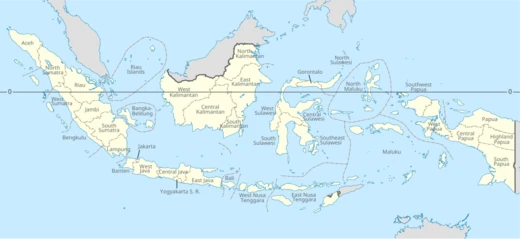
Papua (province)
Indonesian province on northern Western New Guinea with special autonomy.

Papua is an Indonesian province that stretches along the northern coast of Western New Guinea and includes several island groups in Cenderawasih Bay to the west. Its borders roughly match the traditional Papuan region of Mamta–Saireri, and it is split into eight regencies and one city, Jayapura, which serves as the provincial capital. To the east lies Papua New Guinea, to the north the Pacific Ocean, to the west Cenderawasih Bay, and to the south the provinces of Central Papua and Highland Papua. It also has a maritime boundary with Palau in the Pacific. Along with the five other Papuan provinces, Papua enjoys a greater level of autonomy than most Indonesian provinces.
Before 2003, the province covered all of Western New Guinea—a region also called "Papua"—and was known as Irian Barat from 1963 to 1973, then Irian Jaya from 1973 to 2002. In 2002, it took on its current name and was granted special autonomous status under Indonesian law. The western part of the original province was split off in 2001 to form West Papua, and in July 2022, three more provinces—Central Papua, Highland Papua, and South Papua—were carved out. What remains today is a much smaller northern area around Jayapura, along with the islands in Cenderawasih Bay. As of mid-2025, the population within these current borders was estimated at 1,073,640 people, with a growth rate of about 1.31% per year.
The province is run by a directly elected governor and a regional legislature called the People's Representative Council of Papua (DPRP). A distinctive body is the Papuan People's Assembly, created in 2005 under the Papua Special Autonomy Law. This assembly brings together tribal chiefs, religious leaders, and women representatives to handle arbitration and speak for Papuan customs. Since 2014, the DPRP has had 55 members elected every five years, plus 14 appointed through special autonomy, making 69 members total. Its leadership includes one chairperson and three deputy chairs, drawn from the parties with the most seats. The current members were sworn in on 31 October 2019, based on the 2019 general election. Thirteen political parties are represented; the NasDem Party and the Democratic Party each hold eight seats, while the Indonesian Democratic Party of Struggle has seven.
Papua is one of seven provinces with special autonomy status—the others being Aceh, West Papua, Southwest Papua, Central Papua, Highland Papua, and South Papua (Jakarta and Yogyakarta have similar special status as regions). Under Law 21/2001, the provincial government has authority over all administrative sectors except five: foreign affairs, security and defense, monetary and fiscal matters, religion, and justice. It can issue local regulations to implement the autonomy, including rules for districts and municipalities. Thanks to this status, Papua receives substantial special autonomy funds meant to benefit indigenous peoples. However, the province has low fiscal capacity and relies heavily on unconditional transfers and the autonomy fund, which made up about 55% of total revenues in 2008.
To let local communities benefit from timber production, the provincial government issued several decrees. These created a Timber Logging Permit for Customary Communities, allowing small-scale extraction on 250 to 1,000 hectares for one year through community cooperatives. A Permit to Manage Customary Forests allowed larger concessions up to 2,000 hectares for up to 20 years. Logging companies also had to pay compensation to local communities, on top of all other fees and taxes collected by the national government.
As of 2022, after the separation of Central Papua, Highland Papua, and South Papua, the remaining province consists of eight regencies and one city. These cover a northern belt from Waropen Regency to Keerom Regency, plus the island groups to the northwest. Originally, the area now making up Papua Province had three regencies: Jayapura, Yapen Waropen, and Biak Numfor. Jayapura City was split from Jayapura Regency on 2 August 1993 and made a separate administration. On 11 December 2002, three new regencies were created: Keerom and Sarmi from parts of Jayapura Regency, and Waropen from part of Yapen Waropen Regency (the rest became Yapen Islands). On 18 December 2003, Supiori was created from part of Biak Numfor Regency, and on 15 March 2007, Mamberamo Raya was formed.
- Capital
- Jayapura
- Population growth rate
- 1.31% per year
- Number of regencies
- 8
- Number of cities
- 1
- Special autonomy status
- Granted in 2002
Lore & Background
Papua, a province of Indonesia, occupies the northern coast of Western New Guinea and includes island groups in Cenderawasih Bay to the west. Its territory roughly corresponds to the Papuan customary region of Mamta–Saireri. The province is bordered by Papua New Guinea to the east, the Pacific Ocean to the north, Cenderawasih Bay to the west, and the provinces of Central Papua and Highland Papua to the south; it also shares a maritime boundary with Palau. Before 2003, the province covered all of Western New Guinea, known historically as Irian Barat and later Irian Jaya. In 2002, it was renamed Papua and granted special autonomous status. The province was subsequently reduced in size: West Papua split off in 2001, and in July 2022, Central Papua, Highland Papua, and South Papua were created, leaving the current province as a smaller northern area around the capital, Jayapura, plus the Cenderawasih Bay islands. The mid-2025 population estimate within the current borders was 1,073,640, growing at about 1.31% per year. The province is governed by a directly elected governor and a regional legislature, the People’s Representative Council of Papua. A unique body, the Papuan People’s Assembly, formed in 2005, comprises tribal chiefs, religious leaders, and women representatives to arbitrate and represent tribal customs. Papua is one of seven provinces with special autonomy, granting it authority in all administrative sectors except foreign affairs, security, monetary policy, religion, and justice. The province has low fiscal capacity and depends heavily on special autonomy funds, which accounted for about 55% of total revenues in 2008. Under special autonomy, the provincial government issued decrees allowing timber logging permits for customary communities on small concessions and permits to manage customary forests on larger concessions for up to 20 years, with logging companies required to pay compensation to local communities.
Reader's Guide
Papua's significance lies in its special autonomous status, which grants the provincial government authority in all sectors except foreign affairs, security, monetary and fiscal matters, religion, and justice. The province also issued decrees enabling timber logging permits for customary communities and permits to manage customary forests, requiring logging companies to pay compensations to local communities. Papua is one of seven Indonesian provinces with special autonomy status, alongside Aceh, West Papua, Southwest Papua, Central Papua, Highland Papua, and South Papua. Its unique government body, the Papuan People's Assembly, reflects an effort to integrate tribal customs into governance. The province's electoral district elects three members to Indonesia's People's Representative Council.
Did You Know?
- The province's special autonomy status was granted under Law 21/2001.
Frequently Asked Questions
What is Papua (province)?
Papua is an Indonesian province situated along the northern coastline of Western New Guinea, also encompassing the island groups scattered across Cenderawasih Bay. It is one of the country's 38 provinces and holds a distinct place in Indonesia's administrative map due to its geographic remoteness and cultural uniqueness.
Why does Papua (province) enjoy special autonomous status?
Beginning in 2002, national legislation granted the province a higher tier of self-governance than other Indonesian provinces, allowing it greater control over local affairs. This special autonomy reflects recognition of the region's distinct ethnic, linguistic, and geographic character.
What is the capital of Papua (province) and how is it divided administratively?
Jayapura serves as the provincial capital. The province is organized into eight regencies and one city, giving it a relatively compact administrative structure for a territory of its size.
What names has Papua (province) gone through before its current title?
The territory was originally referred to as West Irian after its incorporation into Indonesia, then renamed Irian Jaya for a period, before the name Papua was officially adopted. Each change reflected shifting political and cultural priorities in how the region was framed within the nation.
More in Provinces Of Indonesia 1-24
Spotted an error? Know more?
This is a living reference — every entry is fact-audited, and reader corrections feed straight into our audit queue. Suggest an edit · See this site's audit record