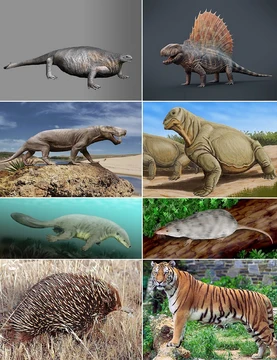
Moschops
A heavily built herbivorous dinocephalian known for head-butting behavior.

Here is the rewritten encyclopedia entry about **Moschops**:
**Moschops** (meaning "calf face" in Greek) is an extinct genus of dinocephalian therapsid from the Middle Permian, living roughly 264.4 to 260 million years ago in what is now South Africa. Its fossils come from the Tapinocephalus Assemblage Zone of the Abrahamskraal Formation. Like other tapinocephalids, Moschops was a heavily built herbivore. Its body mass has been debated; one 2017 study gave an average and maximum weight based on a regression formula, while a 2024 study estimated the mass of one specimen (SAM-PK-11972) using a 3D model, suggesting that method was more accurate. It has also been debated whether Moschops was semi-aquatic, like a hippopotamus. Its short, thick skull and robust build have led many to believe it engaged in head-butting contests with rivals of the same species.
The first Moschops material was found in the Karoo region of South Africa, on the Spitzkop farmstead north of Laingsburg, by Robert Broom and Reverend John Henry Whaits. Broom brought the specimens to the American Museum of Natural History in New York City in 1910. He initially thought the remains came from the Permian upper Ecca Group, based on the lack of pareiasaurs and a single tooth. That original collection includes a holotype (AMNH 5550) and seven topotypes (AMNH 5551–5557). The skulls show varying degrees of pachyostosis, which Broom linked to differences in sex and age. Later researchers determined the fossils actually came from the Tapinocephalus Assemblage Zone, dating to the Middle Permian.
Moschops had a short, broad, massive head, especially wide around the eye sockets. The rear of the skull was deep, but it became shallower and broader toward the front. Like other dinocephalians, the eye sockets are ringed by swollen, thickened bone—the feature that gives the group its name. These bony bosses do not resemble the antlers or horns of modern mammals; instead, they are similar to thickened bone patches seen in some toothed whales, like bottlenose whales. Synchrotron scanning of one *M. capensis* skull suggests neurological adaptations for intense head-to-head combat. The occiput was broad and deep, providing attachment for powerful neck muscles. The pterygoid arches were heavy, and together with the angular bone of the lower jaw, the pterygoid muscles were likely very strong. Like other dinocephalians and non-cynodont therapsids, the skull roof had an opening for a parietal eye, a light-sensitive organ that helps regulate circadian rhythms and body temperature.
The vertebrae of Moschops are holospondylous—the bones are fused. It appears to have had 29 presacral vertebrae and three sacral vertebrae, though the exact number is uncertain. The neck curved upward, but less strongly than in the related *Moschognathus*. The cervical vertebrae were shorter, especially the axis. The cervical ribs attached low on the centra, below the zygapophyses. The front dorsal vertebrae are larger than the rear ones, reflecting the size difference between the shoulder and hip. Each dorsal vertebra is heavily built, short from front to back, and wide from side to side, with flattened front and back faces (amphiplatyan). The lumbar vertebrae are much thinner. No tail vertebrae from the very end are known, but the front tail bones and rear sacrals are large, suggesting a tail of moderate length. Ribs are present on every vertebra from the atlas to the last known tail vertebra. Most ribs resemble those of basal synapsids, but the first sacral rib is exceptionally large and may have helped support the pelvis.
Moschops likely had a semi-erect gait. Its shoulder and hip girdles are intermediate in form between those of basal synapsids (like pelycosaurs) and more advanced therapsids.
- discovered_in
- South Africa (Karoo region, Spitzkop farmstead north of Laingsburg)
- field
- Paleontology
- known_for
- Heavily built herbivorous dinocephalian with thickened skull bosses used for head-butting
Lore & Background
The geologic horizon of these remains was dubious, though Broom suggested that they were from the Permian upper Ecca Group (part of the Karoo Supergroup). The degree of pachyostosis varies within the skulls of the specimens, and Broom believed this to have been linked to variations in sex and age. Subsequent authors have concluded that the remains discovered by Broom and Whaits actually came from the Tapinocephalus Assemblage Zone, dating to the Middle Permian. The head of Moschops is short, broad, and massive, and is especially wide around the orbits. Like many other dinocephalians, the orbits are surrounded by a swollen mass of thickened bone, the trait the clade was named for. These structures, while likely used for head-butting, do not resemble the kind of head-butting implements seen in most modern mammals; rather, they most closely resemble patches of thickened bone observed in certain toothed whales, particularly bottlenose whales. Synchrotron scanning of one M. capensis skull suggests neurological adaptations for such 'intense head-to-head combat'.
Reader's Guide
Moschops is significant as a well-known representative of the dinocephalian therapsids, a dominant group of Middle Permian synapsids that included both large carnivores and herbivores. The anatomy of its pectoral and pelvic girdles suggests a semi-erect gait, intermediate between basal synapsids and more derived therapsids, and its short digits were compared by William Gregory to those of tortoises. The osteohistology of Moschops shows a very well developed medullary spongiosa and a thick layer of cortical bone, which has been argued to support a semi-aquatic lifestyle, but analysis of the lateral canals of the inner ears of a specimen originally suggested to be Moschops capensis (later referred to Moschognathus) suggests the head was habitually held near vertical, contradicting such a lifestyle and indicating it was instead terrestrial. Due to that and the possession of long-crowned, stout teeth, it is believed that Moschops was a herbivore feeding on nutrient-poor and tough vegetation, likely requiring long feeding periods. Delphinognathus conocephalus could represent juvenile Moschops, though it is also considered an indeterminate juvenile tapinocephalid.
Did You Know?
- Moschops means 'calf face' in Greek.
- The degree of pachyostosis (thickening) in Moschops skulls varies, and Robert Broom believed this was linked to differences in sex and age.
- Synchrotron scanning of a Moschops capensis skull suggests neurological adaptations for 'intense head-to-head combat'.
Frequently Asked Questions
What is Moschops?
Moschops is a heavily built herbivorous dinocephalian synapsid from the Permian period. It is distinguished by its short, thick skull topped with prominent bony bosses.
Where were Moschops fossils found?
Fossils of this animal have been recovered from the Karoo region of South Africa, specifically near the Spitzkop farmstead north of Laingsburg, within the Abrahamskraal Formation.
What was Moschops known for?
Moschops is best recognized for its thickened skull bosses, which paleontologists widely interpret as evidence that rival individuals of the same species engaged in head-butting contests with one another.
What did Moschops eat?
Moschops was a herbivore, browsing or grazing on plant material during the Permian. Its robust, heavily built frame supported a large body dedicated to processing vegetation.
Which geological zone is Moschops assigned to?
Moschops is classified within the Tapinocephalus Assemblage Zone of the Abrahamskraal Formation, placing it in the mid-Permian faunal assemblage of South Africa.
More in Prehistoric Synapsids 1-19
Spotted an error? Know more?
This is a living reference — every entry is fact-audited, and reader corrections feed straight into our audit queue. Suggest an edit · See this site's audit record