Diadectes
Early Permian herbivorous reptiliomorph, one of the first large land vertebrates.

User:Slate Weasel · Public domain
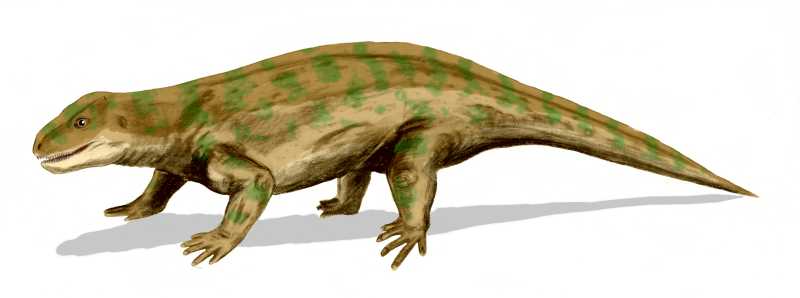
Diadectes, whose name means "crosswise-biter," is an extinct genus of large reptiliomorphs from the early Permian period, specifically the Artinskian and Kungurian stages, around 290 to 272 million years ago. It ranks among the earliest herbivorous tetrapods and was also one of the first fully land-dwelling vertebrates to reach a large size.
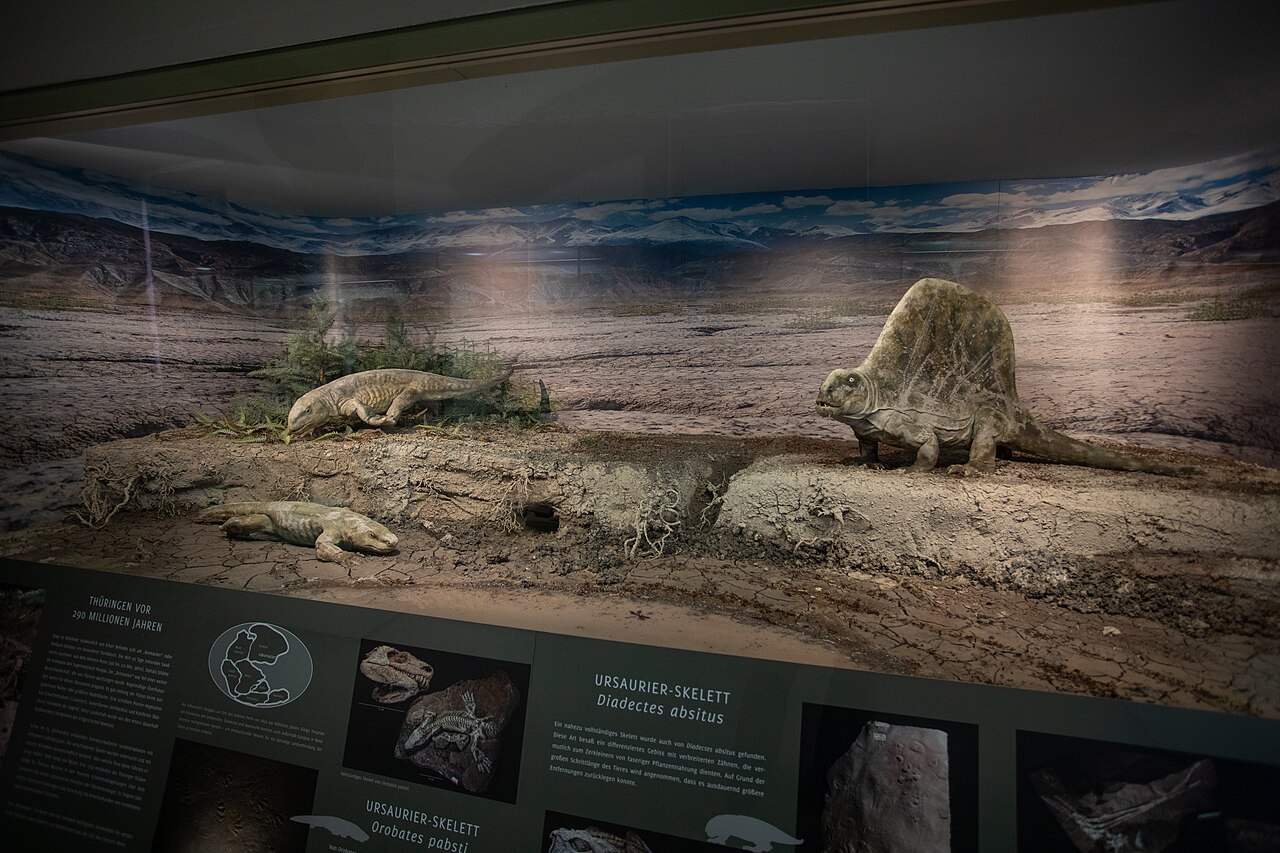
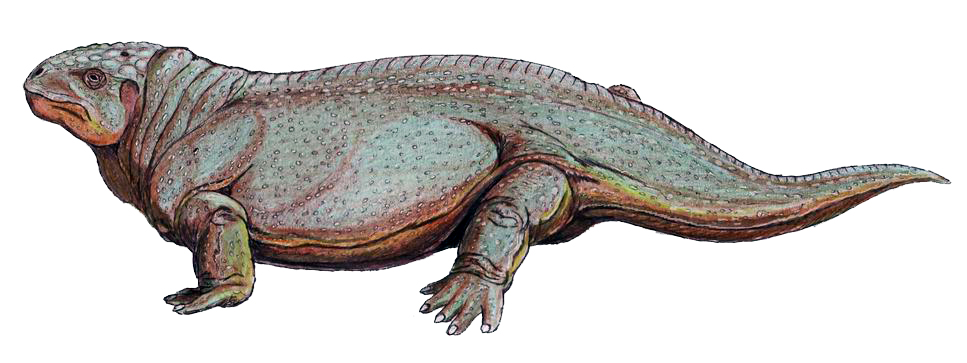
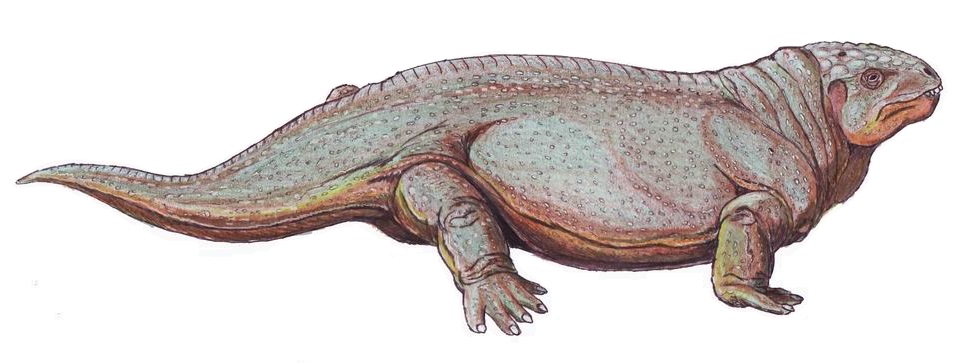
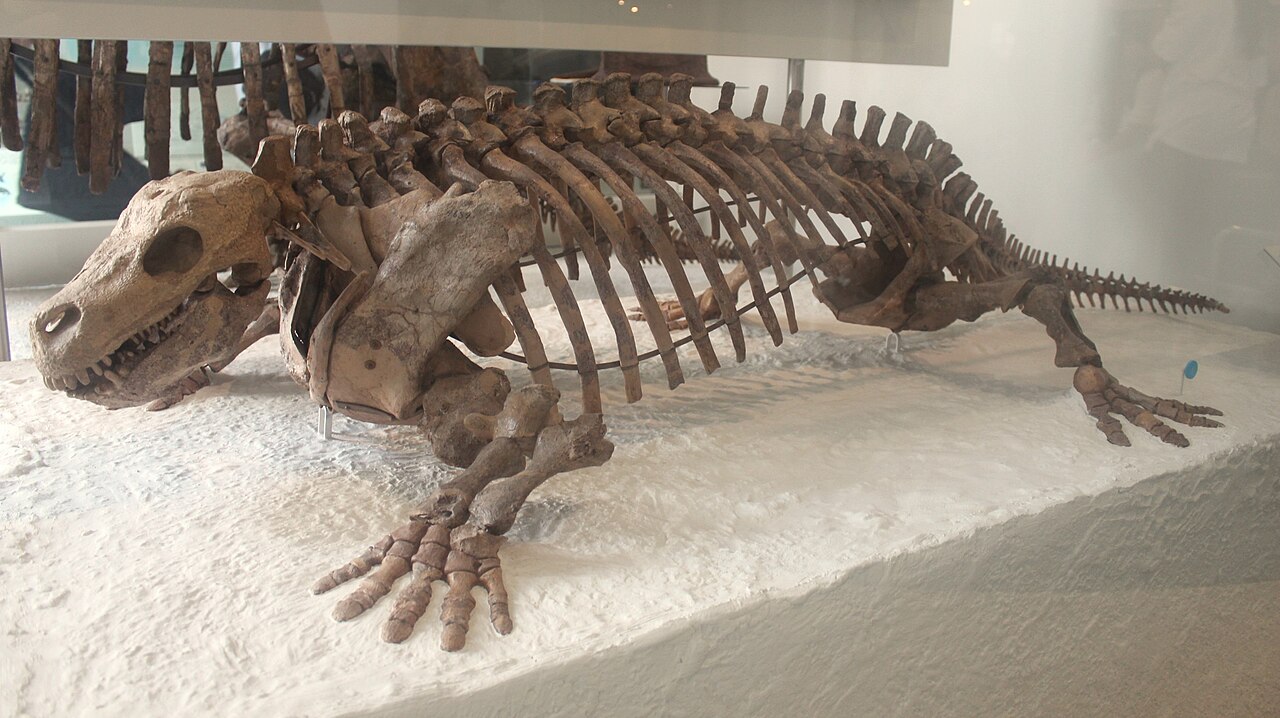
This animal had a robust build, with a thick skull, heavy vertebrae and ribs, massive limb girdles, and short, sturdy limbs. Its skeleton clearly points to a terrestrial lifestyle. While earlier reconstructions suggested a barrel-shaped rib cage, newer fossils show the ribs actually projected outward to the sides. High-resolution X-ray microcomputed tomography of *Diadectes absitus* revealed an inner ear structure—the endosseous labyrinth—within the opisthotic, prootic, and supraoccipital bones, including a well-preserved vestibule, three semicircular canals, and a developed cochlear recess. The supraoccipital, located medially to the anterior semicircular canal, has a shallow, subarcuate fossa on its underside, and an otic tube connects the fenestra vestibuli to the vestibule.
The creature blended features of reptiles and amphibians, with a reptile-like body but a more primitive skull resembling that of seymouriamorphs. It is classified as a close relative of the amniotes. Among its primitive traits is a large otic notch, typical of labyrinthodonts but absent in reptiles, which held an ossified tympanum. At the same time, its teeth show advanced adaptations for eating plants, unmatched among other early Permian animals. The eight front teeth were spatulate and peg-like, acting as incisors to nip off vegetation, while the broad, blunt cheek teeth show heavy wear from occlusion, functioning like molars to grind food. A partial secondary palate allowed it to chew and breathe simultaneously—something many later reptiles could not do. These features likely evolved independently in response to a high-fiber diet, and many reptile-like details of its postcranial skeleton, possibly related to supporting a heavy trunk, are analogous rather than homologous to those of early amniotes like pelycosaurs and pareiasaurs. This similarity is a case of convergent evolution, since the first reptiles evolved from small, swamp-dwelling animals such as *Casineria* and *Westlothiana*. A juvenile skeleton of *Diadectes* bears tooth marks on its limb bones, indicating it was preyed upon by predators like *Varanops*, *Dimetrodon*, or the amphibian *Acheloma*.
Edward Drinker Cope first named and described *Diadectes* in 1878, based on a partial lower jaw (AMNH 4360) from the Permian of Texas. He noted the teeth had short, compressed crowns with their long axis transverse to the jaw, inspiring the name "crosswise-biter" (from Greek *dia* "crosswise" and *dēktēs* "biter"). Cope considered the animal "in all probability, herbivorous." His type species name *sideropelicus* (from Greek *sidēros* "iron" and *pēlos* "clay") referred to the iron-rich clay of the Wichita beds in Texas where the fossil was found. Remains have since been discovered across North America, especially in the Texas Red Beds (Wichita and Clear Fork formations).
Many species have been assigned to *Diadectes*, though most are now considered synonyms. Several supposed separate diadectid genera have also been shown to be junior synonyms. One, *Nothodon*, was published by Othniel Charles Marsh just five days before Cope’s *Diadectes*. In 1912, Case synonymized the two, treating *Diadectes* as the senior synonym—a decision followed by later paleontologists, even though it violates ICZN rules. A 2010 unpublished PhD thesis by Richard Kissel proposed the new genus names "Oradectes" for *D. sanmiguelensis* and "Silvadectes" for *D. absitus* based on phylogenetic analysis, but these names are not valid under the ICZN because they appeared only in a thesis. A 2024 paper formally erected the genus *Kuwavaatakdectes* for *D. sanmiguelensis* and also named another species, *D. dreigleichenensis*, which coexisted with *D. absitus* in Germany’s Tambach Formation.
- field
- Paleontology
- known_for
- One of the first herbivorous tetrapods and large fully terrestrial vertebrates
- length
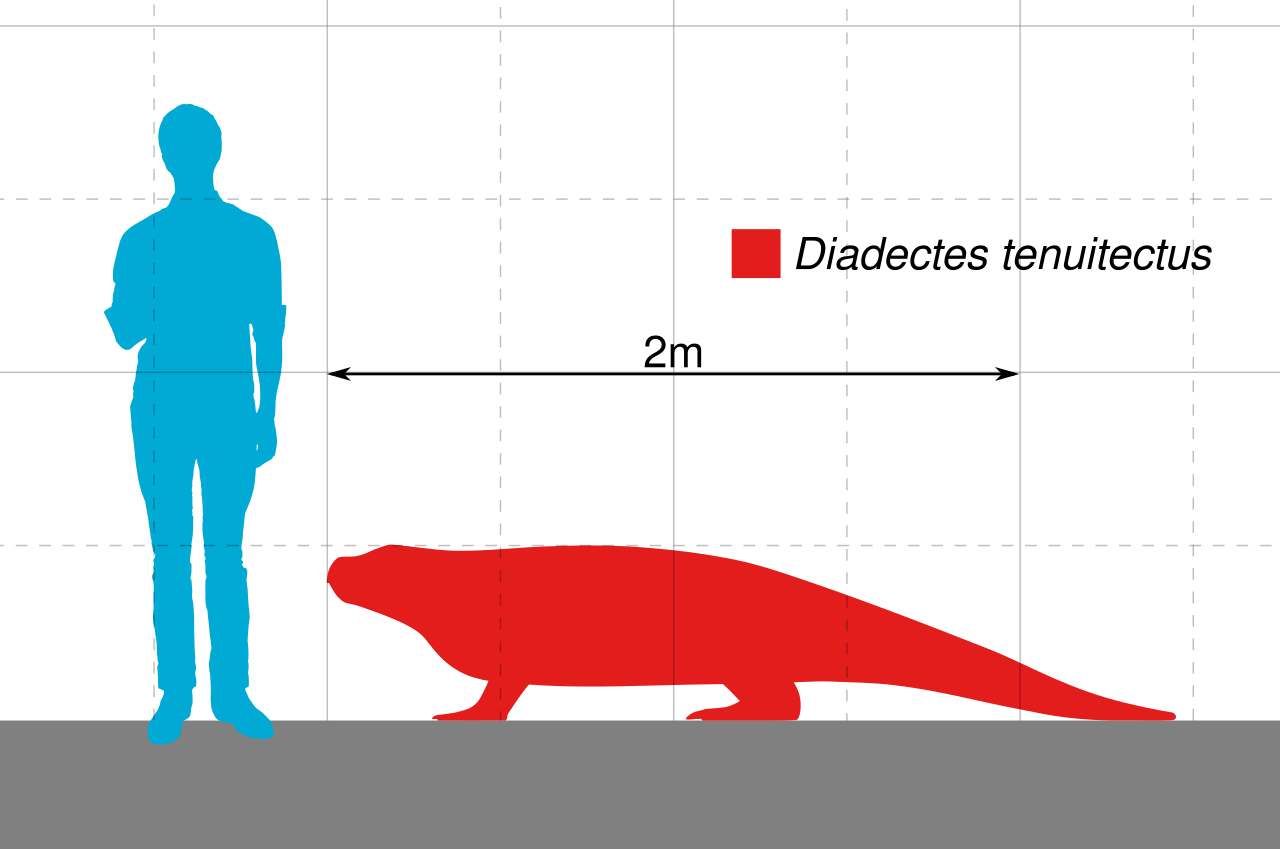
- Up to 3 m (10 ft)
- diet
- Herbivorous
Lore & Background
Cope noted the transverse orientation of the tooth crowns, which inspired the generic name 'crosswise-biter.' He described the animal as 'in all probability, herbivorous.' The type species name sideropelicus alludes to the iron clay of the Wichita beds in Texas where the fossil was found. Diadectes possessed a mix of reptilian and amphibian characteristics, combining a reptile-like skeleton with a more primitive, seymouriamorph-like skull. It had a large otic notch that likely supported a spiracle or other soft tissue, not a tympanic membrane or ossified tympanum, but also advanced herbivorous dental specializations: eight front spatulate teeth for nipping vegetation and broad, blunt cheek teeth for grinding. A partial secondary palate allowed it to chew and breathe simultaneously. Numerous species have been assigned to Diadectes, though most are synonyms. The name Nothodon was published by Othniel Charles Marsh five days before Cope's Diadectes, but Diadectes has been conserved as a nomen protectum under ICZN rules due to long-standing usage.
Reader's Guide
Diadectes holds significance as one of the earliest large herbivorous tetrapods to live fully on land, marking a key step in terrestrial ecosystem evolution. Its combination of primitive amphibian-like skull features (such as the otic notch) with advanced reptilian postcranial traits illustrates the mosaic evolution that characterized the transition from aquatic to terrestrial life. The independent evolution of its herbivorous adaptations—including spatulate incisors, grinding molars, and a secondary palate—highlights convergent evolution with later reptilian herbivores. The discovery of a juvenile skeleton with tooth markings from predators like Varanops, Dimetrodon, or the amphibian Acheloma provides direct evidence of predation pressure. Phylogenetic debates, including the paraphyly of Diadectes and the proposal of new genera in unpublished theses, underscore ongoing taxonomic refinement. The species D. dreigleichenensis from Germany extends the genus's geographic range beyond North America. Diadectes thus serves as a critical reference for understanding early herbivory, terrestrialization, and the complex evolutionary relationships among early tetrapods.
Did You Know?
- Diadectes was one of the first herbivorous tetrapods and one of the first fully terrestrial vertebrates to attain large size.
- Its generic name 'crosswise-biter' refers to the transverse orientation of its tooth crowns.
- A juvenile Diadectes skeleton shows tooth markings from predators such as Varanops, Dimetrodon, or the amphibian Acheloma.
- The name Nothodon was published by Othniel Charles Marsh five days before Cope's Diadectes, but Diadectes has been conserved as a nomen protectum under ICZN rules due to long-standing usage.
Gallery
Frequently Asked Questions
What is Diadectes?
Diadectes was a large, plant-eating reptiliomorph that lived during the Early Permian period. It ranks among the earliest tetrapods to feed exclusively on vegetation and one of the first fully land-dwelling vertebrates to grow to a substantial size.
How big did Diadectes get?
Individuals could reach roughly three meters (about ten feet) in total length, making it one of the larger land animals of its era. For a fully terrestrial vertebrate in the Early Permian, that was a remarkable size.
What was Diadectes's diet?
It was a herbivore, feeding on plant material rather than other animals. This made it one of the earliest known tetrapods to rely entirely on vegetation for sustenance.
Where have Diadectes fossils been discovered?
Fossil remains have been recovered from various sites across North America, with the Texas Red Beds being a particularly well-known source. These deposits preserve some of the best evidence of this animal's anatomy.
Why is Diadectes significant in paleontology?
It marks a key evolutionary milestone as one of the first large, fully terrestrial vertebrates to adopt a plant-based diet. Its existence shows that sizable herbivorous land-dwelling animals had already appeared by the Early Permian.
More in Prehistoric Synapsids 1-19
Spotted an error? Know more?
This is a living reference — every entry is fact-audited, and reader corrections feed straight into our audit queue. Suggest an edit · See this site's audit record