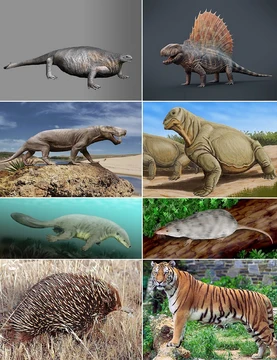
Mammaliaformes
Clade of synapsid tetrapods including mammals and extinct relatives.

Theklan FunkMonk Nobu Tamura ( http://spinops.blogspot.com ) Nobu Tamura ( http: · CC BY 3.0
Mammaliaformes, meaning "mammal-shaped animals," is a group of synapsid tetrapods that includes all crown group mammals and their closest extinct relatives. This clade evolved from earlier probainognathian cynodonts during the Late Triassic. It is defined phylogenetically as the group that shares the most recent common ancestor of Morganucodonta and crown group mammals—the latter being the clade that includes the most recent common ancestor of living monotremes, marsupials, and placentals. In addition to Morganucodonta and crown group mammals, Mammaliaformes also contains Docodonta and the genus Hadrocodium.
The term Mammaliaformes is used in phylogenetic classification. By contrast, the traditional trait-based assignment to class Mammalia is slightly broader, often including genera like Adelobasileus and Sinoconodon, which fall outside Mammaliaformes. These genera belong to the larger clade Mammaliamorpha, defined as the group stemming from the last common ancestor of Tritylodontidae and crown group mammals. This wider clade also includes families such as Tritylodontidae and Brasilodontidae, which trait-based taxonomy does not place in Mammalia.
Animals in Mammaliaformes are commonly called mammaliaforms (sometimes spelled mammaliforms). The origin of crown-group mammals dates to the Jurassic, with many important fossils found in Late Jurassic deposits in Portugal and China. The earliest confirmed fur specimens appear in these animals, indicating that fur had already evolved in the ancestors of mammals.
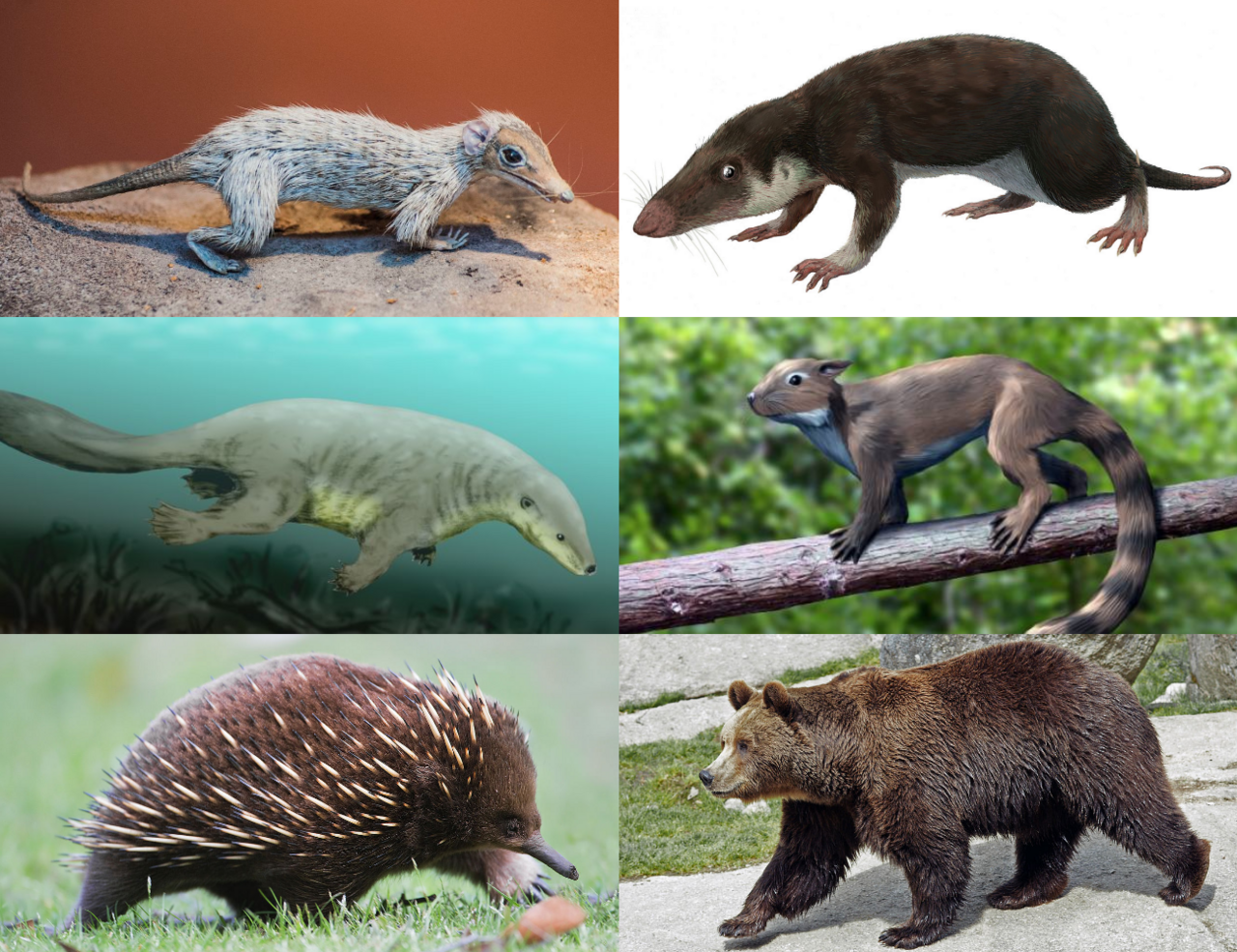
Early mammaliaforms were generally shrew-like in appearance and size, with most of their distinctive features being internal. Their jaw structure and tooth arrangement are nearly unique: instead of many replaceable teeth, they have one set of baby teeth and one set of adult teeth that fit together precisely. This arrangement helps grind food for faster digestion, which is important for endothermic animals that need more calories than ectotherms. The downside is that worn teeth cannot be replaced, unlike in reptiliomorph ancestors. To compensate, mammaliaforms developed prismatic enamel with crystallite discontinuities that help spread bite forces.
Lactation and other mammalian traits are thought to characterize Mammaliaformes, though these are hard to study in fossils. Evidence of lactation appears in morganucodontans through tooth replacement patterns, and the more basal tritylodontids also show signs of it, suggesting milk is ancestral in this group. However, the more derived Sinoconodon seems to have uniquely lost lactation. Before hatching, milk glands likely provided moisture to leathery eggs, a condition still seen in monotremes.
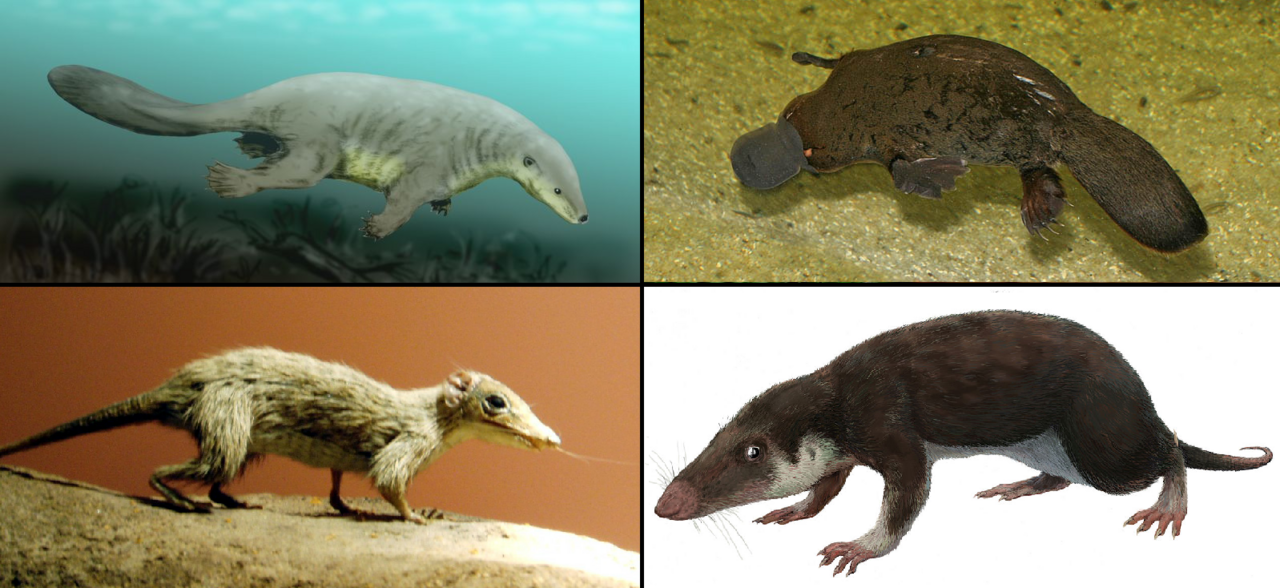
Early mammaliaforms had a harderian gland, which in modern mammals is used for cleaning fur. This suggests they had a furry covering, unlike their cynodont ancestors. Insulation is necessary for small homeothermic animals—those under about 5 cm long. The 3.2 cm Hadrocodium must have had fur, but the 10 cm Morganucodon might not have needed it. The docodont Castorocauda, which is more distant from crown group mammals than Hadrocodium, had two layers of fur—guard hairs and underfur—like modern mammals.
It is possible that early mammaliaforms had whiskers (vibrissae). Tritheledontidae, a group of cynodonts, probably had them, and a common ancestor of all therian mammals did as well. Some humans still develop vestigial vibrissal muscles in the upper lip, suggesting that the whisker sensory system may have played an important role in mammalian evolution.
Like modern monotremes, early mammaliaforms had somewhat sprawling legs, giving a reptile-like gait. But there was a general trend toward more erect forelimbs; forms like eutriconodonts had a fundamentally modern forelimb anatomy while retaining primitive hindlimbs. This tendency is still seen in modern therian mammals, which often have more sprawling hindlimbs. In some species, the hind feet likely bore a spur similar to that of the platypus and echidnas, connected to a venom gland for protection or mating competition.
Hadrocodium lacks the multiple bones in its lower jaw seen in reptiles, though earlier mammaliaforms still retained them. Mammaliaforms also lack the proatlas bones in the neck found in other synapsids.
With the possible exception of Megazostrodon, Erythrotherium, and placental mammals, all mammaliaforms possess epipubic bones—a feature possibly shared with tritylodontids. These pelvic bones strengthen the torso and support abdominal and hindlimb muscles, but they prevent abdominal expansion. This forces species that have them to either give birth to larval young (as in modern marsupials) or produce tiny eggs that hatch into larval young (as in modern monotremes). Most mammaliaforms likely had the same constraints, and some may have had pouches.
- field
- Paleontology
- known_for
- Transitional clade between cynodonts and crown-group mammals
- key_inclusions
- Morganucodonta, Docodonta, Hadrocodium, crown group mammals
- time_period
- Late Triassic to present (crown group mammals from Jurassic)
Quick Facts
- Taxon
- Mammaliaformes
Facts from the source article.
Lore & Background
Early mammaliaforms were generally shrew-like in appearance and size, with most distinguishing characteristics internal. Their jaw structure and tooth arrangement are nearly unique: instead of many frequently replaced teeth, they have one set of baby teeth and later one set of adult teeth that fit together precisely, aiding digestion for endothermic animals. The drawback is that worn teeth cannot be replaced, so mammals developed prismatic enamel with crystallite discontinuities to spread bite force. Lactation is thought to characterize Mammaliaformes, with evidence present in morganucodontans via tooth replacement patterns. More basal tritylodontids also display evidence of lactation, implying milk is ancestral in this group, though the derived Sinoconodon appears to have discarded milk. Prior to hatching, milk glands would provide moisture to leathery eggs, as still seen in monotremes. Early mammaliaforms had a harderian gland for cleaning fur, indicating a furry covering; the 3.2 cm Hadrocodium must have had fur, while the 10 cm Morganucodon might not have needed it. The docodont Castorocauda had two layers of fur, guard hairs and underfur. Early mammaliaforms had somewhat sprawling legs, giving a reptilian gait, but with a tendency toward more erect forelimbs. Some forms likely bore a spur on the hind feet connected to a venom gland. Hadrocodium lacks the multiple lower jaw bones seen in reptiles, which are retained in earlier mammaliaforms. Mammaliaforms lack proatlas bones in the neck. With possible exceptions, all mammaliforms possess epipubic bones, which strengthen the torso but prevent abdominal expansion, forcing birth of larval young or minuscule eggs.
Reader's Guide
Mammaliaformes is a phylogenetically defined clade that captures the transition from cynodonts to crown-group mammals. Its definition—based on the most recent common ancestor of Morganucodonta and crown mammals—provides a precise framework for studying mammalian origins. The group includes early forms like Hadrocodium and Docodonta, which exhibit key mammalian traits such as fur, lactation, and specialized dentition. The term contrasts with trait-based assignments to class Mammalia, which sometimes include genera like Adelobasileus and Sinoconodon that fall outside Mammaliaformes. The earliest confirmed fur specimens are found in mammaliaforms, demonstrating that fur developed in ancestors of mammals. The group's fossil record, particularly from Jurassic outcrops in Portugal and China, documents the origin of crown-group mammals. Understanding Mammaliaformes helps clarify the evolution of endothermy, lactation, and the mammalian jaw and ear structures.
Did You Know?
- Mammaliaformes is defined as the clade originating from the most recent common ancestor of Morganucodonta and crown group mammals.
- The earliest confirmed specimens of fur are found in mammaliaforms, demonstrating that ancestors of mammals had already developed fur.
- Hadrocodium, a mammaliaform, lacks the multiple bones in its lower jaw seen in reptiles, which are retained in earlier mammaliaforms.
- With the possible exception of Megazostrodon and Erythrotherium, all mammaliforms possess epipubic bones, which prevent abdominal expansion and force birth of larval young or minuscule eggs.
Anatomical Distinction and the Skull Architecture
The defining skeletal feature of synapsids is a single opening in the lower region of the skull roof, positioned behind each eye socket. This temporal fenestra forms a bony arch that anchors larger jaw muscles, producing a more powerful and efficient bite than would otherwise be possible. For a long time, this single opening was considered a unique synapsid trait, but recent research suggests that the last common ancestor of both synapsids and sauropsids already possessed this feature, meaning many primitive sauropsids share it as well. This anatomical detail was crucial in separating synapsids from what were once called "reptiles" in the early 1900s. When paleontists examined skeletal remains more closely, the distinctive temporal openings made it clear that synapsids could not simply be slotted into a reptile subclass. The jaw-muscle architecture implied by these openings became a key line of evidence that synapsids represent an independent evolutionary branch rather than a transitional stage within the reptile lineage.
Dominance and Catastrophe Across the Permian and Triassic
Synapsids first appeared toward the close of the Carboniferous, roughly 315 to 307 million years ago, and by the Permian they had become the largest land vertebrates on Earth. Eupelycosaurs like Dimetrodon, Titanophoneus, and Inostrancevia held the top predator niche, while later theriodonts such as Moschorhinus filled that role into the Early Triassic. Their reign was interrupted twice: the Capitanian mass extinction and the far more devastating Permian–Triassic extinction event both slashed synapsid diversity and population. Only two therapsid groups—dicynodonts and eutheriodonts, themselves split into therocephalians and cynodonts—made it into the Triassic. In the aftermath, these survivors exploded as disaster taxa; the dicynodont Lystrosaurus at one point constituted as much as 95 percent of all terrestrial species. That dominance lasted until the Smithian–Spathian boundary event, after which archosaurian sauropsids—first pseudosuchians, then pterosaurs and dinosaurs—gradually displaced synapsids from their ecological niches.
The Taxonomic Revolution and the End of "Mammal-Like Reptiles"
At the start of the twentieth century, synapsids were lumped into one of four reptile subclasses. The label "mammal-like reptile" (or "pelycosaur") became the standard shorthand for non-mammalian synapsids, implying they were simply reptiles on a slow road toward mammalian features. Closer skeletal study overturned that picture: the temporal fenestrae and other traits showed synapsids were not a transitional grade within Reptilia but a separate lineage entirely. Modern cladistics now places Synapsida as a monophyletic sister clade to Sauropsida within Amniota, and the word "reptile" has been redefined to cover only sauropsid descendants. Terms like "mammal-like reptile" and "pelycosaur" have fallen out of favor in technical writing, replaced by stem mammal, proto-mammal, paramammal, or pan-mammal. In phylogenetic nomenclature, daughter clades are included within parent names, so "therapsid" and "synapsid" carry slightly different scopes than under older Linnaean schemes, and most twenty-first-century papers treat "pelycosaur" as merely an informal grouping of primitive members.
From Nocturnal Survivors to Modern Dominance
The cynodont lineage Probainognathia, which encompasses Mammaliaformes, was the only synapsid group to persist beyond the Triassic. During the Jurassic, these early mammal-line cynodonts largely retreated into a nocturnal lifestyle, an ecological strategy that let them avoid direct competition with the dominant dinosaurs. Their window of opportunity arrived with the Cretaceous–Paleogene extinction event, which eliminated all non-avian dinosaurs and pterosaurs. In the Cenozoic that followed, synapsids—now fully realized as mammals—reclaimed terrestrial dominance on a scale unmatched since the Permian. Today roughly 6,800 mammal species inhabit the planet, a testament to a lineage that survived two of the worst mass extinctions in Earth's history, endured millions of years as small, mostly nocturnal creatures, and then radiated explosively once the archosaurian competitors were removed.
Gallery
Frequently Asked Questions
What are Mammaliaformes?
Mammaliaformes is a clade of synapsid tetrapods that groups crown-group mammals together with their closest extinct relatives, serving as the bridge between earlier cynodonts and true mammals. The name simply means "mammal-shaped animals."
When did Mammaliaformes first appear in the fossil record?
The group radiated out of earlier probainognathian cynodonts during the Late Triassic, although crown-group mammals themselves did not show up until the Jurassic.
Which major lineages are included in Mammaliaformes?
In addition to crown-group mammals (Monotremata, Marsupialia, and Placentalia), the clade encompasses Morganucodonta, Docodonta, and the well-known fossil Hadrocodium.
How is Mammaliaformes defined in terms of phylogeny?
It is a node-based clade rooted at the most recent common ancestor of Morganucodonta and crown-group mammals, rather than being delimited by a single shared anatomical feature.
Why is Mammaliaformes important to synapsid fans and paleontologists?
It captures the critical transitional window in which non-mammalian cynodonts gave rise to the first true mammals, making it central to understanding how hallmark mammalian traits evolved.
More in Prehistoric Synapsids 1-19
Spotted an error? Know more?
This is a living reference — every entry is fact-audited, and reader corrections feed straight into our audit queue. Suggest an edit · See this site's audit record