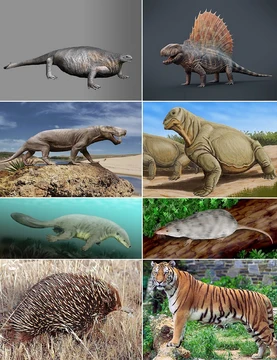
Dicynodontia
Extinct herbivorous therapsids with tusks and a horny beak.

Fröbisch, Jörg · CC BY-SA 4.0
Dicynodontia is an extinct group of anomodonts—a kind of non-mammalian therapsid. These herbivores usually had a pair of tusks, which gives their name the meaning “two dog tooth,” and they also had a horny, typically toothless beak, a feature found in no other synapsid. They first showed up in southern Pangaea around 270–260 million years ago in the mid-Permian, then spread worldwide and became the dominant plant-eaters of the Late Permian (roughly 260–252 million years ago). The end-Permian mass extinction about 252 million years ago hit them hard, wiping out most other therapsids. They bounced back at the start of the Triassic, but their numbers and diversity shrank during the Late Triassic, and they vanished before the end of that period. With over 80 to 90 known genera, dicynodonts were the most successful and varied of the non-mammalian therapsids, ranging from animals the size of rats that dug burrows to elephant-sized megaherbivores.
Their skulls were highly specialized: lightweight yet strong, with large temporal openings at the back to fit bigger jaw muscles. The front of the skull and lower jaw were narrow and, except in a few primitive forms, toothless. Instead, a keratinous horny beak sat at the mouth’s front, similar to what turtles and ceratopsian dinosaurs had. When the mouth closed, the lower jaw retracted, creating a powerful shearing action that let dicynodonts handle tough plant material. Most dicynodonts had a pair of enlarged maxillary caniniform teeth—like the tusks seen in some living mammals. In the earliest genera, these were just oversized teeth, but in later forms they independently evolved into ever-growing tusks multiple times. In some species, tusks may have been sexually dimorphic. A few dicynodonts, such as *Stahleckeria*, lacked true tusks and instead had tusk-like extensions on the side of the beak. Like some other anomodonts, their skull roof included a novel bone called the “preparietal,” not found in earlier synapsids or in the cynodont ancestors of mammals. This unpaired bone forms the front edge of the pineal foramen. Similar preparietal bones appear in gorgonopsid and biarmosuchian therapsids, but these likely evolved independently in each group. Ancestral dicynodonts had three sacral vertebrae, but some later forms had more than six, due to both duplication of vertebrae and incorporation of tail vertebrae into the sacrum.
Size varied enormously. The smallest were rat-sized, common among Permian members, while Triassic dicynodonts were typically much larger. The youngest known, *Lisowicia*, was also the largest, about the size of an elephant with an estimated body mass of several tons. Many Triassic dicynodonts may have held their hindlimbs relatively erect while keeping their forelimbs more splayed, though *Lisowicia* likely had erect forelimbs as well.
Soft tissue evidence is limited. Possible hair remnants in Permian carnivore coprolites have been suggested to come from dicynodonts, since digested dicynodont bones are common in those droppings. However, mummified skin from *Lystrosaurus* specimens shows the skin surface was covered in overlapping tubercles. Tracks attributed to *Pentasauropus* indicate dicynodonts had fleshy pads on their feet.
Whether dicynodonts were warm-blooded has long been debated. Their bones are highly vascularized and contain Haversian canals, and their body proportions help retain heat. In young specimens, bone channel densities are even higher than in most other therapsids. Yet studies of Late Triassic dicynodont coprolites show digestive patterns more typical of animals with slow metabolisms. A 2017 chemical analysis suggested that both cynodonts and dicynodonts independently developed warm-bloodedness before the Permian extinction.
Reproduction and social behavior: A tightly curled embryonic *Lystrosaurus* from the Early Triassic of South Africa suggests dicynodonts laid eggs, as is thought ancestral for synapsids and amniotes. No eggshell was preserved, so the eggs were probably soft and leathery, like those of living monotreme mammals and likely ancestral for amniotes. The relatively large egg size implies *Lystrosaurus* young were precocial—fairly independent from birth—and that the egg had large yolk reserves. This indicates dicynodonts did not produce milk like mammals do (monotreme eggs are small relative to body size) and perhaps also not like some non-mammalian cynodonts. Fossil communal latrines, trackways showing adults and juveniles walking together, and large fossil aggregations of both adults and juveniles suggest that at least some dicynodonts cared for their young after hatching and lived in groups.
History of discovery: A 2024 paper proposed that rock art made by the San people of South Africa before 1835—depicting a walrus-like imaginary creature with downcurved tusks—may have been partly inspired by fossil dicynodont skulls that erode from local rocks.
- extinction
- Norian or Rhaetian, before the Triassic-Jurassic boundary
Lore & Background
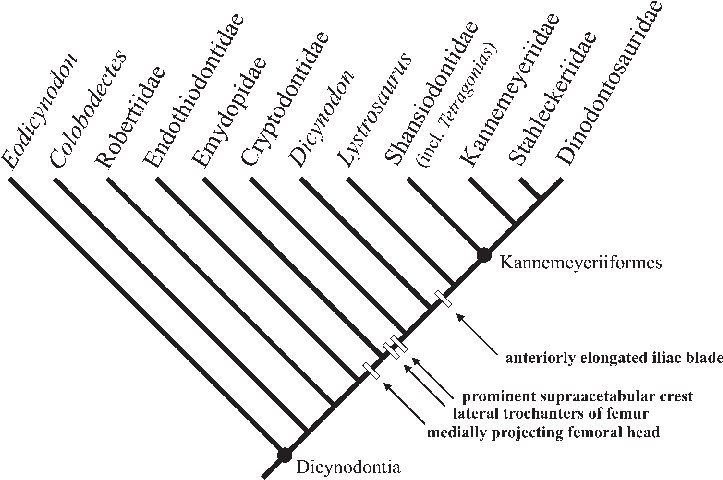
Dicynodonts first appeared in Southern Pangaea during the late Permian (Capitanian or earlier) and underwent a rapid evolutionary radiation, becoming globally distributed and among the most successful land vertebrates of the Late Permian. They included a large variety of ecotypes, from large and medium herbivores to short-limbed mole-like burrowers. Only three lineages survived the end-Permian mass extinction: Lystrosauridae, Kannemeyeriiformes, and the lineage leading to Myosaurus or similar. Lystrosaurus became the most common herbivore of the earliest Triassic. The third group, Kannemeyeriiformes, diversified during the Triassic but declined in the Late Triassic, with the largest known dicynodont, Lisowicia, surviving until at least the late Norian, but no dicynodonts are known from the Jurassic.
Reader's Guide
Dicynodontia represents the most successful and diverse clade of non-mammalian therapsids, dominating terrestrial herbivory for much of the Permian and Triassic. Their highly specialized skull, with a horny beak and powerful shearing jaw action, allowed them to process tough plant material. They varied enormously in size, from rat-sized Permian forms to the elephant-sized Triassic Lisowicia. Their evolutionary history illustrates both the devastation of the end-Permian mass extinction and the subsequent recovery and eventual decline of a major lineage. Dicynodonts have been known to science since the mid-1800s, with early descriptions by Andrew Geddes Bain and Richard Owen. Their fossils have provided insights into reproduction, including evidence of egg-laying and possible parental care, as well as possible endothermy. The clade's long temporal range and global distribution make them key to understanding Permian-Triassic ecosystems and therapsid evolution.
Did You Know?
- The name Dicynodontia means 'two dog tooth', referring to their typical pair of tusks.
- Dicynodonts possessed a horny, toothless beak unique among all synapsids.
Rise, Ruin, and Resilience
Dicynodonts were herbivorous non-mammalian therapsids whose very name, meaning 'two dog tooth,' refers to the prominent pair of tusks most members displayed. They first emerged in the mid-Permian, roughly 270 to 260 million years ago, within the landmass of Southern Pangaea. From that modest origin they expanded to become globally distributed and, by the Late Permian (approximately 260 to 252 million years ago), the dominant plant-eating animals on Earth. Their reign was cut short by the end-Permian mass extinction around 252 million years ago, a catastrophe that eliminated most other therapsid lineages. Yet dicynodonts survived and rebounded at the dawn of the Triassic, only to enter a gradual decline through the Late Triassic until they vanished entirely by the period's close. Despite their ultimate extinction, they remain the most successful and diverse group of non-mammalian therapsids ever documented, with between eighty and ninety genera recognized. Their body plans spanned an extraordinary range, from rat-sized burrowers to elephant-sized megaherbivores, a versatility that underpinned their ecological dominance for tens of millions of years.
A Skull Built for Shearing
The dicynodont skull represents one of the most specialized cranial designs in synapsid history. It was simultaneously lightweight and robust, with the temporal openings at the rear dramatically enlarged to house larger jaw muscles. In nearly all forms beyond the most primitive, the front of the skull and the entire lower jaw were toothless. In their place sat a keratinous, horny beak, a feature unique among all synapsids and comparable to the beaks of turtles or ceratopsian dinosaurs. When the mouth closed, the lower jaw retracted, generating a powerful shearing motion well suited to processing tough vegetation. Behind the beak, a pair of enlarged maxillary caniniform teeth served as tusks. In the earliest dicynodonts these were simply oversized teeth, but in later lineages they evolved independently, on multiple occasions, into ever-growing structures analogous to modern mammalian tusks. In some species the tusks appear to have been sexually dimorphic, and in Stahleckeria true tusks were absent entirely, replaced by tusk-like projections on the beak itself. The skull roof also bears a novel unpaired bone called the preparietal, which marks the forward edge of the pineal foramen and has no counterpart in earlier synapsids or in the cynodont ancestors of mammals.
Warm Bones, Rough Skin, and a Life in Motion
Dicynodonts ranged from rat-sized Permian burrowers to the elephant-sized Lisowicia of the Triassic, whose body mass has been estimated at roughly 5,880 kilograms. Triassic members were generally much larger than their Permian predecessors, and many likely held their hindlimbs in a relatively upright posture while the forelimbs remained more splayed, though Lisowicia probably stood with erect forelimbs as well. Their skin, preserved in mummified Lystrosaurus specimens, was covered in numerous overlapping tubercules, and trackways attributed to Pentasauropus indicate fleshy pads on the feet. The question of whether dicynodonts were warm-blooded has long divided paleontologists. Their bones are densely threaded with blood vessels and Haversian canals, and their body proportions seem built for retaining heat; young individuals show even higher vascular channel densities than most other therapsids. A 2017 chemical-analysis study proposed that both dicynodonts and cynodonts independently evolved endothermy before the Permian extinction. Yet Late Triassic coprolites reveal digestive patterns more consistent with slow metabolisms, leaving the picture genuinely ambiguous.
Eggs, Herds, and a Long Human Story
A tightly curled embryonic Lystrosaurus from the Early Triassic of South Africa confirms that dicynodonts laid eggs, consistent with the ancestral synapsid condition. No eggshell has been preserved, suggesting the shells were soft and leathery, much like those of living monotremes. The eggs were relatively large, implying that hatchlings were precocial and independent from birth, and the substantial yolk reserves indicate dicynodonts did not produce milk. Fossil communal latrines, trackways showing adults walking alongside juveniles, and large aggregations of mixed-age individuals all point to gregarious behavior and post-hatching parental care in at least some species. The human story of dicynodont discovery began in 1845, when South African geologist Andrew Geddes Bain, then supervising military road construction under the Corps of Royal Engineers, described the fossils he had collected during his surveys, calling them 'bidentals.' That same year Richard Owen formally named two species. A 2024 paper further suggested that pre-1835 San rock art depicting a walrus-like creature with downcurved tusks may have been partly inspired by dicynodont skulls eroding from local rock.
Gallery
Frequently Asked Questions
What is Dicynodontia?
Dicynodontia is an extinct clade of anomodont therapsids, meaning they were non-mammalian synapsids that fed exclusively on plants. Their name literally refers to the pair of prominent tusks most species bore, and they are set apart from every other synapsid by a distinctive horny, toothless beak.
How big did Dicynodontia get?
The group spanned a remarkable size range, from rat-sized burrowers up to elephant-sized giants. This breadth of body plans, combined with roughly 80 to 90 described genera, makes them the most diverse and successful non-mammalian therapsid lineage known.
Did Dicynodontia survive the end-Permian extinction?
They were severely reduced by the end-Permian mass extinction but recovered and continued to diversify through the Triassic. Their final disappearance came in the Norian or Rhaetian stages, just before the Triassic-Jurassic boundary.
What made Dicynodontia different from other therapsids?
Besides their signature twin tusks, dicynodonts possessed a horny, toothless beak that no other synapsid group had. They were also obligate herbivores, unlike many therapsid relatives that were carnivorous or omnivorous.
Why is Dicynodontia important in therapsid history?
They represent the evolutionary peak of non-mammalian therapsids, occupying an extraordinary array of ecological niches across a vast body-size spectrum. Their persistence from the late Permian through most of the Triassic makes them a key case study in therapsid resilience and diversification.
More in Prehistoric Synapsids 1-19
Spotted an error? Know more?
This is a living reference — every entry is fact-audited, and reader corrections feed straight into our audit queue. Suggest an edit · See this site's audit record