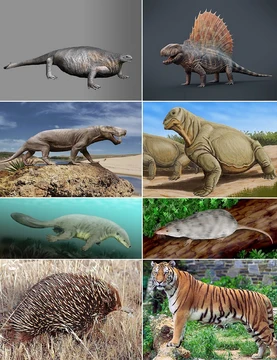
Cynodontia
Clade of therapsids that includes mammals and their extinct relatives.

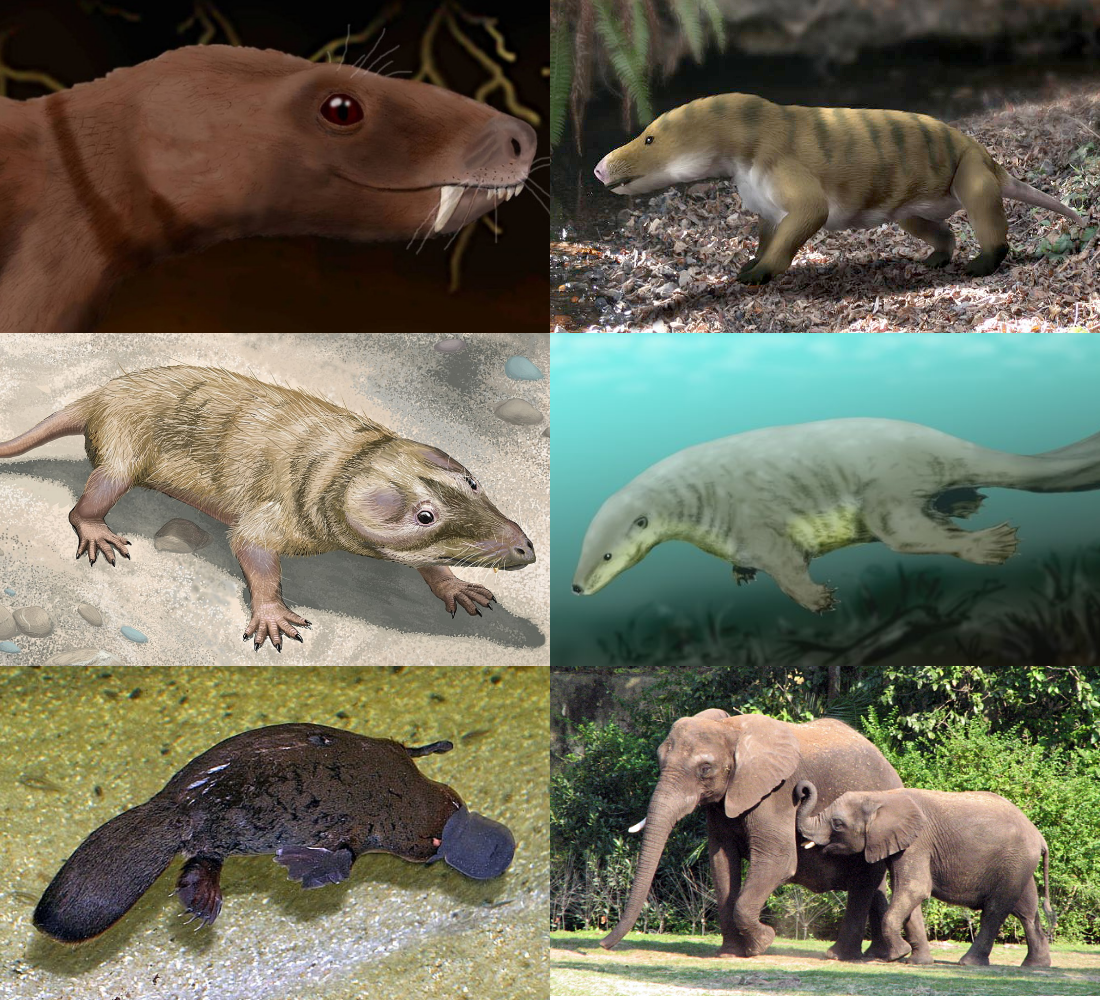
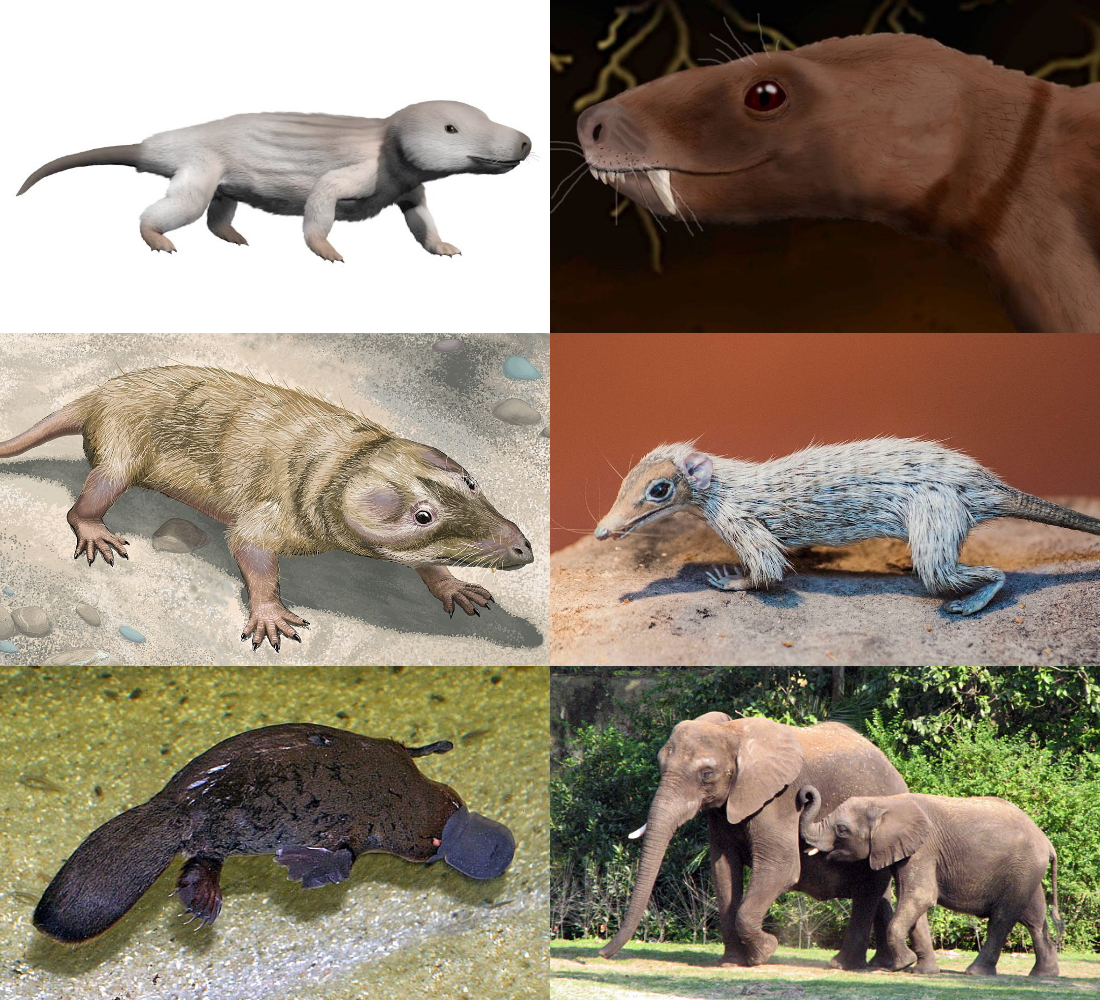
Momotarou2012 Nobu Tamura ( http://spinops.blogspot.ca/ ) Smokeybjb Nobu Tamura · Public domain
Cynodontia is a group of eutheriodont therapsids that first appeared around 260 million years ago in the Late Permian. They underwent a major expansion in diversity after the Permian–Triassic extinction event. Mammals are cynodonts, as are their extinct ancestors and close relatives (Mammaliaformes), which evolved from advanced probainognathian cynodonts in the Late Triassic. Non-mammalian cynodonts filled roles as both carnivores and herbivores. After mammals appeared, most other cynodont lineages died out; the last known non-mammaliaform group, the Tritylodontidae, survived into the Early Cretaceous.
The name "Cynodontia" (meaning "dog tooth") was coined by Richard Owen in 1861, based on their distinctive pair of canine-like upper teeth, which he compared to those of living carnivoran mammals. Early cynodonts already showed many skeletal features typical of mammals. Their teeth were fully differentiated, and the braincase bulged at the back of the head. Except for some crown-group mammals (especially therians), all cynodonts probably laid eggs. Their temporal fenestrae were larger than those of earlier therapsids, and the wider zygomatic arch allowed for stronger jaw muscles. They also possessed a secondary palate, which other primitive therapsids (except therocephalians, their closest relatives) lacked. However, in cynodonts the secondary palate is mainly formed by the maxillae and palatines (as in mammals), whereas in therocephalians it is primarily made up of the maxillae and the vomer. The palatine teeth found on the roof of the mouth in other therapsids were lost in the cynodont ancestor. The dentary was the largest bone in the lower jaw.
Cynodonts likely had a warm-blooded metabolism, which has led many reconstructions to depict them with fur. Endothermy would have required insulation, but direct fossil evidence of fur has been elusive. Modern mammals have Harderian glands that secrete lipids to coat fur, but the imprint of this structure is only found from the primitive mammal *Morganucodon* onward. Nevertheless, studies of Permian synapsid coprolites suggest that more basal therapsids may have had fur, and fur was certainly present in Mammaliaformes such as *Castorocauda* and *Megaconus*. Early cynodonts had many small foramina on their snout bones, like reptiles, indicating they had immobile, non-muscular lips similar to those of lizards and lacked muscular cheeks. Since a mobile, muscular face is needed for whisking movements and to protect whiskers, early cynodonts probably did not have whiskers. In prozostrodontian cynodonts (the group that includes mammals), these foramina are replaced by a single large infraorbital foramen, suggesting the face became muscular and whiskers would have been present.
Derived cynodonts developed epipubic bones, which strengthened the torso and supported abdominal and hindlimb muscles, aiding an erect gait. However, this came at the cost of prolonged pregnancy, forcing these animals to give birth to highly altricial young, as seen in modern marsupials and monotremes. Only placentals, and possibly *Megazostrodon* and *Erythrotherium*, lost these bones. A specimen of *Kayentatherium* shows that at least tritylodontids already had a fundamentally marsupial-like reproductive style, but produced much larger litters—around 38 perinates or possibly eggs. Cynodonts are the only synapsid lineage known to have produced aerial locomotors: gliding appeared in haramiyidans and various mammal groups, while placental mammals later developed true flight. The largest known non-mammalian cynodont is *Scalenodontoides*, a traversodontid, estimated to have had a maximum skull length based on a fragmentary specimen.
The closest relatives of cynodonts are therocephalians, together forming the clade Eutheriodontia. The earliest cynodonts are known from early Lopingian (early Wuchiapingian) sediments of the *Tropidostoma* Assemblage Zone in the Karoo Supergroup of South Africa, belonging to the basal family Charassognathidae. Permian cynodont fossils are rare outside South Africa; the most widespread genus is *Procynosuchus*, found in South Africa, Germany, Tanzania, Zambia, and possibly Russia. After the Permian–Triassic extinction, cynodont diversity expanded rapidly. Peak disparity occurred from the Induan to the Carnian and in the middle Norian. Post-Early Triassic cynodonts were dominated by the advanced clade Eucynodontia, which splits into two main groups: the mostly herbivorous Cynognathia and the mostly carnivorous Probainognathia. During the Early and Middle Triassic, cynognathians were the most diverse, while probainognathians did not become prominent until the Late Triassic (early Norian). Almost all Middle Triassic cynodonts are known from Gondwana; only one genus, *Nanogomphodon*, has been found in the Northern Hemisphere. Among the most dominant Middle and Late Triassic cynodonts were the herbivorous Traversodontidae, mainly in Gondwana, which reached peak diversity in the Late Triassic. Mammaliaformes originated from probainognathian cynodonts during the Late Triassic. Early mammaliaforms were small-bodied insectivores.
- clade
- Eutheriodontia
- key_characteristic
- Differentiated teeth, secondary palate, reduced jaw bones
Lore & Background
Early cynodonts have many skeletal characteristics of mammals: fully differentiated teeth, a bulging braincase, larger temporal fenestrae, and a secondary palate primarily comprising the maxillae and palatines. The dentary was the largest bone in their lower jaw. While early cynodonts likely laid eggs, derived cynodonts including mammaliaforms and early mammals are widely believed to have given live birth.
Reader's Guide
Cynodonts are significant as the direct ancestors of mammals, having evolved from advanced probainognathian cynodonts during the Late Triassic. They expanded rapidly in diversity after the Permian–Triassic extinction event, with peak disparity from the Induan to the Carnian and in the middle Norian. During their evolution, the number of jaw bones reduced, paving the way for bones of the jaw to migrate to the cranium as parts of the mammalian hearing system. The development of a secondary palate allowed chewing and breathing simultaneously, a characteristic present in all mammals. Only two groups of non-mammaliaform cynodonts existed beyond the end of the Triassic: the insectivorous Tritheledontidae (into the Early Jurassic) and the herbivorous Tritylodontidae (into the Early Cretaceous). Cynodonts are the only known synapsid lineage to have produced aerial locomotors, with gliding known in haramiyidans and various mammal groups.
Did You Know?
- Cynodonts are one of the few synapsid lineages known to have produced aerial locomotors, including gliding and flight, though gliding has also been proposed for some non-cynodont therapsids and possibly varanopids.
- Epipubic bones are known primarily from mammaliaforms and early mammals, not from most non-mammalian cynodonts, and their presence in other synapsids is not well-supported.
Gallery
Frequently Asked Questions
What is Cynodontia in the Prehistoric Synapsids series?
Cynodontia is the major therapsid clade that contains all living mammals together with their now-vanished close relatives, the mammaliaforms. It nests inside the broader group Eutheriodontia and represents one of the most consequential branches in the entire synapsid family tree.
What are Cynodontia's signature anatomical traits?
Fans typically point to three hallmarks: teeth that split into clearly distinct functional types, the emergence of a secondary palate, and a streamlining of the jaw by losing several bones. Together these features mark the transition away from the more generalized therapsid skull.
What ecological niches did non-mammalian cynodonts occupy?
Rather than being a single body-plan, non-mammalian cynodonts spread across a wide range of roles, with some lineages hunting as carnivores and others grazing as herbivores. That breadth of niche use made them one of the most ecologically versatile synapsid groups of the Triassic.
How exactly did mammals arise within Cynodontia?
During the Late Triassic, a lineage of advanced probainognathian cynodonts gave rise to the first true mammals, splitting the mammaliaform branch off from its non-mammalian cousins. In other words, mammals are not outside Cynodontia—they are the surviving tip of one of its many sub-branches.
Why is Cynodontia considered the pivotal link in synapsid evolution?
It is the anatomical bridge between the more reptile-like early therapsids and the fully mammalian condition, showing stepwise changes in jaw structure, tooth specialization, and palate development. Without this clade, the evolutionary story from early synapsids to modern mammals simply has no connecting thread.
More in Prehistoric Synapsids 1-19
Spotted an error? Know more?
This is a living reference — every entry is fact-audited, and reader corrections feed straight into our audit queue. Suggest an edit · See this site's audit record