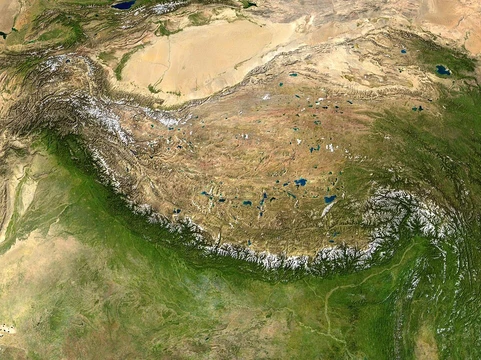
Central Siberian Plateau
A major plain of North Asia, part of the Angara Shield between the Yenisey and Lena Rivers.

via Wikipedia: North Asia · see source
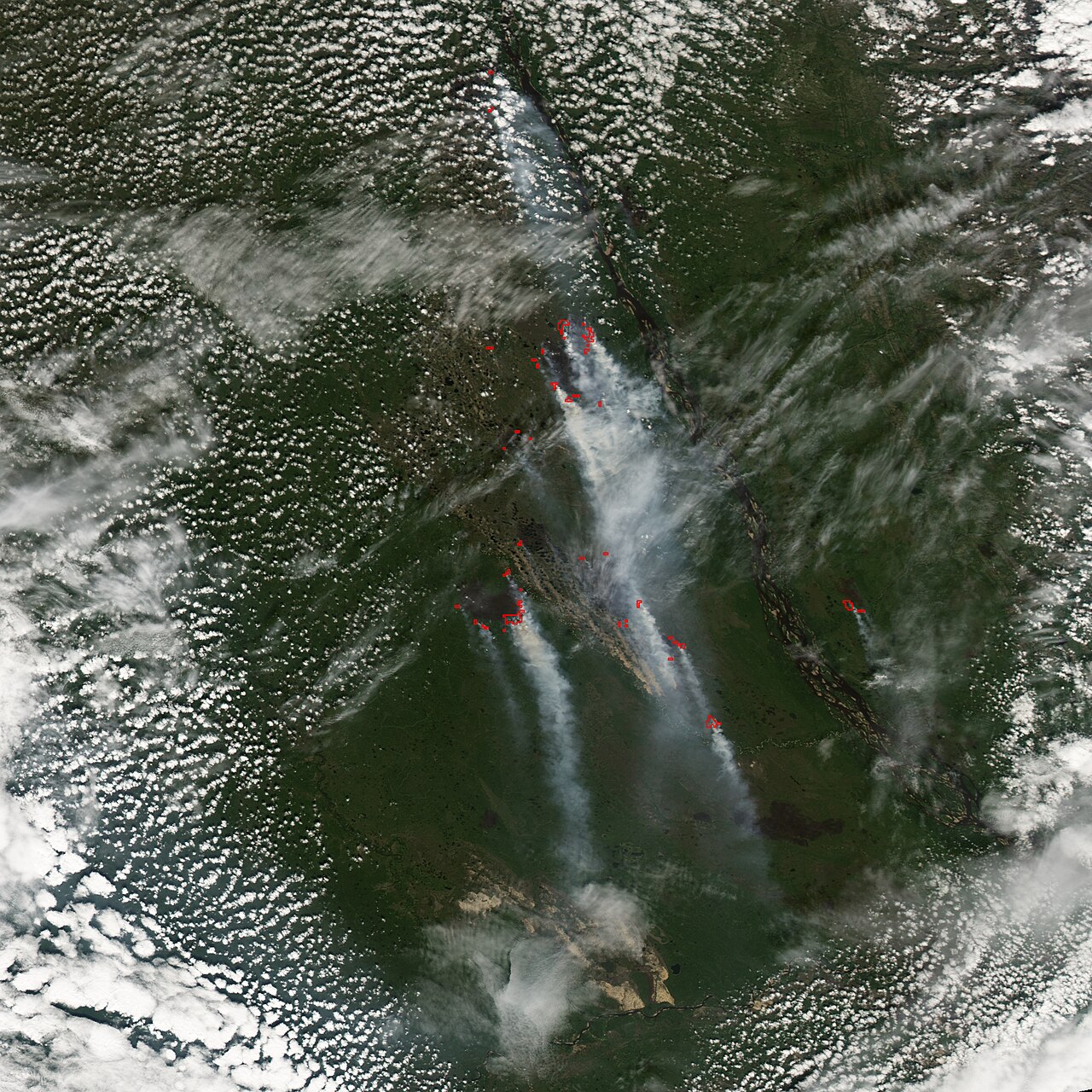
The Central Siberian Plateau is a vast mountainous region in central Siberia, covering an area of 3,500,000 square kilometers. It is bounded by the Yenisei River to the west and the Central Yakutian Lowland to the east. To the south, it meets the Altai Mountains, Salair Ridge, Kuznetsk Alatau, the Eastern and Western Sayan Mountains, other mountains of Tuva, the North Baikal Highlands, and the Baikal Mountains. The North Siberian Lowland lies to its north, while the Central Yakutian Lowland and the Lena Plateau border it to the east. The plateau’s surface is marked by alternating wide plateaus and ridges, some sharply jagged, and it covers roughly one-third of Siberia. Its system includes several subplateaus and subranges, such as the Putorana Plateau (the highest point of the entire system at 1,678 meters), the Anabar Plateau, Vilyuy Plateau, Syverma Plateau, Tunguska Plateau, Lena Plateau, Lena-Angara Plateau, Yenisei Range, and Angara Range. The climate is continental, with short, warm summers and long, severely cold winters. Most of the territory is covered by conifer forests, with larch especially abundant. The major river is the Lower Tunguska. Geologically known as the Siberian Traps, the plateau holds rich mineral resources, including coal, iron ore, gold, platinum, diamonds, and natural gas.
- area
- approximately 1.5 to 1.8 million square kilometers
Lore & Background
The Central Siberian Plateau is built around the Angara Shield, which lies between the Yenisey River and the Lena River. The Angara Shield developed from fragments of Laurasia, whose rocks were mainly Precambrian crystalline rocks, gneisses, and schists, and Gondwana. The central part of North Asia is a large igneous province called the Siberian Traps, formed by a massive eruption which occurred 250 million years ago. The formation of the traps coincided with the Permian–Triassic extinction event. The plateau and plains of North Asia comprise the West Siberian Lowlands; the Angara Shield, with the Taymyr Peninsula, the coastal lowlands (the East Siberian Lowland and the North Siberian Lowland), and the Central Siberian Plateau (the Anabar Plateau, the Lena Plateau, the Lena-Angara Plateau, the Putorana Plateau, the Tunguska Plateau, and the Vilyuy Plateau); and the Central Yakutian Lowland.
Reader's Guide
The Central Siberian Plateau is a key part of the Angara Shield, a stable geological structure. It is one of three major plains in North Asia. The plateau system includes six named sub-plateaus: the Anabar Plateau, the Lena Plateau, the Lena-Angara Plateau, the Putorana Plateau, the Tunguska Plateau, and the Vilyuy Plateau. The region is underlain by the Siberian Traps, a large igneous province formed by a massive eruption 250 million years ago that coincided with the Permian–Triassic extinction event. The geomorphology of North Asia in general is imperfectly known, although the deposits and mountain ranges are well known.
Did You Know?
- The Central Siberian Plateau is built around the Angara Shield, which lies between the Yenisey River and the Lena River.
- The central part of North Asia is a large igneous province called the Siberian Traps, formed by a massive eruption which occurred 250 million years ago.
- The formation of the Siberian Traps coincided with the Permian–Triassic extinction event.
- The plateau system includes six named sub-plateaus: the Anabar, Lena, Lena-Angara, Putorana, Tunguska, and Vilyuy Plateaus.
- There are no mountain chains in North Asia to prevent air currents from the Arctic flowing down over the plains of Siberia and Turkestan.
Geological Heritage and the Siberian Traps
The central part of North Asia is a large igneous province called the Siberian Traps, formed by a massive eruption which occurred 250 million years ago. The formation of the traps coincided with the Permian–Triassic extinction event. The Central Siberian Plateau is built around the Angara Shield, which lies between the Yenisey River and the Lena River. The Angara Shield developed from fragments of Laurasia, whose rocks were mainly Precambrian crystalline rocks, gneisses, and schists, and Gondwana. The plateau and plains of North Asia comprise the West Siberian Lowlands; the Angara Shield, with the Taymyr Peninsula, the coastal lowlands (the East Siberian Lowland and the North Siberian Lowland), and the Central Siberian Plateau (the Anabar Plateau, the Lena Plateau, the Lena-Angara Plateau, the Putorana Plateau, the Tunguska Plateau, and the Vilyuy Plateau); and the Central Yakutian Lowland. The Eurasian Plate and the North American Plate meet across the neck of Alaska, following the line of the Aleutian Trench, rather than meeting at the Bering Straits. To compensate for new sea floor having been created in the Siberian basin, the whole of the Eurasian Plate has pivoted about a point in the New Siberian Islands, causing compression in the Verkhoyansk mountains.
Topographic Architecture and Climate Exposure
The Central Siberian Plateau is one of three major plains that divide North Asia, alongside the West Siberian Plain and the Verhoyansk-Chukotka collision zone. The plateau and plains of North Asia comprise the West Siberian Lowlands; the Angara Shield, with the Taymyr Peninsula, the coastal lowlands (the East Siberian Lowland and the North Siberian Lowland), and the Central Siberian Plateau (the Anabar Plateau, the Lena Plateau, the Lena-Angara Plateau, the Putorana Plateau, the Tunguska Plateau, and the Vilyuy Plateau); and the Central Yakutian Lowland. There are no mountain chains in North Asia to prevent air currents from the Arctic flowing down over the plains of Siberia and Turkestan. The geomorphology of North Asia in general is imperfectly known, although the deposits and mountain ranges are well known.
Deep Human History and Indigenous Cultures
The region was first populated by hominins in the Late Pleistocene, approximately 100,000 years ago, and modern humans are confirmed to arrived in the region by 45,000 years ago with the first humans in the region having West Eurasian origins. Its Neolithic culture is characterized by characteristic stone production techniques and the presence of pottery of eastern origin. The Bronze Age began during the 3rd millennium BCE, with influences of Indo-Iranian cultures as evidenced by the Andronovo culture. During the 1st millennium BCE, polities such as the Scythians and Xiongnus emerged in the region, who often clashed with its Persian and Chinese neighbors in the south. Historically, it has been home to various East Asian-related ethnic groups from a diverse range of language families, including the Ainu, Chukotko-Kamchatkan, Mongolic, Nivkh, Tungusic, Turkic, Uralic, Yeniseian, Yukaghir, and Eskaleut peoples. The Khanate of Sibir was one of the last independent Turkic states in North Asia before its conquest by the Tsardom of Russia in the 16th century.
Soviet Industrialization and Modern Strategic Relevance
After World War II, North Asia played a critical role in Soviet industrialization and military strategy. Major industrial centers were developed in Norilsk, Novosibirsk, and Irkutsk, supported by labor from the Gulag system. The Trans-Siberian Railway, which spanned from Moscow to Vladivostok, became vital for transporting natural resources such as timber, coal, and metals to western parts of the USSR. Throughout the 1930s, the Soviet Union fortified the region militarily due to increasing tensions with Japan. The Soviet–Japanese border conflicts culminated in the Battles of Khalkhin Gol in 1939, where Soviet General Georgy Zhukov led a decisive victory over Japanese forces. With the collapse of the Soviet Union in 1991, North Asia faced economic turmoil and depopulation. Many towns built around single industries experienced sharp decline. In the 2000s and 2010s, the region gained strategic importance due to its vast reserves of natural gas, oil, and mineral resources. Russia began expanding infrastructure such as the Power of Siberia gas pipeline to China, marking a strategic pivot to Asia. As of the 2020s, the Russian government continues efforts to develop the Russian Far East through the "Far Eastern Hectare" program and special economic zones, though progress remains mixed due to geographic challenges and demographic decline.
Gallery
Frequently Asked Questions
Who is Central Siberian Plateau?
Central Siberian Plateau is a sprawling mountainous region occupying the heart of Siberia, generally bounded by the Yenisei and Lena rivers. It spans roughly 1.5 to 1.8 million square kilometers on the Siberian Platform and is one of the three great geographical divisions of the Great Russian Regions.
What are Central Siberian Plateau's powers or role?
Its signature ability is serving as a massive barrier that blocks and redirects Arctic air masses before they can push southward. Its terrain shifts between broad elevated surfaces and deeply cut river valleys, giving it a rugged, layered character.
How does Central Siberian Plateau's story end?
As a permanent landform it has no narrative finale, but its influence fades where the terrain hands off to the East Siberian Highlands to the east. In the lineup of Great Russian Regions it functions as the central act, flanked by the West Siberian Plain on one side and the East Siberian Highlands on the other.
Why is Central Siberian Plateau important?
It shapes the climate, river systems, and ecology across millions of square kilometers of central Siberia. Its elevation and structure channel water flow and modulate weather patterns, making it a keystone feature of the entire Siberian landscape.
Where exactly does Central Siberian Plateau sit between the Yenisei and Lena?
It generally fills the broad corridor between those two major rivers, though some definitions extend its eastern boundary past the Lena. This makes it the geographic 'middle child' of the three great Siberian divisions, wedged between the low-lying West Siberian Plain and the higher East Siberian Highlands.
More in Plateaus And Plains 1-24
Spotted an error? Know more?
This is a living reference — every entry is fact-audited, and reader corrections feed straight into our audit queue. Suggest an edit · See this site's audit record