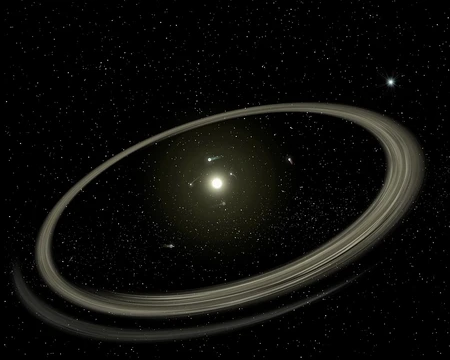
GJ 3929
Last updated
GJ 3929, also called Gliese 3929 or TOI-2013, is a red dwarf star in Corona Borealis, 51.6 light-years away. Its apparent magnitude of 12 makes it invisible without a telescope. Two exoplanets were found circling it in 2022.
Quick Facts
- Spectral type
- M3.5V
- Apparent magnitude
- 12.7
- Distance from earth
- 51.6 light-years (18.6 parsecs)
- Constellation
- Corona Borealis
- Closest neighbor
- G 179–57 (3.9 light-years)
Facts from the source article.
Characteristics
GJ 3929 is a red dwarf of spectral type M3.5V, with an apparent magnitude of 12.7, making it invisible to the naked eye or a small telescope. It has no companion stars and its age is estimated at 7.1 billion years, give or take four or five billion. The star lies in the northern hemisphere, about 50 light-years from Earth in Corona Borealis, with its nearest neighbor being the red dwarf G 179–57 at 3.9 light-years.
Planetary system
Two exoplanets were detected orbiting GJ 3929 in 2022. The innermost, GJ 3929 b, is a rocky planet 9% larger than Earth, discovered by the transit method. It orbits at 0.0252 AU with a period of 2 days and 15 hours, has an equilibrium temperature of 568 K, and receives 17 times Earth's insolation. Its mass was calculated from photometric observations using the NEID spectrometer, and its radius was constrained by the ARCTIC imager plus TESS and LCOGT photometry.
A team led by Jonas Kemmer reported the transit signal; subsequent CARMENES observations confirmed the planet. GJ 3929 b is an excellent target for atmospheric study with the James Webb Space Telescope, but observations have found no molecular features, ruling out a thick carbon dioxide atmosphere, and its dayside temperature matches a zero-albedo bare rock. The outermost planet, GJ 3929 c, is a sub-Neptune with 5.7 times Earth's mass, discovered via radial velocity.
It orbits at 0.081 AU every 15 days, with an equilibrium temperature of 317 K and insolation 68% greater than Earth's. Its radius is unknown, but mass-radius estimates give 2.26 Earth radii. An additional planet candidate was found from follow-up radial velocity analysis in 2025. All three planets orbit inside the star's habitable zone.
More in Planetary Systems with Two Confirmed Planets
Sources
Compiled from Wikipedia and the sources listed below. Text from Wikipedia is available under CC BY-SA 4.0; this entry is adapted from it.
- Wikipedia: GJ 3929 (CC BY-SA 4.0).
Spotted an error? Know more?
Reader corrections go straight into our review queue. Suggest an edit · How this site is sourced