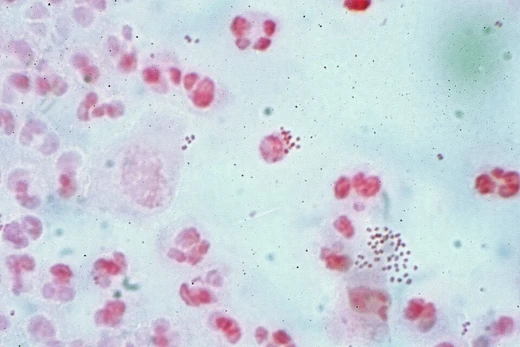
Neisseria meningitidis
A Gram-negative diplococcus causing epidemic meningitis and sepsis.

Neisseria meningitidis, commonly known as the meningococcus, is a Gram-negative bacterium responsible for meningitis and meningococcal disease, including meningococcemia, a severe bloodstream infection. As a coccus, it is round in shape, and it typically appears in pairs, classifying it as a diplococcus. This pathogen is exclusive to humans, colonizing the nasopharynx without causing illness in about 8–25% of adults. Transmission occurs through saliva and respiratory droplets from coughing, sneezing, or kissing, as well as via shared water sources or contaminated toys; it has also been linked to oral sex, causing urethritis in men. The bacterium adheres to host cells using pili and surface proteins Opa and Opc, and it possesses several virulence factors. Its lipooligosaccharide acts as an endotoxin, triggering septic shock and hemorrhage by destroying red blood cells. A polysaccharide capsule helps it evade phagocytosis, while an IgA protease cleaves antibodies to bypass immune defenses. To survive in the bloodstream, it acquires iron from human transferrin and lactoferrin, resists oxidative killing with catalase and superoxide dismutase, and avoids complement-mediated killing via factor H binding protein. Disease-causing strains are classified by their polysaccharide capsule; among 13 capsular types, six (A, B, C, W135, X, and Y) cause most cases globally. Type A predominates in Africa and Asia but is rare in North America, while serogroups B and C are most common in the United States. This diversity has hindered universal vaccine development. Meningococcal disease initially presents with fatigue, fever, and headache, progressing rapidly to neck stiffness, coma, and death in about 10% of cases. A petechial rash occurs in roughly half of patients. Meningococcemia, often overlooked due to its non-blanching purpuric rash and absence of classic meningitis symptoms, carries a mortality rate near 50% within hours. Survival correlates with blood cortisol levels, with lower levels linked to higher mortality. Complications include Waterhouse–Friderichsen syndrome, adrenal insufficiency, and disseminated intravascular coagulation. Suspicion of meningitis is a medical emergency; in the United Kingdom, immediate intravenous antibiotics and hospitalization are recommended, even if this reduces laboratory detection.
- type
- Gram-negative diplococcus
- size
- 0.6–1.0 micrometers
- carrier_rate
- 8–25% of adults (nasopharynx)
- mortality_rate
- about 10% (meningitis); about 50% (septicaemia)
- known_for
- causing epidemic bacterial meningitis and meningococcemia
- serogroups
- A, B, C, W135, X, Y (six main disease-causing types)
Lore & Background
Neisseria meningitidis, or the meningococcus, is a Gram-negative bacterium that appears as a round coccus, typically found in pairs, hence its description as a diplococcus. Its size ranges from 0.6 to 1.0 micrometers. The organism tests positive for the enzyme cytochrome c oxidase. It is an exclusively human pathogen, never isolated from other animals, a restriction thought to stem from its dependence on human-specific iron sources like transferrin and lactoferrin. As part of the normal nonpathogenic flora, it colonizes the nasopharynx of approximately 8–25% of adults. The bacterium adheres to host cells using long, thin extensions called pili, along with surface-exposed proteins Opa and Opc. Its defining characteristics include a polysaccharide capsule that helps evade the host immune response and a lipooligosaccharide (LOS) component of its outer membrane that acts as an endotoxin, responsible for septic shock and hemorrhage. Other virulence factors include an IgA protease that cleaves antibodies, and proteins like NadA, FetA, and fHbp that aid in adhesion, iron acquisition, and complement inhibition. The bacterium is spread through respiratory secretions, saliva, and occasionally oral sex, causing both meningitis and meningococcemia, a life-threatening sepsis.
Reader's Guide
Neisseria meningitidis is significant as the causative agent of meningococcal meningitis and septicaemia, diseases that can rapidly progress to death. Meningococcal meningitis initially produces general symptoms like fatigue, fever, and headache and can rapidly progress to neck stiffness, coma and death in 10% of cases. Septicaemia carries an approximate 50% mortality rate over a few hours from initial onset. The bacterium's lipooligosaccharide acts as an endotoxin responsible for septic shock and hemorrhage. Its polysaccharide capsule prevents host phagocytosis, and it produces an IgA protease to evade the humoral immune system. The multiple subtypes (six main capsular types: A, B, C, W135, X, Y) have hindered development of a universal vaccine. Current guidance in the United Kingdom recommends immediate intravenous antibiotics if meningococcal meningitis or septicaemia is suspected, even though this may reduce laboratory confirmation. The bacterium's genome contains genes that undergo phase variation, a mechanism that helps it evade the host immune system.
Did You Know?
- About 10% of adults are carriers of the bacteria in their nasopharynx.
- It causes the only form of bacterial meningitis known to occur epidemically, mainly in Africa and Asia.
- Meningococcal septicaemia carries an approximate 50% mortality rate over a few hours from initial onset.
- The bacterium's genome contains more genes that undergo phase variation than any pathogen then known.
Frequently Asked Questions
Who is Neisseria meningitidis?
Neisseria meningitidis, commonly called the meningococcus, is a tiny Gram-negative diplococcus measuring roughly 0.6 to 1.0 micrometers. It is an exclusively human pathogen that colonises the nasopharynx of 8–25% of adults without ever causing illness.
What are Neisseria meningitidis's powers/role?
The meningococcus is best known for triggering epidemic bacterial meningitis and meningococcemia, a life-threatening form of sepsis. It transmits through saliva and respiratory secretions, so close personal contact is its primary route of spread.
How does Neisseria meningitidis's story end?
Once meningitis takes hold, the case-fatality rate sits around 10%, while meningococcemia pushes mortality to roughly 50%. Survivors of meningitis can still face lasting neurological damage, so the ending is far from guaranteed to be a happy one.
Why is Neisseria meningitidis important?
It holds the unique distinction of being the only bacterial meningitis documented to occur in true epidemics, particularly across the African meningitis belt and parts of Asia. That epidemic potential is what sets it apart from every other bacterial cause of meningitis.
What is Neisseria meningitidis's main 'cast' of variants?
Six principal serogroups—A, B, C, W135, X, and Y—account for the vast majority of invasive disease. These serogroups also define the targets of the vaccines developed to prevent the most dangerous strains.
More in Pathogenic Bacteria 1-20
Spotted an error? Know more?
This is a living reference — every entry is fact-audited, and reader corrections feed straight into our audit queue. Suggest an edit · See this site's audit record